
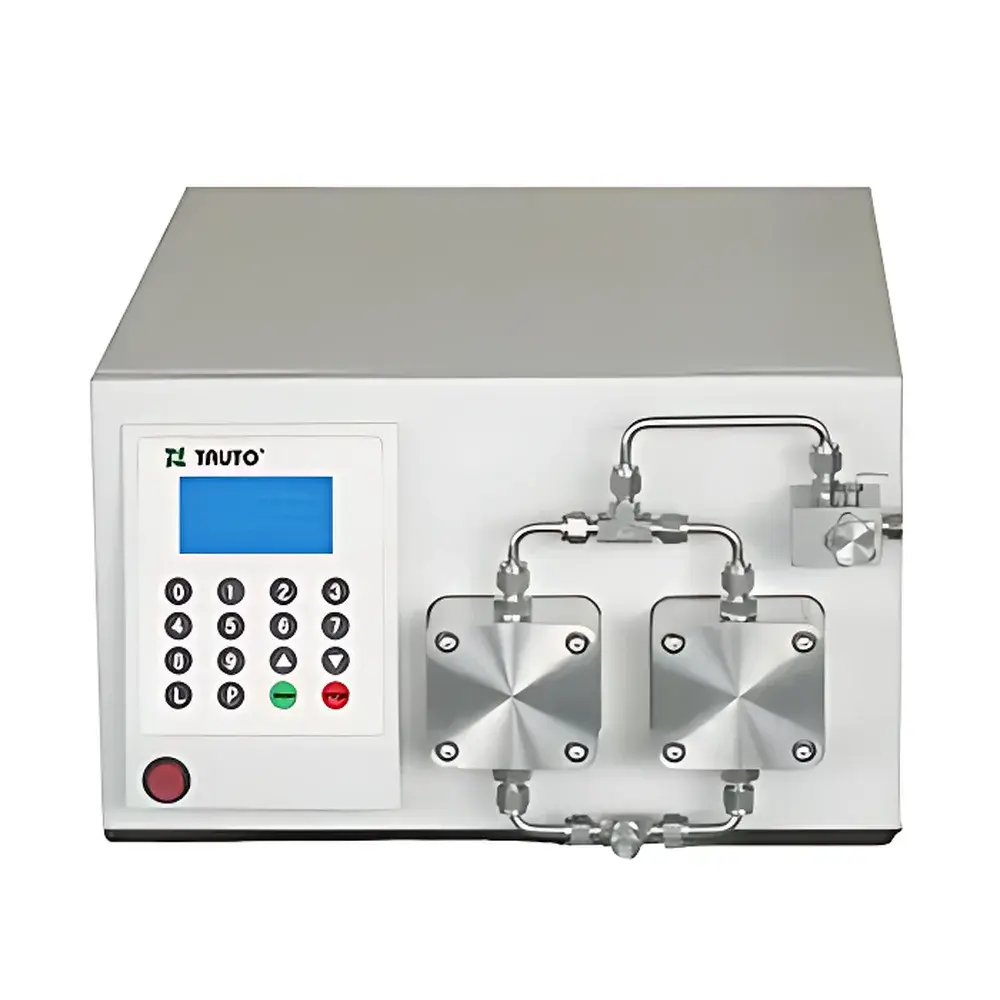
Tongtian TBP5H02S High-Pressure Dual-Piston Constant Flow Pump
| Brand | Tongtian |
|---|---|
| Origin | Shanghai, China |
| Model | TBP5H02S |
| Pressure Range | 0–2.0 MPa |
| Flow Rate Range | 1–500 mL/min |
| Pressure Pulsation | ≤0.05 MPa |
| Pressure Accuracy | ≤0.10 MPa |
| Flow Setting Error | ≤3% (1–100 mL/min), ≤1.5% (100–500 mL/min) |
| Flow Repeatability | ≤1.5% (1–100 mL/min), ≤1% (100–500 mL/min) |
| Power Supply | 220 V ±10%, 50/60 Hz |
| Power Consumption | 1 kW |
| Weight | 48 kg |
| Dimensions | 380 × 560 × 230 mm |
| Flow Path Materials | Sapphire ball valves, ceramic plungers |
| pump head options | 316L stainless steel (L), pure titanium (T), PEEK (K), PTFE (F) |
| Communication Interface | RS232 |
Overview
The Tongtian TBP5H02S is a high-performance dual-piston constant flow pump engineered for precision liquid delivery in mid-pressure analytical and preparative applications. Operating on the principle of reciprocating positive displacement, it delivers stable, pulse-dampened flow across a wide dynamic range (1–500 mL/min) while maintaining pressure stability up to 2.0 MPa. Its dual-piston architecture—paired with sapphire ball check valves and ceramic plungers—minimizes mechanical wear and ensures long-term volumetric accuracy under continuous operation. Unlike conventional HPLC-grade microbore pumps, the TBP5H02S features intentionally enlarged flow paths (2 mm, 3 mm, and 6 mm internal diameters, plus customizable 1/8″ tubing interfaces), significantly reducing clogging risk when handling viscous, particulate-laden, or precipitating solvents common in industrial process development, extraction workflows, and environmental sample preparation.
Key Features
- Dual-piston design with sapphire ball check valves and ceramic plunger rods for exceptional chemical resistance and extended service life
- Modular pump head construction with four chemically inert material options: 316L stainless steel (L), commercially pure titanium (T), PEEK (K), and PTFE (F)—enabling compatibility with aggressive solvents including concentrated acids, halogenated organics, and high-pH aqueous bases
- Integrated pressure relief and real-time flow calibration system compliant with GLP-aligned operational integrity requirements
- Front-accessible modular sealing architecture permitting in-situ inspection and maintenance without system shutdown
- Patented air-bleed mechanism for automatic degassing of inlet fluid streams—critical for eliminating baseline noise in downstream detection systems
- RS232 serial interface supporting bidirectional communication with host PCs for remote parameter setting, data logging, and firmware updates
- Memory retention for user-defined pressure/flow setpoints and operational timers—facilitating repeatable method execution across shifts or laboratories
Sample Compatibility & Compliance
The TBP5H02S is validated for use with organic solvents (e.g., THF, DMF, chloroform), aqueous buffers (pH 1–14), and multiphase mixtures encountered in pharmaceutical synthesis, coal liquefaction, pesticide formulation, and food-grade extraction. Its wetted-path materials meet ASTM F2136 (biocompatibility of polymeric components) and ISO 10993-5 cytotoxicity screening criteria where applicable. While not certified for FDA 21 CFR Part 11 environments out-of-the-box, its RS232 protocol supports integration into validated chromatography data systems (CDS) that implement electronic signature and audit trail functionality per GMP Annex 11 and USP guidelines. All electrical components conform to IEC 61010-1 safety standards for laboratory equipment.
Software & Data Management
The embedded microprocessor firmware provides real-time monitoring of actual pressure, set pressure, and programmed flow rate via a backlit LCD interface. Optional PC-based control software (Windows-compatible, no license required) enables graphical plotting of pressure vs. time profiles, export of timestamped CSV logs, and programmable sequence execution—including ramped flow gradients and timed start/stop cycles. Data records include system status flags (e.g., overpressure event, valve timeout, temperature warning), supporting root-cause analysis during quality investigations. Exported datasets are compatible with LIMS platforms via standard ODBC drivers and can be archived in accordance with ISO/IEC 17025 clause 7.5.2 on record retention.
Applications
- Preparative liquid chromatography (prep-LC) and simulated moving bed (SMB) systems requiring robust solvent delivery at 10–100 mL/min
- In-line sample introduction for ICP-OES and ICP-MS where consistent nebulizer uptake is critical to signal stability
- Continuous-flow reactor feeding in fine chemical synthesis, especially for exothermic or heterogeneous reactions
- Environmental wastewater treatment pilot studies involving coagulant dosing or membrane feed pressurization
- Pharmaceutical dissolution testing per USP , where precise, uninterrupted flow across multiple vessels is mandatory
- Food matrix extraction (e.g., QuEChERS, SFE) using ethanol, ethyl acetate, or supercritical CO₂ co-solvents
FAQ
What flow path configurations are supported for corrosion-resistant operation?
The TBP5H02S offers four interchangeable pump head materials: 316L stainless steel (L), pure titanium (T), PEEK (K), and PTFE (F). Titanium and PTFE variants are recommended for hydrochloric acid, bromine-containing reagents, or hot alkaline solutions.
Is the pump compatible with third-party chromatography data systems?
Yes—via its RS232 interface and ASCII command protocol, it integrates with Agilent ChemStation, Waters Empower, and Thermo Chromeleon through custom driver modules or generic serial device abstraction layers.
How is flow calibration performed and documented?
Calibration is executed using gravimetric measurement at three points across the flow range (10%, 50%, and 100% of max). The system stores calibration coefficients and timestamps in non-volatile memory, generating a printable report with operator ID, ambient conditions, and uncertainty estimates per ISO/IEC 17025.
Can the pump operate unattended for extended periods?
Yes—the built-in thermal cutoff, pressure-limit interlock, and dry-run protection enable safe 72-hour continuous operation. Scheduled shutdowns may be programmed via the timer function or external PLC trigger.
What maintenance intervals are recommended for optimal performance?
Sapphire valves and ceramic plungers require inspection every 2,000 operating hours; seals and gaskets should be replaced annually or after 500 hours in abrasive slurry service. Full service kits include torque-spec tools and alignment jigs to ensure repeatable reassembly.



