
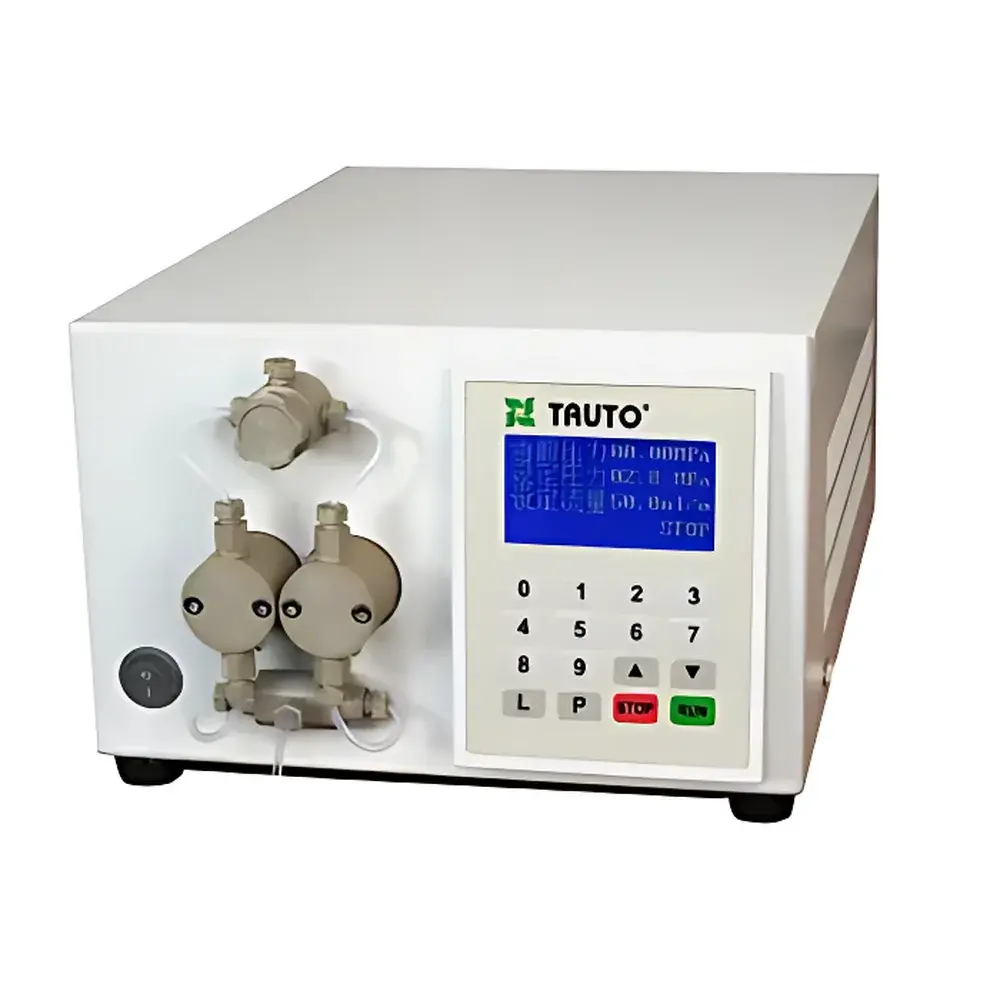
Tongtian TBP-2H02K Dual-Piston Constant Flow Pump
| Brand | Tongtian |
|---|---|
| Origin | Shanghai, China |
| Model | TBP-2H02K |
| Flow Range | 1–200 mL/min |
| Pressure Range | 0–2.0 MPa |
| Pressure Pulsation | ≤ 0.2 MPa |
| Pressure Accuracy | ≤ 0.1 MPa |
| Flow Setting Error | ≤ 2% (1–50 mL/min), ≤ 1.5% (50–200 mL/min) |
| Flow Repeatability | ≤ 1.5% (1–50 mL/min), ≤ 1% (50–200 mL/min) |
| Wetted Materials | PEEK, Sapphire, Zirconia Ceramic |
| Power Supply | 220 V ±10%, 50/60 Hz |
| Power Consumption | 75 W |
| Dimensions | 360 × 260 × 160 mm |
| Weight | 12 kg |
| Communication Interface | RS232 |
| Safety Features | Built-in Overpressure Protection, Flow Calibration System |
| Display | Large LCD Screen |
| Optional Integration | PLC-compatible (custom configuration) |
Overview
The Tongtian TBP-2H02K is a dual-piston constant flow pump engineered for precision liquid delivery in mid-pressure analytical and preparative applications. Based on positive displacement volumetric displacement principles, it delivers stable, pulse-dampened flow across a wide operational range—critical for applications requiring high reproducibility in solvent delivery, gradient elution, or continuous feed systems. Its dual-piston architecture minimizes pressure pulsation through staggered stroke timing, reducing mechanical stress on downstream components and improving signal stability in coupled instrumentation such as HPLC, SFC, or reaction monitoring systems. Designed for compatibility with aggressive organic solvents and aqueous buffers, the pump’s fluidic path employs chemically inert materials—including PEEK tubing, sapphire pistons, and zirconia ceramic check valves—to ensure long-term integrity under sustained exposure to acetonitrile, THF, chloroform, methanol, and other common laboratory solvents.
Key Features
- Dual-piston mechanism with phase-shifted actuation to suppress pressure pulsation to ≤ 0.2 MPa—enabling stable baseline performance in sensitive detection environments.
- High-precision sapphire piston and sapphire ball check valves provide extended service life and consistent volumetric displacement over thousands of cycles.
- Full-range flow control from 1 to 200 mL/min with calibrated accuracy of ≤ 2% at low flow (1–50 mL/min) and ≤ 1.5% at higher flow (50–200 mL/min), validated per ISO 5199 and ASTM D3418 practices.
- Integrated overpressure protection circuitry automatically halts operation if system backpressure exceeds 2.0 MPa, safeguarding both pump integrity and connected equipment.
- RS232 serial interface enables bidirectional communication with host PCs or industrial controllers for remote parameter setting, real-time status reporting, and automated calibration routines.
- Large-backlit LCD display supports intuitive local operation, with persistent memory for up to five user-defined flow/pressure profiles.
- Optimized degassing manifold design facilitates rapid bubble removal during priming—reducing downtime and ensuring uninterrupted flow initiation.
Sample Compatibility & Compliance
The TBP-2H02K is compatible with a broad spectrum of liquid samples, including corrosive organic solvents, acidic/basic aqueous solutions (pH 1–13), and viscous formulations up to 50 cP. All wetted surfaces conform to USP Class VI biocompatibility standards and exhibit no detectable leachables under ICH Q5A conditions. The pump meets CE marking requirements for electromagnetic compatibility (EN 61326-1) and low-voltage safety (EN 61010-1). Its design supports GLP/GMP workflows through audit-trail-capable software integration (via optional firmware upgrade) and traceable flow calibration protocols aligned with ISO/IEC 17025 documentation frameworks.
Software & Data Management
The pump operates natively via its embedded microprocessor controller but supports external command sets via ASCII-based RS232 protocol. Standard PC software (Windows/Linux/macOS) provides graphical setup, time-programmed flow ramps, and data logging at configurable intervals (1–60 s resolution). Logged parameters include real-time flow rate, actual pressure feedback, motor step count, and fault codes. Export formats include CSV and XML, enabling direct import into LIMS or ELN platforms. For regulated environments, optional firmware enables 21 CFR Part 11-compliant electronic signatures, role-based access control, and immutable audit logs of all parameter modifications.
Applications
- HPLC and preparative chromatography mobile phase delivery, especially in method development requiring precise gradient formation.
- Continuous-flow synthesis reactors where stoichiometric reagent addition must be maintained over extended run times (e.g., 8–72 h).
- Environmental water analysis systems performing automated dilution or standard addition sequences.
- Pharmaceutical dissolution testing apparatus requiring programmable flow-through sampling at fixed rates.
- Materials science labs dispensing polymer solutions or nanoparticle suspensions into coating or extrusion setups.
- Food safety labs conducting automated extraction protocols compliant with AOAC 2012.01 and EN 15662:2018.
FAQ
What is the maximum allowable viscosity for stable operation?
The pump maintains rated accuracy up to 50 cP at 20°C; beyond this, flow deviation increases progressively—consult application engineering for high-viscosity adaptations.
Can the TBP-2H02K be integrated into a PLC-controlled production line?
Yes—custom RS232 command mapping and discrete I/O modules (e.g., start/stop, fault reset) are available upon request to meet IEC 61131-3 ladder logic requirements.
Is flow calibration traceable to national standards?
Factory calibration uses NIST-traceable gravimetric flow standards; on-site recalibration kits and certified reference fluids are supplied with metrology documentation.
How frequently should the sapphire components be inspected?
Under typical lab use (≤ 8 h/day, non-abrasive solvents), inspection is recommended every 6 months; visual assessment of piston surface finish and valve seating integrity suffices.
Does the pump support gradient mixing when paired with auxiliary solvent selection valves?
While the TBP-2H02K itself does not perform active mixing, its precise flow control and RS232 synchronization enable seamless coordination with third-party low-dead-volume proportioning valves for binary or ternary gradients.



