
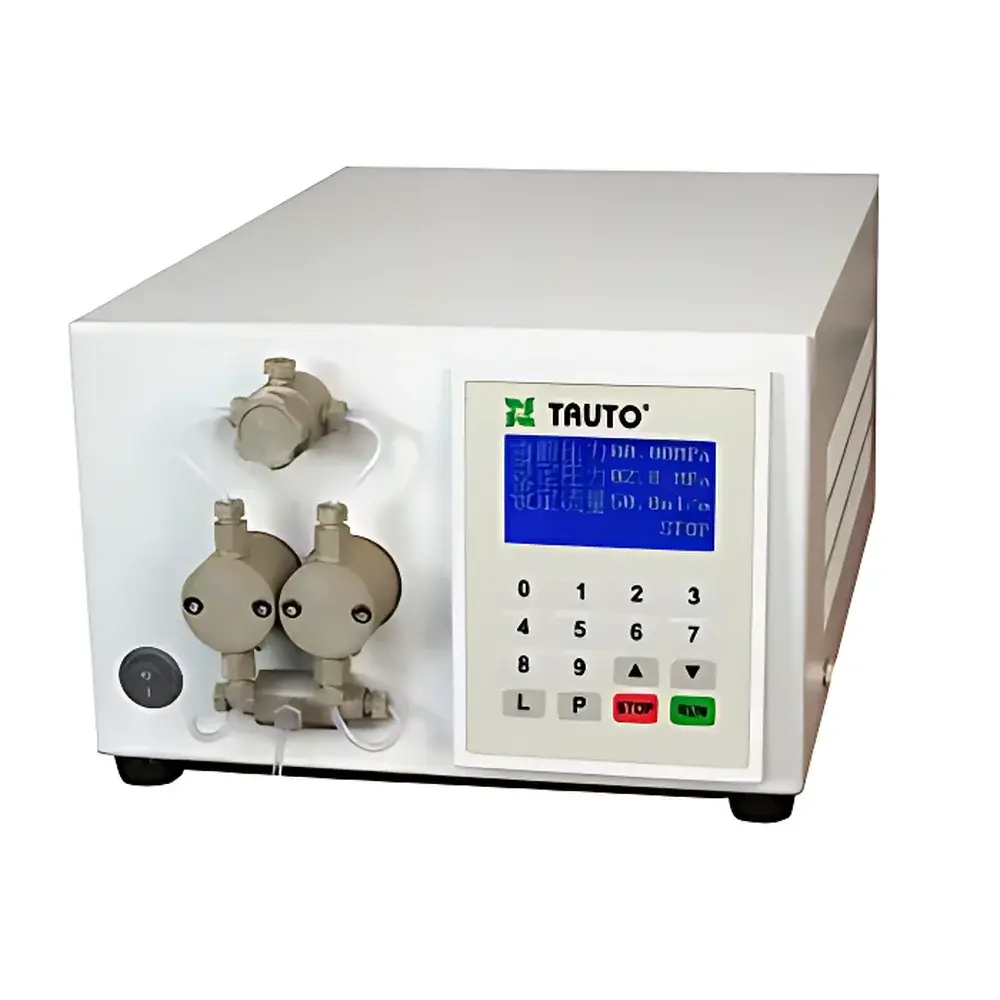
Tongtian TBP-1002K Dual-Piston Constant Flow Pump
| Brand | Tongtian |
|---|---|
| Origin | Shanghai, China |
| Model | TBP-1002K |
| Flow Range | 0.1–10.0 mL/min |
| Pressure Range | 0–2.0 MPa |
| Pressure Pulsation | ≤ 0.08 MPa |
| Pressure Accuracy | ≤ ±0.05 MPa |
| Flow Setting Error | ≤ ±1% |
| Flow Repeatability | ≤ ±1% |
| Wetted Materials | PEEK, Sapphire, Zirconia Ceramic |
| Power Supply | 220 V ±10%, 50/60 Hz |
| Power Consumption | 75 W |
| Dimensions | 360 × 260 × 160 mm |
| Weight | 12 kg |
| Communication Interface | RS232 (standard), PLC-compatible (customizable) |
| Safety Features | Built-in Overpressure Protection, Automatic Flow Calibration, Integrated Air-Elimination System |
Overview
The Tongtian TBP-1002K is a dual-piston constant flow pump engineered for high-precision, low-pulsation liquid delivery in mid-pressure analytical and preparative applications. Based on positive displacement principles, it utilizes two synchronized sapphire-tipped pistons operating in phase opposition to minimize pressure ripple—critical for chromatographic stability, reaction dosing, and continuous extraction workflows. Unlike single-piston or peristaltic alternatives, the TBP-1002K achieves consistent volumetric displacement across its full operational range (0.1–10.0 mL/min) without flow decay or backflow, even under variable backpressure up to 2.0 MPa. Its wetted path—comprising chemically inert PEEK tubing, sapphire balls, and zirconia ceramic seals—ensures long-term compatibility with aggressive organic solvents (e.g., acetonitrile, THF, chloroform), acidic/basic aqueous buffers, and halogenated media commonly encountered in HPLC, SFC, and continuous-flow synthesis systems.
Key Features
- Dual-piston architecture with counter-phase actuation reduces pressure pulsation to ≤ 0.08 MPa—enabling stable baseline performance in UV/Vis detection and mass spectrometry-coupled setups.
- Sapphire ball valves and zirconia ceramic pump heads deliver exceptional wear resistance and dimensional stability over >10,000 hours of operation under typical laboratory duty cycles.
- RS232 serial interface supports bidirectional communication with host PCs or LIMS platforms; firmware allows remote parameter setting, real-time flow/pressure monitoring, and event logging.
- Integrated air-elimination manifold with precision vent valve and transparent PEEK sight glass enables rapid de-gassing of mobile phases without disassembly or external vacuum sources.
- Onboard microprocessor implements automatic flow calibration routines using internal reference volumes—traceable to NIST-traceable standards—and stores up to 10 user-defined method profiles with recall functionality.
- Overpressure protection activates at 2.1 MPa (105% of max rated pressure), triggering immediate piston halt and audible/visual alert—compliant with IEC 61000-6-2 electromagnetic immunity and EN 61010-1 safety requirements.
Sample Compatibility & Compliance
The TBP-1002K accommodates a broad spectrum of liquid samples including polar/nonpolar solvents, viscous solutions (up to 50 cP at 25 °C), suspensions with particles <5 µm, and mildly corrosive reagents (pH 1–13). All fluid-contact components meet USP Class VI biocompatibility criteria and are certified free of extractables per ASTM D4296. The pump complies with ISO 9001:2015 manufacturing protocols and supports GLP/GMP documentation workflows through audit-trail-enabled software (optional). While not inherently 21 CFR Part 11 compliant, its RS232 interface permits integration with validated third-party control systems meeting electronic record integrity requirements.
Software & Data Management
The standard control software (Windows-based, v3.2+) provides intuitive graphical configuration of flow ramps, pressure limits, hold times, and multi-step gradient programs. All operational parameters—including actual delivered flow rate (measured via integrated thermal time-of-flight sensor), instantaneous pressure, motor current draw, and error codes—are timestamped and exportable as CSV or XML. Raw data files include SHA-256 checksums for integrity verification. Custom API libraries (C++, Python SDK) enable direct integration into LabVIEW, MATLAB, or custom SCADA environments. Firmware updates retain user calibration coefficients and historical logs without reset.
Applications
- HPLC and UHPLC mobile phase delivery where pulse-free flow ensures retention time reproducibility (RSD < 0.15% over 24 h).
- Continuous-flow chemistry reactors requiring stoichiometric reagent metering under elevated temperature/pressure (e.g., hydrogenations, nitrations).
- Automated sample preparation systems (SPE, LLE) with programmable fraction collection triggered by pressure thresholds.
- Environmental water analysis labs performing EPA Method 8081B/8270D extractions with solvent-resistant pumping of hexane, DCM, and acetone.
- Pharmaceutical QC labs executing USP <621> chromatographic system suitability tests under ICH Q2(R2) validation guidelines.
- Academic research in microfluidics and organ-on-chip platforms demanding sub-mL/min accuracy with minimal shear-induced cell damage.
FAQ
What is the maximum allowable viscosity for stable operation?
The pump maintains rated accuracy up to 50 cP at 25 °C; above this, flow deviation increases linearly—calibration correction tables are provided in the operator manual.
Can the TBP-1002K be used in explosion-proof environments?
No; it lacks ATEX or IECEx certification. For hazardous area deployment, consult Tongtian’s OEM division for intrinsically safe enclosure options (IP66-rated, purge-compatible variants).
Is flow calibration traceable to national standards?
Yes—factory calibration uses gravimetric measurement against NIST-traceable mass standards (NIST SRM 2820), with certificate included. Field recalibration requires optional certified flowmeter kit (TTF-FLM-01).
Does the pump support analog input/output for PLC synchronization?
Standard unit includes digital RS232 only; 4–20 mA analog I/O and Modbus RTU are available as factory-installed options (specify at order entry).
How often does the sapphire ball require replacement under typical HPLC use?
Under continuous operation at 5 mL/min with acetonitrile/water (80:20), mean time between replacements exceeds 18 months—validated via accelerated wear testing per ISO 15197 Annex C protocols.



