
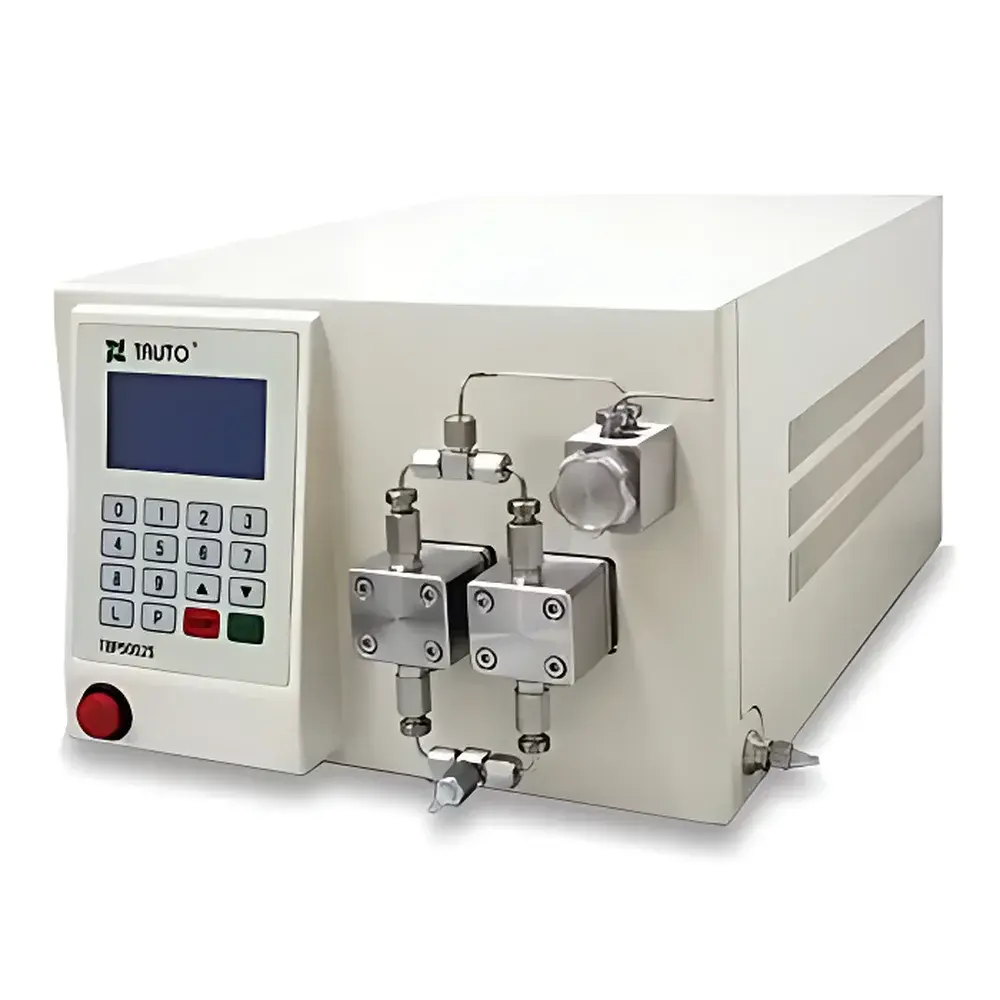
Tongtian TBP1002S Precision Constant-Flow Peristaltic-Free Reciprocating Pump
| Brand | Tongtian |
|---|---|
| Origin | Shanghai, China |
| Model | TBP1002S |
| Flow Range | 0.1–10.0 mL/min |
| Pressure Range | 0–2.0 MPa |
| Pressure Pulsation | ≤0.01 MPa |
| Flow Accuracy | ≤±0.5% |
| Flow Repeatability | ≤±0.5% |
| Pressure Accuracy | ≤±0.10 MPa |
| Wetted Materials | Sapphire Ball Valves, Ceramic Plungers |
| Input Voltage | 220 V ±10%, 50/60 Hz |
| Power Consumption | 75 W |
| Dimensions (W×D×H) | 270 × 400 × 190 mm |
| Weight | 17 kg |
Overview
The Tongtian TBP1002S is a microprocessor-controlled, dual-plunger reciprocating pump engineered for high-precision, low-pulsation liquid delivery in analytical and preparative laboratory systems. Unlike peristaltic or diaphragm-based designs, the TBP1002S employs a true positive-displacement architecture with ceramic plungers and sapphire ball check valves—ensuring long-term stability, chemical inertness, and minimal flow deviation under variable backpressure. Its core operating principle relies on synchronized plunger displacement and valve timing to achieve near-continuous volumetric output, with pressure pulsation suppressed to ≤0.01 MPa through optimized fluidic geometry and mechanical damping. Designed for integration into modular fluid-handling platforms—including microreactors, chromatographic purification systems, and corrosion-resistant feed modules—the TBP1002S delivers calibrated, repeatable flow across its full range of 0.1–10.0 mL/min at pressures up to 2.0 MPa. This makes it suitable for applications demanding strict adherence to GLP-compliant operational protocols and reproducible process parameters.
Key Features
- True constant-flow performance with ≤±0.5% flow accuracy and ≤±0.5% repeatability—validated across the entire operating range
- Ultra-low pressure pulsation (≤0.01 MPa) achieved via dual-plunger phase offset and precision-machined sapphire/valve seating
- Chemically resistant wetted path options: 316L stainless steel (L), pure titanium (T), PEEK (K), and PTFE (F)—enabling compatibility with aggressive solvents, acids, bases, and halogenated media
- Integrated real-time monitoring: simultaneous digital display of setpoint and actual pressure, flow rate, and elapsed runtime
- Intelligent control interface supporting both manual keypad operation and RS232/USB communication for remote parameter setting, data logging, and synchronization with external controllers
- Programmable timer function for automated start/stop sequences—critical for unattended overnight operation in synthesis or purification workflows
- Fully sealed drive train with IP54-rated enclosure, eliminating lubricant contamination risk and enhancing long-term reliability in humid or solvent-rich environments
Sample Compatibility & Compliance
The TBP1002S accommodates a broad spectrum of liquid samples—from aqueous buffers and organic solvents (e.g., acetonitrile, THF, DMF) to concentrated mineral acids (e.g., HCl, HNO₃) and alkaline reagents (e.g., NaOH, KOH), provided the selected wetted material variant is matched to chemical exposure requirements. The optional titanium (T) and PTFE (F) configurations meet ASTM D5117-18 standards for corrosion resistance in aggressive media handling. While not certified to IEC 61000-6-3 for EMC or UL 61010-1 out-of-the-box, the pump complies with CE marking requirements for laboratory equipment under Directive 2014/30/EU (EMC) and 2014/35/EU (LVD). Its firmware architecture supports audit-trail-capable operation when paired with compliant host software—facilitating alignment with FDA 21 CFR Part 11 expectations for electronic records in regulated pharmaceutical and biotech environments.
Software & Data Management
The TBP1002S communicates via ASCII-based serial protocol over RS232 or USB virtual COM port, enabling seamless integration with LabVIEW, MATLAB, Python (pySerial), or custom SCADA platforms. A Windows-compatible configuration utility provides graphical setup of flow/pressure profiles, timer schedules, and calibration offsets. All operational parameters—including timestamped pressure readings, flow deviations, and error codes—are exportable as CSV files for traceability and statistical process analysis (SPC). No proprietary runtime environment is required; configuration and monitoring can be performed using standard terminal emulators or third-party automation frameworks. Firmware updates are delivered via signed binary packages with checksum verification—ensuring integrity during field deployment.
Applications
- Modular continuous-flow chemistry: precise reagent dosing in microchannel reactors, tubular flow systems, and jacketed batch reactors
- Medium- to high-pressure preparative chromatography: gradient elution support in flash and MPLC systems requiring stable flow under variable column backpressure
- Corrosive feed delivery: metering of HF, bromine, chlorine solutions, or anhydrous alkyl lithiums in air-sensitive synthesis setups
- Bioprocess auxiliary pumping: sterile buffer exchange, pH adjustment, and nutrient feeding in controlled bioreactor loops
- Environmental sample introduction: consistent delivery of extractants in solid-phase extraction (SPE) and leaching protocols per EPA Method 3550C
- Food safety analytics: mobile phase delivery in HPLC-based pesticide residue screening aligned with AOAC 2007.01 validation criteria
FAQ
What is the maximum allowable viscosity for optimal performance?
The TBP1002S is optimized for Newtonian liquids with viscosities up to 500 cP at 25°C. For higher-viscosity fluids, reduced flow range and increased wear on ceramic components must be anticipated.
Can the pump operate continuously for 72+ hours without maintenance?
Yes—under nominal load (<1.5 MPa, 10,000-hour MTBF in accelerated life testing per ISO 13384-1.
Is calibration traceable to NIST or equivalent national standards?
Factory calibration uses gravimetric flow verification against ISO/IEC 17025-accredited reference standards; users may perform in-house recalibration using certified syringe pumps or Coriolis mass flow meters.
Does the pump support analog input/output for PLC integration?
No native 4–20 mA or 0–10 V I/O is included; however, optional third-party signal converters (e.g., Phoenix Contact MINI MCR-SL-U-I) enable analog interfacing via RS232 command mapping.
How often should sapphire valves and ceramic plungers be replaced?
Under typical use with HPLC-grade solvents, replacement is recommended every 12–18 months or after 5,000 operating hours—whichever occurs first—to maintain specified pulsation and accuracy tolerances.



