
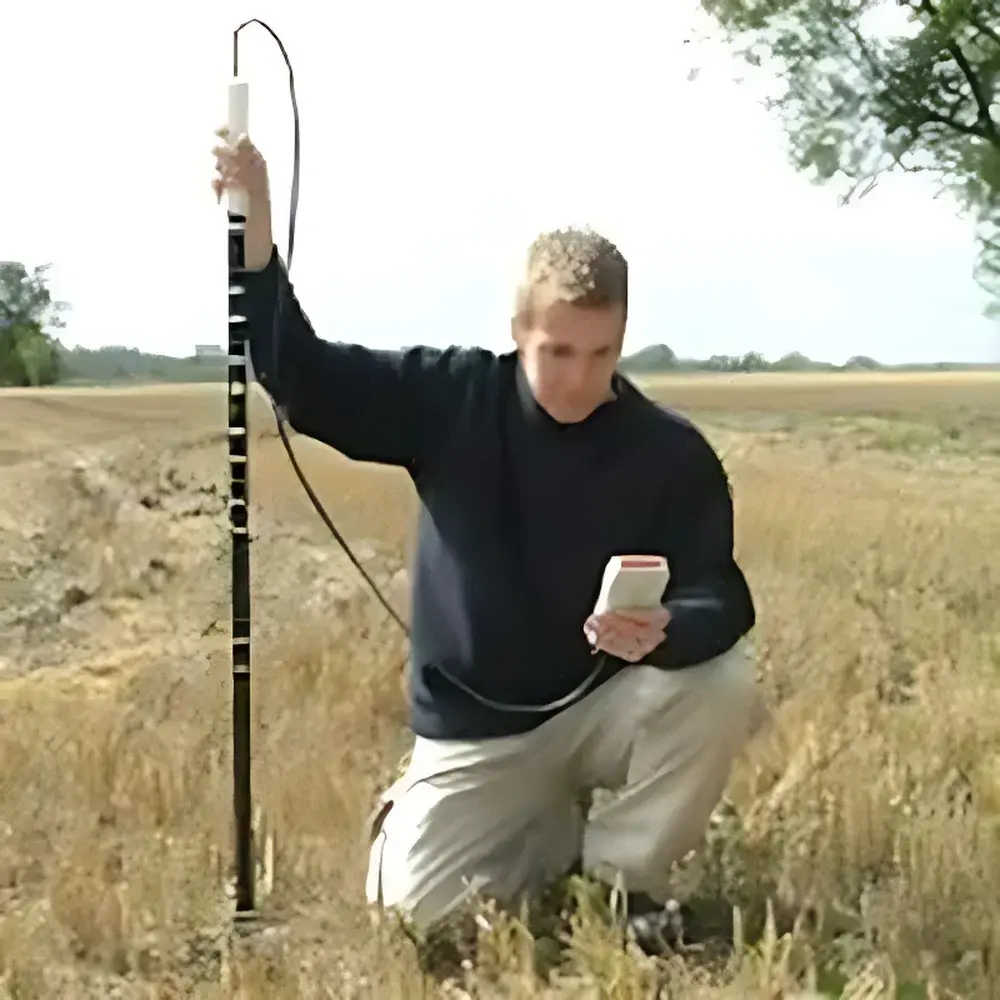
English Product Name
| Origin | United Kingdom |
|---|---|
| Manufacturer Type | Authorized Distributor |
| Import Status | Imported |
| Model | PR2 |
| Pricing | Available Upon Request |
| Measurement Principle | Frequency Domain Reflectometry (FDR) |
| Sensor Count Options | 4-sensor (PR1/4) or 6-sensor (PR1/6) configurations |
| Depth Intervals | 10, 20, 30, 40 cm (PR1/4) |
| Volumetric Water Content Range | 0–1.0 m³·m⁻³ (0–100% vol.) |
| Sensor Accuracy | ±3% (post-calibration) |
| Sensor Repeatability | ±1% |
| Operating Temperature | −20 to +70 °C |
| Standard Cable Length | 2 m (extendable up to 100 m) |
| Probe Diameter | 28 mm |
| PR1/4 Dimensions | 637 mm L × 28 mm Ø, 0.55 kg |
| PR1/6 Dimensions | 1246 mm L × 28 mm Ø, 0.95 kg |
| HH2 Handheld Meter Resolution | 1 mV |
| HH2 Memory Capacity | 1100 readings |
| HH2 Battery Life | ~6500 readings |
| HH2 Display Units | m³·m⁻³, % vol., mm, mV |
Overview
The Delta-T Devices PR2 Profile Soil Moisture Profiler is an engineered solution for high-fidelity, multi-depth soil water content monitoring in agricultural research, hydrological studies, and environmental impact assessment. Based on Frequency Domain Reflectometry (FDR), the PR2 eliminates the salinity-dependent drift common in time-domain transmission (TDT) or capacitance-based sensors—ensuring stable, repeatable measurements across variable soil types, including saline, clay-rich, or organic soils. Unlike single-point probes requiring multiple installations, the PR2 integrates either four or six calibrated FDR sensors along a single rigid probe rod, enabling simultaneous volumetric water content (θv) acquisition at predefined depths (e.g., 10–40 cm or 10–100 cm). This architecture supports vertical profile analysis without spatial interpolation artifacts, delivering data essential for root-zone water balance modeling, irrigation scheduling validation, and vadose zone flux estimation.
Key Features
- Multi-depth FDR sensing with factory-calibrated, temperature-compensated sensors—no field recalibration required under standard conditions
- Robust stainless-steel and epoxy-sealed cylindrical probe design rated IP68 for long-term burial in saturated or freeze-thaw environments
- Two configuration options: PR1/4 (4 sensors at 10, 20, 30, 40 cm) and PR1/6 (6 sensors at 10, 20, 30, 40, 60, 100 cm), both with identical 28 mm diameter and corrosion-resistant housing
- Modular system integration: compatible with HH2 handheld meter for manual spot measurements or DL6 datalogger for autonomous, multi-parameter monitoring (including rainfall, single-point ML2X probes, and threshold alarms)
- High signal integrity over extended cable runs—tested performance maintained up to 100 m using shielded twisted-pair cabling
- Direct unit output flexibility: readings displayed and stored as m³·m⁻³, % volume, mm water equivalent, or raw mV—enabling seamless conversion for evapotranspiration or drainage modeling
Sample Compatibility & Compliance
The PR2 is validated for use in mineral soils (sand to heavy clay), peat, and amended horticultural substrates. Its FDR operating frequency (~30 MHz) minimizes dielectric dispersion effects and ensures minimal sensitivity to bulk electrical conductivity (EC < 8 dS·m⁻¹), making it suitable for coastal, irrigated, or reclaimed land applications. The probe meets IEC 60529 (IP68) for ingress protection and complies with CE marking requirements for electromagnetic compatibility (EMC Directive 2014/30/EU). While not certified to ISO 11274 or ASTM D5859 per se, its measurement methodology aligns with the physical principles outlined in these standards for soil water retention characterization. Data generated with HH2 or DL6 loggers support GLP-compliant recordkeeping when paired with timestamped metadata and user-defined site identifiers.
Software & Data Management
Data collected via HH2 is transferred via USB to Windows-based Delta-T software (v3.x), which exports native .csv files directly importable into Excel, R, Python (pandas), or GIS platforms. The software enforces structured metadata entry—including probe ID, depth assignment, date/time stamp, operator ID, and GPS coordinates (if externally tagged)—to ensure traceability. When deployed with the DL6 datalogger, the system supports programmable sampling intervals (1 min to 24 h), alarm-triggered event logging, and SD card storage with automatic file rotation. All firmware and configuration files are version-controlled; audit trails for parameter changes are retained locally on the DL6’s non-volatile memory, satisfying foundational requirements for 21 CFR Part 11–aligned workflows where electronic records are subject to review.
Applications
- Agricultural water use efficiency studies: quantifying deep percolation losses and root water uptake distribution across crop growth stages
- Wetland hydrology: tracking capillary fringe dynamics and seasonal water table fluctuations in riparian buffers
- Landfill cover monitoring: verifying moisture thresholds for gas migration control and vegetative barrier performance
- Climate change impact modeling: long-term profiling of soil water storage trends in paired experimental watersheds
- Irrigation system evaluation: validating uniformity coefficients and detecting subsurface lateral flow in drip or pivot systems
- Educational field labs: teaching soil physics concepts including matric potential estimation via water content–depth gradients
FAQ
Can the PR2 be used in frozen soil?
Yes—the probe operates from −20 °C to +70 °C, and FDR signals remain interpretable in partially frozen soils, though liquid-phase water content interpretation requires caution below 0 °C.
Is sensor-to-sensor crosstalk observed between adjacent FDR elements?
No—each sensor operates on a distinct frequency band within the 20–40 MHz range; electromagnetic isolation is verified through bench testing and field intercomparison studies.
How often does the PR2 require recalibration?
Factory calibration is stable for ≥5 years under normal burial conditions; field verification against gravimetric samples is recommended annually for research-grade applications.
Does the HH2 meter support real-time graphing during measurement?
No—the HH2 displays numeric values only; real-time profile visualization requires connection to PC-based Delta-T software or third-party SCADA interfaces via DL6.
Can the PR2 probe be installed horizontally or at an angle?
Installation must be vertical to maintain prescribed depth intervals and avoid mechanical stress on internal wiring; angled insertion compromises depth accuracy and voids warranty.
Related Products







