
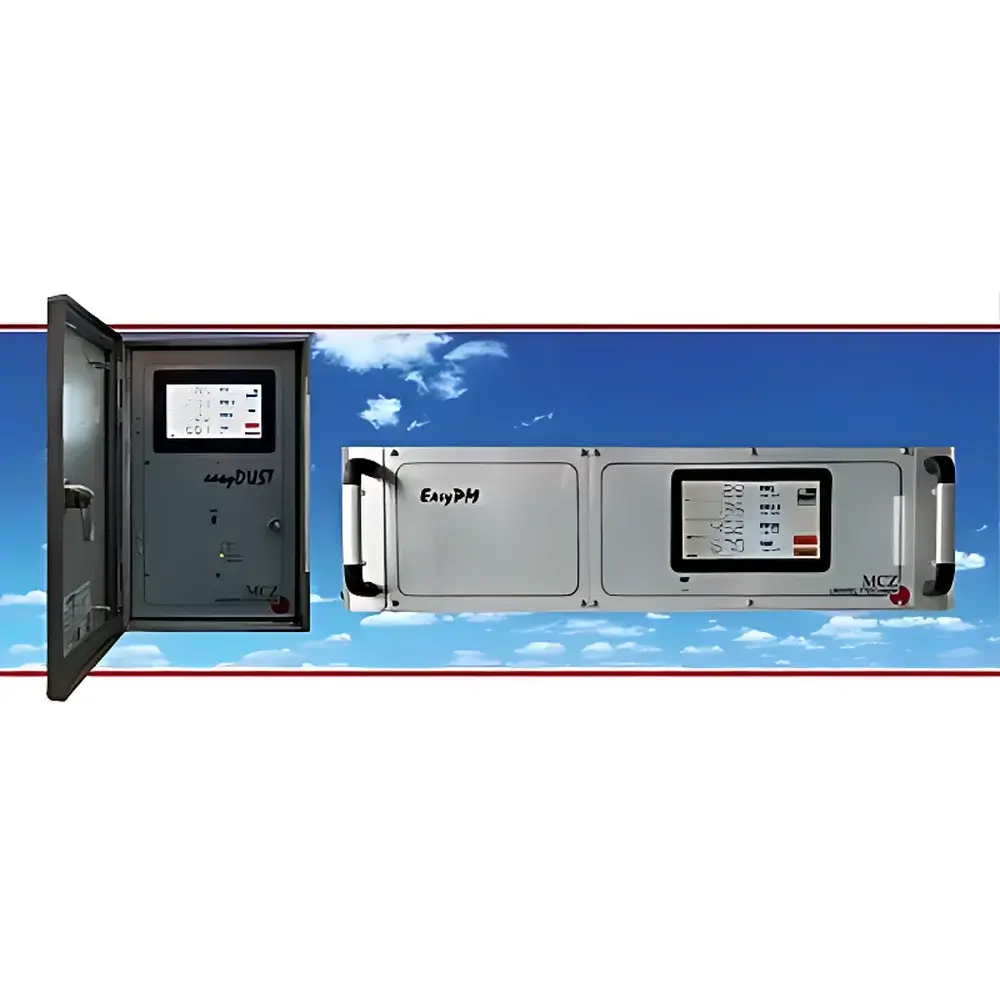
EasyDust Atmospheric Particulate Matter Analyzer by MCZ
| Origin | Germany |
|---|---|
| Manufacturer Type | Authorized Distributor |
| Origin Category | Imported Instrument |
| Model | EasyDust |
| Measurement Principle | Laser Light Scattering |
| Measurable Parameters | TSP, PM₁₀, PM₂.₅, PM₁ |
| Measurement Range (PM₁₀) | 0.01–2000 µg/m³ |
| Sampling Interval | 1–10 s |
| Sample Flow Rate | 220 mL/min |
| Total Flow Rate | 1.2 L/min |
| Particle Size Range (spherical equivalent diameter) | 0.38–17 µm |
| Max Particle Counting Rate | 10,000 particles/s |
| Detection Limit (PM₁₀) | 0.01 µg/m³ |
| Output Interfaces | RS232 digital, 0–10 VDC analog (optional) |
| Power Supply | 230 V/50 Hz or 115 V/60 Hz |
| Dimensions (with weatherproof enclosure) | 200 × 200 × 150 mm |
| Weight | ~2 kg |
Overview
The EasyDust Atmospheric Particulate Matter Analyzer is a compact, high-sensitivity optical aerosol monitor engineered for continuous, real-time quantification of airborne particulate mass concentrations across four standardized size fractions: Total Suspended Particulates (TSP), PM10, PM2.5, and PM1. Developed by MCZ (Germany), the instrument employs a calibrated laser light scattering principle—based on Mie theory—to detect individual particles within the 0.38–17 µm spherical equivalent diameter range. Scattered light intensity is converted into particle size distribution via an internal calibration curve traceable to NIST-traceable polystyrene latex (PSL) standards. Mass concentration values are then derived using internationally accepted density and shape assumptions per ISO 7708 and EN 481, ensuring alignment with regulatory monitoring frameworks.
Key Features
- Simultaneous real-time reporting of TSP, PM10, PM2.5, and PM1 mass concentrations in µg/m³ or mg/m³ units
- High temporal resolution with configurable sampling intervals from 1 to 10 seconds
- Optimized dual-flow architecture: dedicated 220 mL/min sampling flow for aerosol intake and 1.2 L/min total system flow for stable optical chamber conditioning
- Detection limit of 0.01 µg/m³ for PM10, enabling reliable measurement in low-concentration indoor environments and clean ambient air
- Robust mechanical design with IP65-rated weatherproof enclosure (200 × 200 × 150 mm, ~2 kg) suitable for fixed outdoor mounting, 19-inch rack integration, or deployment within portable air monitoring systems (e.g., CAMS platforms)
- Standard RS232 serial interface for direct data logging; optional 0–10 VDC analog output for PLC or SCADA integration
- Wide-range power compatibility: 115 V/60 Hz or 230 V/50 Hz operation without external converters
Sample Compatibility & Compliance
The EasyDust analyzer is validated for use with ambient air, indoor workplace air, and industrial process exhaust streams containing non-volatile, non-hygroscopic, and moderately hygroscopic aerosols. It complies with core requirements of EN 12341 (ambient PM10 reference method), EN 14907 (PM2.5 reference method), and ISO 29463-3 (high-efficiency filter testing). While not a certified reference method per EU Directive 2008/50/EC, its performance characteristics support indicative monitoring, trend analysis, and source apportionment studies under QA/QC protocols aligned with ISO/IEC 17025. Data integrity is maintained through timestamped output, internal diagnostics, and firmware-controlled flow verification—supporting GLP-compliant recordkeeping when paired with validated data acquisition software.
Software & Data Management
Data acquisition and configuration are managed via ASCII-based command protocol over RS232, enabling seamless integration with third-party SCADA, LIMS, or custom Python/Matlab scripts. Optional PC-based configuration utility provides real-time visualization of size-resolved count rates, flow diagnostics, and alarm status. All outputs include UTC timestamps, instrument ID, and measurement unit flags. For regulated environments, the system supports audit-trail-capable data logging when interfaced with 21 CFR Part 11–compliant software platforms—though native electronic signature or user-role management is not embedded in the device firmware.
Applications
- Ambient air quality monitoring networks (urban, rural, roadside)
- Indoor air quality assessment in offices, schools, hospitals, and cleanrooms
- Occupational hygiene monitoring in manufacturing, construction, and mining sites
- Point-source emission surveillance at stack outlets or fugitive dust locations
- Research-grade aerosol characterization in atmospheric science laboratories
- Mobile monitoring when integrated into vehicle-mounted or drone-deployable CAMS platforms
FAQ
Does EasyDust require routine calibration with gravimetric reference methods?
Yes—while factory-calibrated against PSL standards, periodic verification against EN 12341-compliant gravimetric samplers is recommended every 3–6 months for regulatory reporting applications.
Can the instrument distinguish between dust, smoke, and sea salt aerosols?
No—EasyDust reports mass concentrations based on optical equivalence; chemical speciation requires complementary techniques such as XRF, IC, or mass spectrometry.
Is humidity compensation implemented internally?
The analyzer includes temperature and relative humidity sensors, but no active hygroscopic growth correction algorithm; users must apply post-processing corrections per ISO/CD 21745 if operating above 60% RH.
What maintenance intervals are specified for the optical chamber and flow system?
MCZ recommends quarterly inspection of the laser window and inlet nozzle, biannual replacement of the internal pump filter, and annual full-system verification including flow rate and zero-check procedures.
Is remote firmware update supported?
Firmware updates require local physical access via RS232 connection and MCZ-provided update utility; over-the-air updates are not available.
Related Products







