
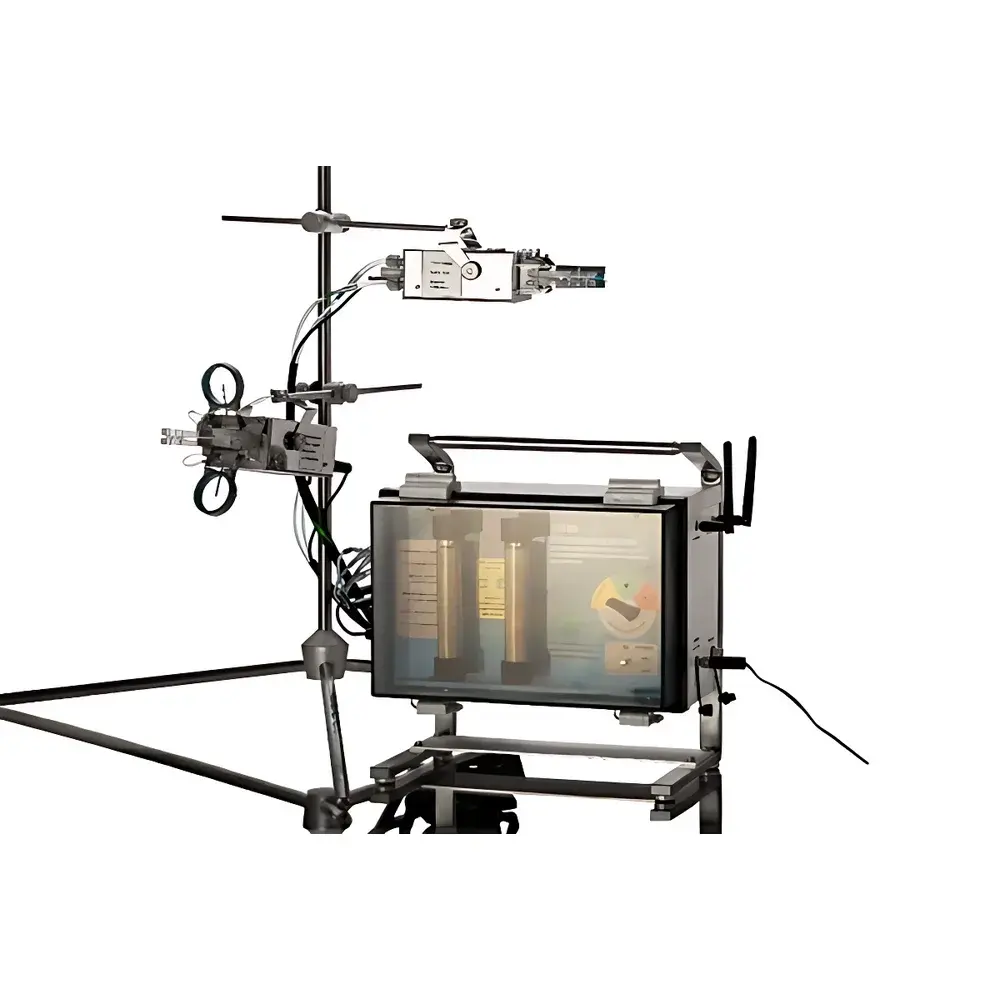
OLAN PTM-50 Continuous Multi-Channel Photosynthesis and Plant Physiological Monitoring System
| Origin | Israel |
|---|---|
| Manufacturer Type | Authorized Distributor |
| Product Category | Imported Instrument |
| Model | PTM-50 |
| Price Range | USD 68,000 – 136,000 |
| CO₂ Measurement Range | 0–1000 ppm |
| CO₂ Exchange Range | −70 to +70 µmol CO₂·m⁻²·s⁻¹ |
| H₂O Exchange Measurement | Integrated Air Temperature & Relative Humidity Sensor |
| Leaf Chamber Area | 10 cm² |
| Chamber Cycling Time | 20 s |
| Sampling Interval | 5–120 min (user-configurable) |
| Airflow Control | 0.25–0.5 LPM (adaptive) |
| Power Supply | 9–24 VDC |
| Communication | Built-in 2.4 GHz RF Transmitter + USB RF Receiver |
| Operating Temperature | 10–40 °C |
| IP Rating | IP55 |
Overview
The OLAN PTM-50 is a field-deployable, multi-channel continuous monitoring system engineered for long-term, non-invasive assessment of plant photosynthetic gas exchange and associated physiological responses under ambient or controlled environmental conditions. Unlike conventional portable photosynthesis systems designed for spot measurements, the PTM-50 implements a true time-series architecture based on sequential, automated leaf chamber cycling—enabling high-temporal-resolution tracking of net CO₂ assimilation, transpiration, and stomatal conductance over hours, days, or weeks. Its core measurement principle relies on non-dispersive infrared (NDIR) CO₂ analysis coupled with precision humidity sensing and adaptive airflow control to maintain stable boundary layer conditions across repeated sampling cycles. The system is calibrated per ISO 17025-accredited procedures and supports traceable data acquisition compliant with GLP and long-term ecological research (LTER) protocols. Designed for integration into both open-field agroecological studies and growth chamber experiments, the PTM-50 delivers reproducible, low-drift gas exchange data while preserving natural leaf microclimate through its patented auto-opening leaf chamber mechanism.
Key Features
- Four independently addressable LC-10R leaf chambers with motorized auto-open/close actuation—minimizing mechanical stress and maintaining leaf hydration and light exposure between measurements
- Sequential multi-chamber measurement cycle (20 s per chamber), enabling synchronized diurnal profiling across up to four genotypes or treatments
- Configurable sampling interval (5–120 minutes) with onboard data logging capacity for >30 days at 15-minute resolution
- Dual NDIR CO₂ analyzer with zero-point stability < ±2 ppm over 24 h and full-scale linearity ±0.5% of reading
- Integrated air temperature and relative humidity sensor (H₂O vapor pressure deficit derived in real time)
- Modular wireless sensor architecture supporting up to 15 concurrent external sensors via optional RF router (IEEE 802.15.4 compliant)
- Embedded 3G cellular module for remote data telemetry and firmware updates—compatible with secure HTTPS/FTP protocols
- IP55-rated enclosure suitable for outdoor deployment in temperate and Mediterranean climates
Sample Compatibility & Compliance
The PTM-50 accommodates broadleaf and narrow-leaf species with leaf areas ≥10 cm² and petiole diameters compatible with LC-10R chamber gasket sealing. Its non-contact leaf temperature monitoring (via LT-LRz IR sensor option) eliminates thermal perturbation during measurement. All external sensor interfaces comply with IEC 61000-4 electromagnetic immunity standards. Data integrity meets FDA 21 CFR Part 11 requirements for electronic records when used with audit-trail-enabled software configuration. System validation documentation includes as-delivered calibration certificates traceable to NIST standards for CO₂ and humidity, and supports ISO 14064-1 greenhouse gas quantification workflows for ecosystem-level carbon flux studies.
Software & Data Management
The proprietary PTM Control Suite (v5.2+) provides role-based user access, scheduled measurement protocol definition, real-time dashboard visualization, and batch export in CSV, NetCDF, and HDF5 formats. Raw sensor timestamps are synchronized via internal RTC with GPS-derived UTC offset (when 3G module active). Audit trails log all parameter changes, manual overrides, and calibration events with user ID and timestamp. Data encryption (AES-256) is applied during transmission and local storage. The software supports automated generation of daily net CO₂ assimilation integrals, night-time respiration estimates, and stomatal limitation index (SLI) calculations per Farquhar-von Caemmerer-Berry model assumptions. Exported datasets are structured to align with FluxNet, ICOS, and TRY Plant Trait Database metadata schemas.
Applications
- Long-term phenotyping of drought-tolerant crop varieties under field conditions, correlating stem sap flow (SD-5z/SD-6z) with instantaneous Anet and gs
- Diurnal partitioning of carbon gain vs. respiratory loss in perennial orchard species using integrated fruit growth (FI-Sz/FI-Mz) and trunk diameter variation (DE-1z) metrics
- Evaluation of stomatal vs. mesophyll limitations to photosynthesis across irrigation regimes, supported by concurrent PAR (PRI-1z), air vapor pressure deficit (ATH-2z), and leaf temperature (LT-1z) data
- Validation of land surface models (LSMs) in Mediterranean shrubland ecosystems, where multi-year PTM-50 deployments feed eddy covariance gap-filling algorithms
- Growth chamber-based circadian rhythm studies in Arabidopsis and rice, leveraging 4-chamber parallelism to isolate genotype × photoperiod interactions
FAQ
What is the maximum number of external sensors the PTM-50 can support simultaneously?
Up to 15 sensors via the optional Router wireless repeater unit; base system supports direct connection of up to 4 analog/digital sensors.
Does the system meet regulatory requirements for GxP-compliant plant physiology studies?
Yes—the software supports 21 CFR Part 11-compliant electronic signatures, audit trails, and data backup verification when configured with password-protected administrator mode.
Can the PTM-50 operate autonomously for extended periods without AC power?
Yes—when powered by a 24 VDC deep-cycle battery bank (≥50 Ah) and optionally paired with a solar charge controller, field deployments exceeding 4 weeks are routinely achieved.
Is calibration of the CO₂ analyzer performed in situ or only at the factory?
Field-zero calibration is supported using certified zero-air cartridges; span calibration requires NIST-traceable 400 ppm CO₂ standard gas and is recommended quarterly for critical applications.
Are raw measurement units and calculation methods fully documented for method validation?
Yes—complete metrological documentation, including uncertainty budgets for CO₂ flux derivation, is provided in the Technical Reference Manual (TRM-PTM50-Rev3.1).




