
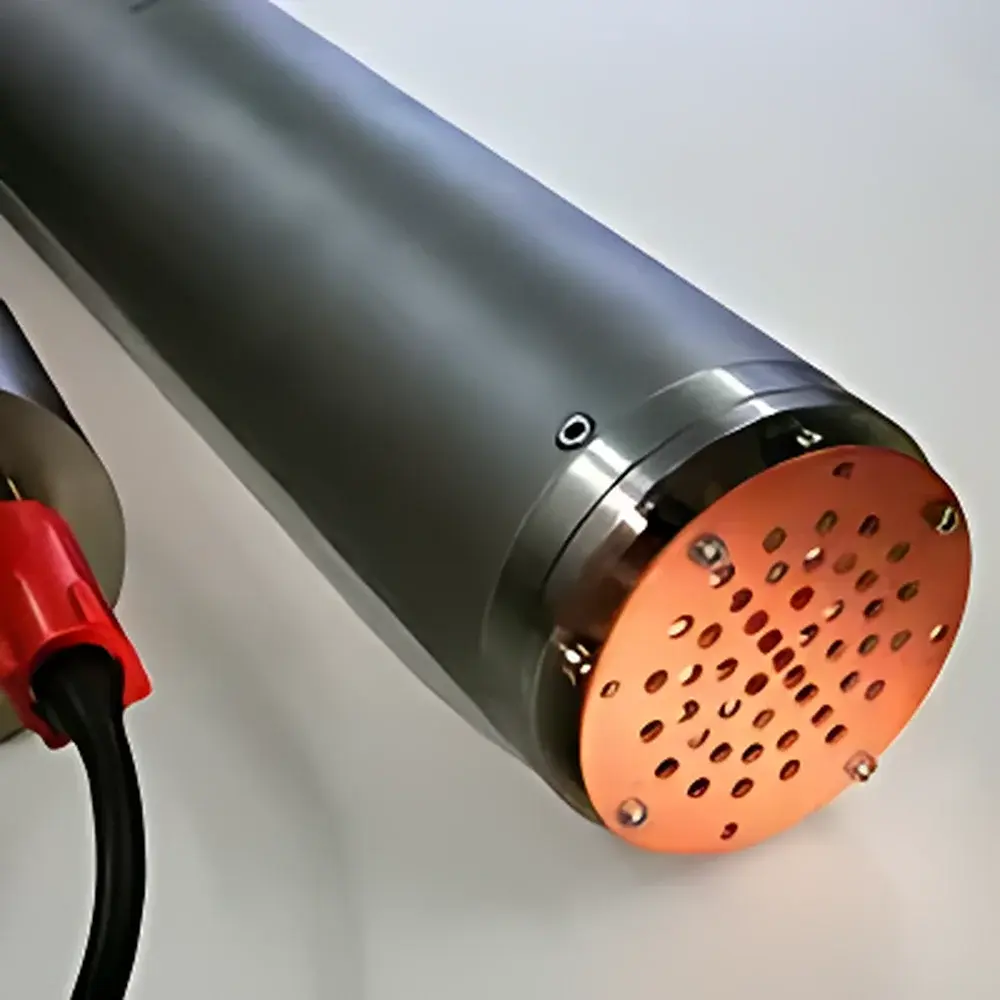
HYDRO CH4 Submersible Methane Sensor – German-Made Infrared Gas Analyzer for Underwater CH₄ Flux Monitoring
| Origin | Germany |
|---|---|
| Manufacturer Type | Authorized Distributor |
| Origin Category | Imported |
| Model | HYDRO CH4 |
| Pricing | Upon Request |
Overview
The HYDRO CH4 is a high-performance, submersible infrared methane sensor engineered for long-term, in-situ quantification of dissolved and gaseous methane (CH₄) in marine, freshwater, and benthic environments. Designed and manufactured in Germany, it operates on the principle of non-dispersive infrared (NDIR) spectroscopy — leveraging the unique absorption characteristics of CH₄ at specific mid-infrared wavelengths (typically ~3.3 µm). Methane diffuses from the surrounding liquid phase through a proprietary silicone membrane into an optically sealed measurement chamber, where an infrared source and photodetector assembly quantify absorbance changes with high spectral selectivity. This physical-chemical transduction mechanism ensures minimal cross-sensitivity to CO₂, H₂O vapor, or other hydrocarbons under typical aquatic conditions. The sensor is optimized for deployment in demanding offshore and polar applications — including seafloor hydrocarbon seep mapping, gas hydrate (clathrate) stability zone characterization, pipeline integrity monitoring, and ecosystem-scale CH₄ flux studies across wetlands, permafrost lakes, and rice paddies.
Key Features
- NDIR-based optical detection system with patented silicone membrane interface — enables selective, drift-resistant CH₄ measurement in liquid and headspace phases
- Titanium pressure housing rated for operational depths of 2000 m, 4000 m, or 6000 m — compliant with ISO 17713-2 for deep-sea instrumentation
- Two configuration variants: “Shorty” (standard sensitivity) and “Long John” (ultra-low-concentration mode), with detection limits down to 30 nmol/L
- Automatic zero calibration at power-on and programmable software-triggered zeroing — eliminates manual intervention during multi-month deployments
- Fast response kinetics: t90 < 30 s (Shorty); t90 < 60 s (Long John) — suitable for dynamic flux profiling and AUV/ROV-based surveys
- Flexible analog outputs (0–5 V, 0–10 V, 4–20 mA) and digital interfaces (RS-232, RS-485) supporting ASCII and NMEA-0183 protocols
- Optional SmartDI™ data logger integration — 2 GB onboard flash memory, timestamped binary logging, and GLP-compliant audit trail capability
Sample Compatibility & Compliance
The HYDRO CH4 is validated for direct immersion in seawater, brackish water, freshwater, sediment porewater, and atmospheric headspace above aquatic systems. Its silicone membrane exhibits stable permeability across pH 4–10 and salinities up to 45 PSU. Temperature compensation is applied over the standard operating range (+4 °C to +30 °C), with extended-range variants certified for -5 °C to +30 °C operation — meeting IEC 60068-2-1 and IEC 60068-2-2 environmental stress testing requirements. The sensor conforms to marine electronics standards including IP68, MIL-STD-810G (shock/vibration), and EN 61000-6-2/6-4 (EMC). For regulated environmental monitoring workflows, its output traceability supports ISO/IEC 17025-compliant calibration documentation and integrates with FDA 21 CFR Part 11–enabled data acquisition platforms when paired with SmartDI™ firmware v3.2+.
Software & Data Management
Sensor configuration, real-time diagnostics, and calibration management are performed via the vendor’s Windows-based HydroSoft™ desktop application (v5.4+), which supports batch parameter export/import and firmware updates over serial or Ethernet. When equipped with SmartDI™, the system logs time-stamped CH₄ concentration (nmol/L), temperature (°C), pressure (bar), and diagnostic flags at user-defined intervals (1 s to 24 h). All stored data include CRC-32 checksums and optional encryption (AES-128). ASCII output follows standardized field-delimited format (e.g., “$HYDRO,CH4,23.45,12.7,25.3,OK*3F”), enabling seamless ingestion into MATLAB, Python (pandas), or commercial environmental data management systems (EDMS) compliant with ISO 19115 metadata schemas.
Applications
- Quantitative CH₄ flux estimation across continental margins using benthic landers or moored observatories
- In-situ validation of satellite-derived atmospheric CH₄ anomalies via coordinated surface-to-seafloor profiling
- Real-time leak detection along subsea natural gas transmission infrastructure
- Seasonal monitoring of CH₄ ebullition from thawing permafrost lakes and boreal peatlands
- Integration into OceanPack+ mobile surface pCO₂/pCH₄ survey systems for underway oceanographic mapping
- Mounted on AUVs (e.g., REMUS 6000) or ROVs (e.g., Schilling UHD) for targeted seep localization and plume tracking
- Controlled mesocosm experiments studying methanogenesis inhibition or oxidation kinetics under varying redox conditions
FAQ
What is the minimum detectable CH₄ concentration for the “Long John” variant?
The Long John configuration achieves a lower limit of quantification (LLOQ) of 30 nmol/L in aqueous phase, with noise-equivalent concentration (NEC) ≤ ±3 nmol/L.
Can the sensor be deployed continuously for more than six months without maintenance?
Yes — with titanium housing, fouling-resistant membrane geometry, and SmartDI™-based autonomous zeroing, deployments exceeding 12 months have been documented in low-turbidity deep-sea sites.
Is factory calibration traceable to NIST or PTB standards?
All units undergo multi-point calibration against gravimetrically prepared CH₄-in-N₂ and CH₄-in-water standards; certificates include traceability to PTB (Physikalisch-Technische Bundesanstalt) reference gases.
Does the sensor require external gas supply or consumables?
No — it is a true passive diffusion sensor requiring no carrier gas, reagents, or replaceable optical components.
How is pressure compensation handled at depth?
Integrated piezoresistive pressure transducer (0–600 bar full scale) provides real-time hydrostatic correction; algorithm applies Henry’s law and temperature-dependent solubility coefficients per IAPWS formulations.







