
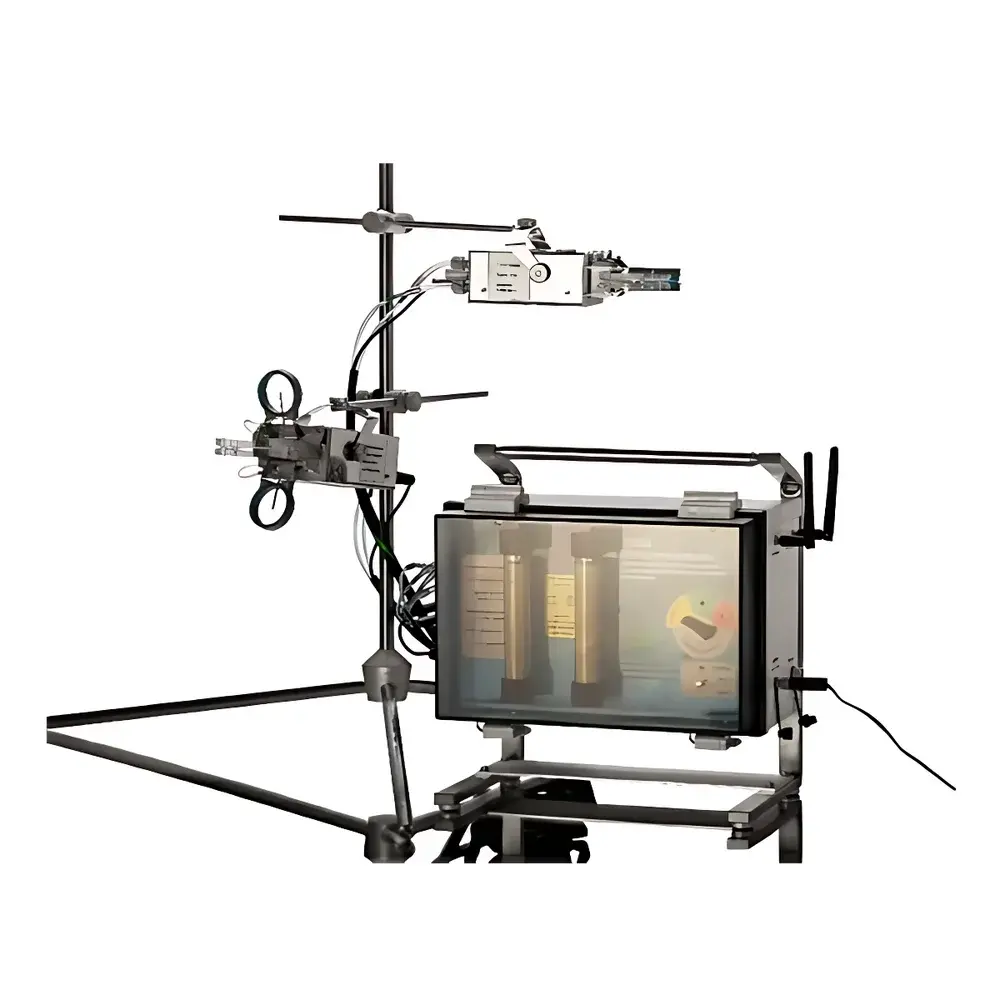
Zealquest PTM-50 Continuous Multi-Channel Photosynthesis and Plant Physiological Monitoring System
| Brand | Zealquest |
|---|---|
| Origin | Israel (manufactured by OLAN Ltd.) |
| Model | PTM-50 |
| CO₂ Measurement Range | 0–1000 ppm |
| CO₂ Exchange Range | −70 to +70 µmol CO₂·m⁻²·s⁻¹ |
| H₂O Exchange & Transpiration | Continuous |
| Leaf Chamber Type | Automated Opening/Closing |
| Number of Chambers | Configurable (2, 3, or 4) |
| Chamber Area | 10 cm² |
| Measurement Cycle Time | 20 s per chamber |
| Sampling Interval | 5–120 min (user-defined) |
| Airflow Control | 0.25–0.5 LPM (adaptive) |
| PAR Sensor Range (RTH-50) | 0–2000 µmol·m⁻²·s⁻¹ |
| Operating Temperature | 10–40 °C |
| IP Rating | IP55 |
| Communication | Integrated 2.4 GHz RF + Optional 3G Module |
| Power Supply | 9–24 VDC |
Overview
The Zealquest PTM-50 is a field-deployable, multi-channel continuous monitoring system engineered for long-term, non-invasive assessment of plant photosynthetic gas exchange and integrated physiological responses under ambient or controlled environmental conditions. Unlike conventional portable photosynthesis systems designed for spot measurements, the PTM-50 implements a closed-path, differential infrared (NDIR) CO₂ and humidity analysis architecture with automated leaf chamber actuation—enabling true diurnal and multi-day time-series acquisition without mechanical disturbance to leaf microclimate. Its core measurement principle relies on real-time differential CO₂ concentration analysis between reference and sample air streams across actively regulated laminar airflow paths, coupled with high-stability relative humidity and temperature compensation algorithms. This architecture supports quantification of net CO₂ assimilation (Anet), stomatal conductance (gs), transpiration rate (E), and intrinsic water-use efficiency (iWUE) at sub-minute temporal resolution. The system is purpose-built for ecological monitoring networks, agronomic phenotyping trials, controlled-environment facility validation, and climate-response physiology studies where reproducibility, sensor interoperability, and unattended operation over weeks are critical operational requirements.
Key Features
- Four independently addressable LC-10R leaf chambers with motorized opening/closing mechanisms—minimizing leaf boundary layer disruption during non-measurement intervals
- Configurable chamber count (2/3/4) and programmable sequential sampling cycle (20 s per chamber)
- Integrated NDIR CO₂ analyzer (0–1000 ppm range) and high-accuracy capacitive humidity/temperature sensors for simultaneous H₂O vapor density calculation
- Adaptive airflow control (0.25–0.5 LPM) with pressure-compensated mass flow regulation
- Dual wireless communication stack: embedded 2.4 GHz RF (with USB receiver) and optional 3G module for remote data telemetry and firmware updates
- IP55-rated enclosure suitable for outdoor deployment in variable weather conditions
- Modular sensor expansion via standardized analog/digital interfaces—supporting up to 15 additional wireless nodes using optional Router repeater
Sample Compatibility & Compliance
The PTM-50 accommodates broad leaf morphologies through its 10 cm² standard chamber aperture and adjustable clamping force. It complies with ISO 11737-1 for biological monitoring instrumentation design integrity and meets IEC 60529 ingress protection standards (IP55). Data acquisition workflows support GLP-compliant metadata tagging—including operator ID, protocol version, chamber calibration timestamps, and sensor serial traceability. When deployed with FDA 21 CFR Part 11–enabled software configuration (optional), the system provides electronic audit trails, user access controls, and immutable raw data archiving—facilitating regulatory submissions in agricultural biotechnology and crop protection research. All external sensors (e.g., RTH-50, SD-5z, SMTE-z) adhere to ASTM E1847 (soil moisture), ISO 9277 (PAR spectral response), and WMO guidelines for meteorological sensor performance.
Software & Data Management
The proprietary PTM Control Suite (v4.2+) delivers cross-platform (Windows/macOS/Linux) configuration, real-time visualization, and post-acquisition analysis. Users define custom measurement schedules, trigger logic (e.g., sunrise/sunset synchronization), and fail-safe recovery protocols. Raw data are stored in HDF5 format with embedded units, coordinate metadata, and sensor calibration coefficients. Export options include CSV, NetCDF, and MATLAB-compatible binaries. Batch processing modules enable automatic calculation of derived parameters: daily integral Anet, night-time respiratory carbon loss, diurnal gs hysteresis, and environmental sensitivity indices (e.g., Q10 for temperature response). Software validation documentation is available upon request for ISO/IEC 17025-accredited laboratories.
Applications
- Long-term phenotyping of drought-tolerant cultivars under field conditions, correlating stem diameter variation (SD-6z) with stomatal conductance dynamics
- Evaluating canopy-level carbon balance in Mediterranean shrublands using multi-site PTM-50 deployments synchronized with eddy-covariance towers
- Validating growth chamber environmental uniformity by mapping spatial heterogeneity in leaf-level Anet across racks using four-chamber configurations
- Quantifying fruit expansion kinetics (FI-Sz/FI-Mz) relative to diurnal PAR and vapor pressure deficit gradients in greenhouse tomato production
- Assessing root-zone water status effects on whole-plant hydraulic conductance via concurrent soil moisture (SMS-5z) and sap flow (SF-1z) integration
FAQ
Can the PTM-50 operate autonomously for more than 72 hours without manual intervention?
Yes—the system supports continuous unattended operation for up to 28 days when powered by a regulated 12 VDC source and configured with appropriate sampling intervals (e.g., 30-min cycles). Internal memory retains >1 million timestamped records.
Is calibration traceable to NIST or other national metrology institutes?
CO₂ analyzers are factory-calibrated against certified gas standards (NIST-traceable 400 ppm and 800 ppm blends); users receive calibration certificates with uncertainty budgets compliant with ISO/IEC 17025 Annex A.3.
How does the system handle condensation inside leaf chambers during high-humidity measurements?
Chambers incorporate heated optical windows and active dew-point monitoring; airflow modulation reduces residence time, while firmware applies dynamic humidity correction based on real-time dew-point depression.
Are firmware updates delivered over-the-air via the 3G module?
Yes—secure HTTPS-based OTA updates are supported, with SHA-256 signature verification and rollback capability to previous stable versions.
Does the software support statistical comparison across treatment groups (e.g., ANOVA, repeated-measures linear mixed models)?
Basic statistics (mean ± SE, ANOVA) are embedded; advanced modeling requires export to R, Python (SciPy/statsmodels), or SAS—but metadata structure ensures seamless integration with common agricultural analytics pipelines.





