
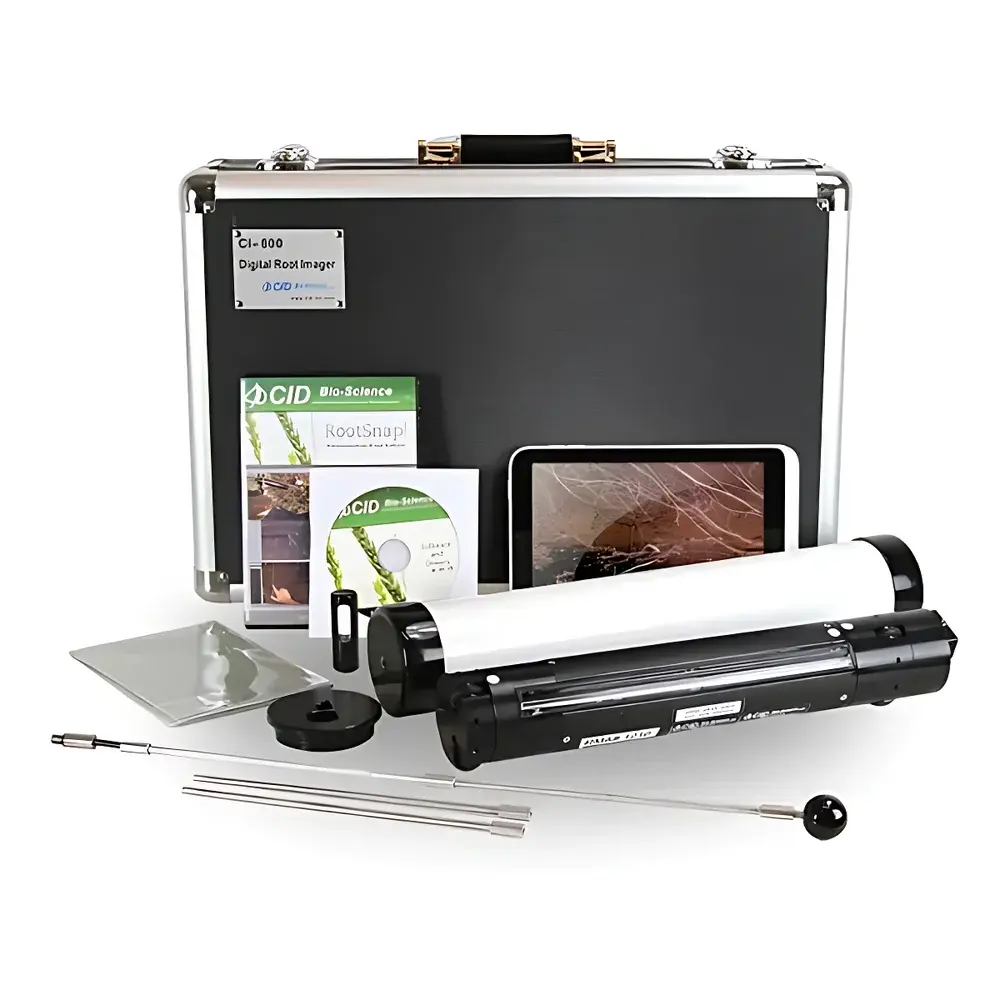
CID CI-600 Plant Root Growth Monitoring System
| Brand | CID |
|---|---|
| Origin | USA |
| Manufacturer Type | Authorized Distributor |
| Product Category | Imported Instrument |
| Model | CI-600 |
| Pricing | Upon Request |
| Operating Environment | 0–50 °C, 0–100% RH (non-condensing) |
| Imaging Resolution Options | 100 / 300 / 600 / 1200 DPI |
| Sensor Pixel Count | 2.35 Megapixels |
| Scan Area per Frame | 21.56 cm × 19.56 cm |
| Scan Time | ≥30 seconds (resolution-dependent) |
| Probe Dimensions | 34.3 cm length × 6.4 cm diameter |
| Transparent Access Tube ID | 6.36 cm, OD: 7.0 cm, Wall Thickness: 3.2 mm, Length Options: 1 m or 2 m |
| System Mass | 750 g (probe only) |
| Power Supply | UMPC-based terminal |
| Data Storage | Direct to onboard processing terminal |
| Image Formats | BMP, JPG, TIFF, PNG |
| Software Platforms | CI-690 RootSnap (touch-optimized), WinRHIZO Tron MF (desktop-based) |
Overview
The CID CI-600 Plant Root Growth Monitoring System is a non-invasive, in situ imaging platform engineered for longitudinal observation of live root architecture within soil profiles. Based on high-resolution optical line-scan technology with 360° rotational photodiode coupling, the system captures undistorted, linearly calibrated cross-sectional images of roots inside transparent access tubes installed vertically in field or greenhouse soils. Unlike destructive excavation or destructive staining methods, the CI-600 enables repeated, season-long monitoring without perturbing root-soil interactions—critical for studying phenotypic plasticity, drought response, nutrient foraging behavior, and rhizosphere dynamics under natural or controlled conditions. Its modular probe design integrates seamlessly with standard 6.4 cm inner-diameter acrylic or polycarbonate access tubes, supporting deployments from shallow herbaceous layers to deep-rooted tree systems up to 2 meters in depth.
Key Features
- 360° rotational optical sensor head ensures geometrically accurate, distortion-free linear scanning across full tube circumference
- Selectable optical resolution (100–1200 DPI) allows trade-off between spatial detail and scan speed based on experimental requirements
- 2.35-megapixel linear CCD array delivers sub-millimeter feature resolution at 600 DPI, sufficient to resolve individual root tips, lateral branching points, and fine root hairs in high-contrast soil backgrounds
- UMPC-integrated control architecture enables fully autonomous operation: real-time image acquisition, on-device storage, and immediate preview without external computers
- Adjustable LED illumination intensity and spectral balance accommodates variable soil color, moisture content, and organic matter interference
- Lightweight probe (750 g) and ergonomic handheld deployment facilitate rapid installation and repositioning across multiple field plots or long-term monitoring sites
- Robust mechanical housing rated for continuous outdoor use in ambient temperatures from 0 °C to 50 °C and humidity up to 100% RH (non-condensing)
Sample Compatibility & Compliance
The CI-600 is compatible with both mineral and organic soils, including clay loam, sandy loam, peat-based substrates, and hydroponic root mats when placed in appropriate transparent chambers. It requires pre-installed rigid access tubes (1 m or 2 m length, 6.36 cm ID) cemented into the ground prior to planting or treatment application. The system complies with ISO 22082:2021 guidelines for non-destructive root phenotyping instrumentation and supports GLP-aligned data traceability when used with RootSnap’s audit-ready metadata tagging (timestamp, depth coordinate, DPI setting, illumination index). While not FDA-regulated, its data output format (TIFF/BMP with embedded EXIF) meets archival standards referenced in USDA ARS protocols and NSF-funded plant phenomics initiatives.
Software & Data Management
Two validated software environments are supported: CI-690 RootSnap and WinRHIZO Tron MF. RootSnap runs natively on the integrated UMPC touchscreen and features gesture-driven root segmentation—including finger-drag tracing, auto-snapping to root contours, dynamic zoom, and real-time curvature adjustment for angled root segments. It computes 36 morphometric parameters per image, including total root length, surface area, volume, average diameter, tip count, branch angle distribution, and projected biomass estimates—all exportable as CSV or Excel-compatible reports. WinRHIZO Tron MF provides complementary batch analysis capabilities, enabling time-series normalization, statistical comparison across treatments, and integration with GIS-linked plot metadata. Both platforms maintain full audit trails: operator ID, acquisition timestamp, calibration status, and user-modified thresholds are logged automatically per session.
Applications
The CI-600 serves core research and applied monitoring functions across agronomy, forestry, ecological restoration, and civil infrastructure management. In crop science, it quantifies root system architecture shifts under nitrogen limitation, salinity stress, or mycorrhizal inoculation. Forestry applications include tracking deep rooting patterns of riparian species for slope stabilization modeling. For ecological restoration, it validates seed mix efficacy in grassland revegetation by measuring vertical root penetration rates and seasonal turnover. In civil engineering, the system supports long-term evaluation of turfgrass root reinforcement in dam embankments and highway cut-slopes—providing empirical input for bioengineered erosion control design. Additionally, it aids arborists in diagnosing root decay or pest infestation in heritage trees via comparative temporal imaging.
FAQ
What depth range can the CI-600 effectively monitor?
The system supports imaging down to 2 meters depth using optional 2 m access tubes; effective resolution depends on soil opacity and illumination settings.
Is calibration required before each scan?
A single factory calibration is retained across sessions; however, periodic verification using the included calibration tube is recommended every 6 months or after mechanical shock.
Can the CI-600 distinguish live vs. dead roots?
It does not provide physiological viability assessment; differentiation relies on morphological criteria (e.g., turgor, cortical integrity) interpreted manually or via supervised machine learning modules in RootSnap.
How is positional accuracy maintained across repeated scans?
Depth markers etched onto the access tube interior and motorized encoder feedback ensure ±0.5 mm vertical repeatability between visits.
Does the system support automated time-lapse scheduling?
No native intervalometer; scheduled scans require external scripting via USB-serial API or manual triggering through the UMPC interface.



