
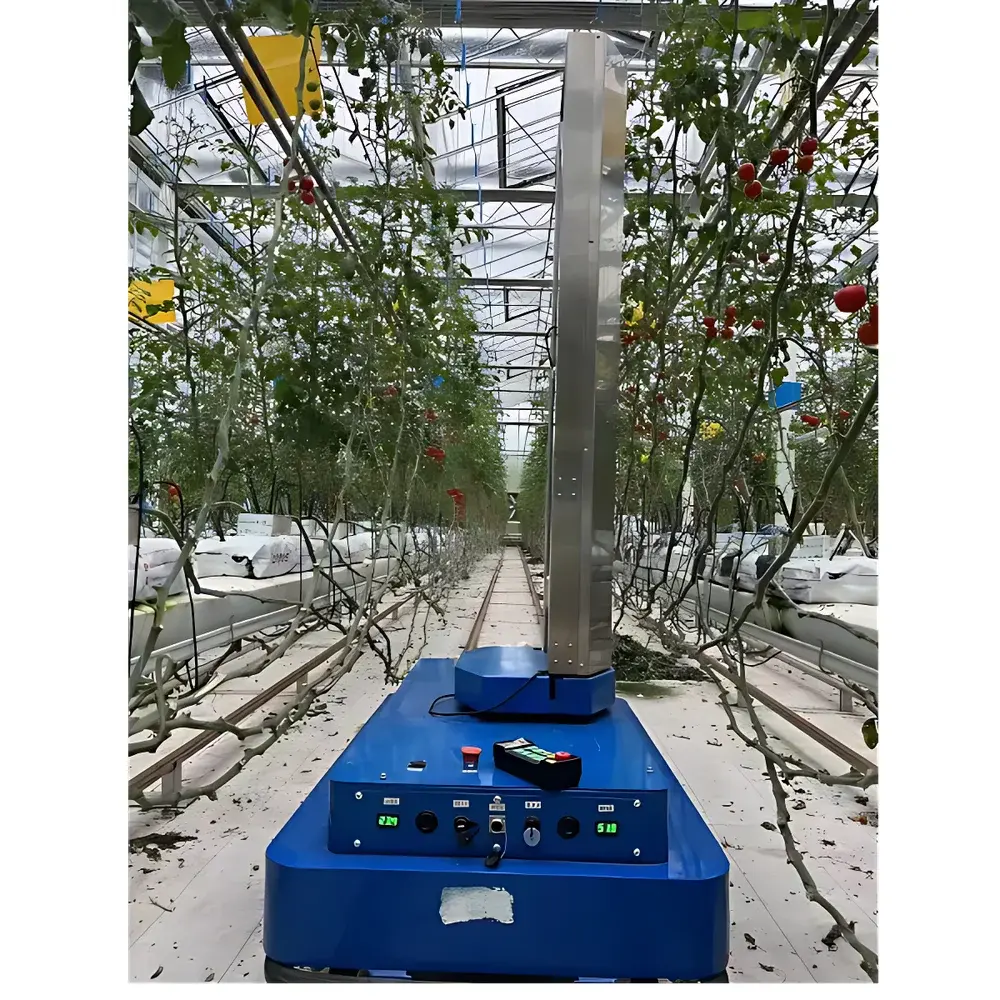
Greenhouse Inspection Robot GI-UGV by BiAgro (RockTec)
| Brand | BiAgro (RockTec) |
|---|---|
| Origin | Shanghai, China |
| Manufacturer Type | Authorized Distributor |
| Country of Origin | China |
| Model | GI-UGV |
| Pricing | Available Upon Request |
Overview
The GI-UGV Greenhouse Inspection Robot is an autonomous mobile platform engineered for continuous, non-intrusive monitoring and data-driven management of controlled-environment agriculture systems. Designed specifically for modern glass and polytunnel greenhouses, it integrates multi-modal sensing, AI-powered computer vision, and ROS-based navigation to deliver high-fidelity spatial and physiological data across heterogeneous crop stands. Unlike generic mobile robots, the GI-UGV operates under the constraints of narrow aisle widths (≥0.6 m), low ceiling clearance (≤3.2 m), variable substrate surfaces (soil, gravel, rail tracks), and strict electromagnetic compatibility requirements typical of agricultural IoT deployments. Its core measurement principle combines synchronized environmental telemetry (air temperature, relative humidity, CO₂ concentration) with spectral imaging (400–1000 nm) to correlate microclimate gradients with phenotypic expression—enabling early detection of abiotic stress, irrigation anomalies, and canopy development deviations.
Key Features
- Multi-sensor environmental monitoring suite: Integrated PT100-grade temperature sensor (±0.2°C accuracy), capacitive humidity sensor (±2% RH), and NDIR-based CO₂ sensor (0–5000 ppm range, ±50 ppm ±3% reading)
- Adaptive stereo-vision system: Dual 5 MP global-shutter cameras with motorized pan-tilt-zoom (PTZ) mechanism; supports visible (RGB) and near-infrared (NIR) band acquisition at 30 fps for real-time vegetation index computation (e.g., NDVI, GNDVI)
- AI-driven fruit analytics pipeline: Pre-trained deep learning models (YOLOv5s architecture) optimized for greenhouse-grown tomato clusters; enables pixel-level segmentation, maturity classification (green/breaker/turning/ripe), and count estimation with ≥92% precision under variable lighting and occlusion conditions
- Hybrid locomotion architecture: Modular chassis supporting interchangeable wheel and track configurations; differential drive with active suspension allows stable operation on slopes up to 12° and step obstacles ≤45 mm
- ROS 2 Foxy-based autonomy stack: Includes SLAM (Cartographer), path planning (Nav2), and behavior tree execution framework; provides standardized ROS interfaces (sensor_msgs, nav_msgs, custom agri_msgs) for seamless integration with farm management information systems (FMIS)
Sample Compatibility & Compliance
The GI-UGV is validated for deployment in hydroponic, substrate-based, and soil-cultivated greenhouse environments housing Solanum lycopersicum (tomato), Cucumis sativus (cucumber), Capsicum annuum (pepper), and leafy greens (e.g., Lactuca sativa). It complies with IEC 60529 IP54 ingress protection rating for dust and water resistance, meets EN 61000-6-2/6-4 electromagnetic immunity and emission standards, and adheres to ISO 11783-12 (ISOBUS) physical layer signaling conventions for future actuator interoperability. All onboard firmware and data logging modules support timestamped audit trails aligned with GLP-compliant recordkeeping practices.
Software & Data Management
The robot ships with a web-accessible dashboard (HTTPS/TLS 1.2) enabling remote mission scheduling, live telemetry visualization, and annotated image export in GeoTIFF and CSV formats. Raw sensor streams are stored locally on industrial-grade eMMC (32 GB) with automatic rollover and optional cloud sync via MQTT over LTE/5G. Software development kit (SDK) includes Python/C++ APIs, Gazebo-based simulation environment with greenhouse digital twin assets, and documented ROS message definitions. All data exports conform to AgGateway ADAPT schema v2.1, facilitating ingestion into third-party platforms such as Climate Corp’s FieldView or Bosch’s Farming Solutions.
Applications
- Automated phenotyping in breeding programs: Longitudinal tracking of fruit set rate, cluster distribution density, and color uniformity across genotypes
- Microclimate mapping: Generation of 2D/3D thermal-humidity-CO₂ gradient models correlated with yield maps from harvest records
- Early disease symptom detection: Identification of localized chlorosis, necrosis, or powdery mildew patterns through multispectral anomaly detection
- Educational demonstration: Real-time robotics curriculum integration for agricultural engineering programs covering perception, control, and edge AI deployment
- Regulatory documentation support: Automated generation of inspection logs meeting EU Regulation (EU) 2018/848 Annex III traceability requirements for organic production units
FAQ
Does the GI-UGV support integration with existing greenhouse climate control systems?
Yes—it exposes Modbus TCP and MQTT endpoints compatible with major vendors including Priva, Hoogendoorn, and Argus Controls.
Can the robot operate autonomously during nighttime or low-light conditions?
Yes—its NIR-capable imaging system and optional IR illuminators enable full functionality under 5 lux ambient illumination.
Is the AI model retrainable for other crops beyond tomato?
Yes—the SDK includes annotation tools and transfer learning templates supporting fine-tuning on user-collected datasets for additional species.
What safety certifications does the platform hold for unattended operation near personnel?
It complies with ISO 13857 (safe distances) and incorporates dual-channel emergency stop circuitry certified to PLd/SIL2 per ISO 13849-1.
How frequently is firmware updated, and what is the update mechanism?
BiAgro releases quarterly security and feature updates delivered OTA via signed package verification; critical patches are issued within 72 hours of vulnerability disclosure.



