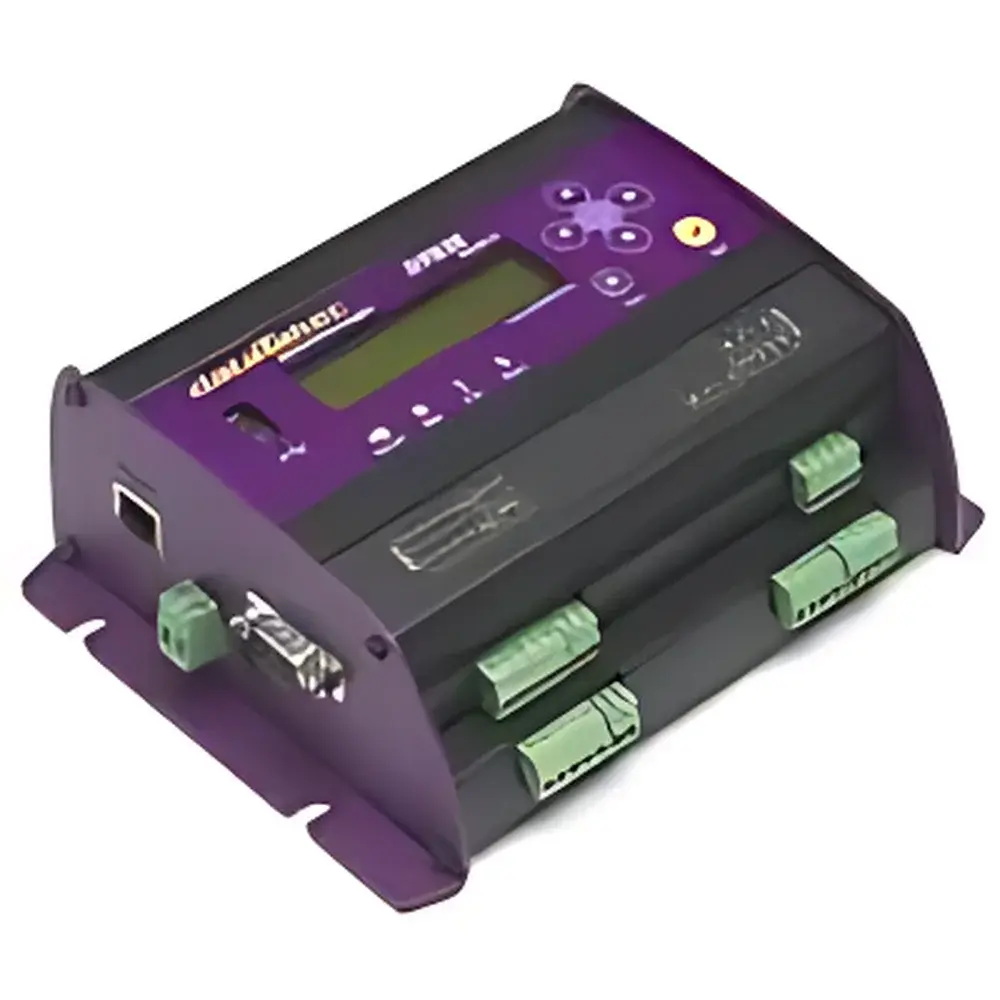
DataTaker DT82e Intelligent Data Acquisition Unit
| Origin | Australia |
|---|---|
| Manufacturer Type | Authorized Distributor |
| Origin Category | Imported |
| Model | DT82e |
| Pricing | Upon Request |
Overview
The DataTaker DT82e Intelligent Data Acquisition Unit is a rugged, low-power, field-deployable data logger engineered for long-term, unattended environmental and industrial monitoring applications. Built on a deterministic real-time architecture, the DT82e acquires, processes, and transmits measurement data using synchronized sampling across multiple input types—including analog voltage, current (4–20 mA), resistance, thermistor/RTD temperature, strain gauge bridges, frequency, pulse count, and serial digital sensors. Its core measurement engine implements 18-bit analog-to-digital conversion with programmable gain and anti-aliasing filtering, ensuring high-resolution acquisition even under variable signal conditions. Designed for deployment in remote or harsh environments—from alpine meteorological stations to underground geotechnical arrays—the DT82e operates reliably across –25 °C to +70 °C and meets IEC 60529 IP67 ingress protection when housed in its optional enclosure. Its dual-channel isolation architecture provides galvanic separation between groups of analog inputs, eliminating ground loops and enabling safe simultaneous measurement of referenced and floating signals—critical for mixed-sensor deployments involving both earth-referenced soil moisture probes and isolated industrial transmitters.
Key Features
- Dual-channel isolated analog input architecture supporting up to six ±30 V differential or single-ended analog inputs (configurable as 4 isolated + 2 referenced, or 6 referenced)
- One SDI-12 sensor port supporting daisy-chained networks of up to 10 compliant environmental sensors (e.g., Campbell Scientific, Decagon, METER Group)
- Eight flexible digital I/O channels—programmable as inputs (with edge-triggered counting), outputs (open-collector or CMOS), or bidirectional pulse-width modulated (PWM) sources
- Integrated 10/100BASE-T Ethernet interface with full TCP/IP stack, supporting HTTP, FTP, SMTP, Modbus TCP, and SNMP v2c/v3
- USB 2.0 host port for direct connection to flash drives—enabling local firmware updates, configuration import/export, and manual data retrieval without host software
- Onboard monochrome LCD display with backlight and four-button navigation for local setup, real-time value viewing, and alarm status verification
- Configurable memory management: user-defined allocation of internal non-volatile flash (standard 100,000 records, expandable via microSD card up to 32 GB)
- Programmable data logging intervals from 100 ms to 999 days; event-triggered logging based on threshold crossings, digital state changes, or external interrupts
Sample Compatibility & Compliance
The DT82e supports a broad spectrum of sensor technologies common in environmental science, civil infrastructure, and process monitoring. Analog inputs accommodate standard industrial signal types including 0–5 V, 0–10 V, ±5 V, ±10 V, 4–20 mA (with internal 250 Ω shunt), PT100/PT1000 RTDs (2-/3-/4-wire), thermistors (NTC/PTC), full/half-bridge strain gauges, and frequency/pulse sources (0.1 Hz to 100 kHz). Its SDI-12 interface complies fully with SDI-12 Version 1.3 specification, enabling interoperability with certified hydrological, meteorological, and soil physics sensors. The unit conforms to IEC 61000-4 electromagnetic compatibility standards (including ESD, EFT, surge immunity), RoHS 2011/65/EU, and WEEE directives. While not certified for SIL or ATEX use, its isolation design and operating temperature range align with typical requirements for Class I, Division 2 hazardous locations when installed per NEC Article 500 guidelines.
Software & Data Management
Configuration, calibration, and data retrieval are managed through DataTaker’s free, cross-platform DeLogger software (Windows/macOS/Linux), which provides graphical scripting (DTL language), real-time plotting, statistical post-processing, and report generation in CSV, Excel, PDF, or XML formats. All configuration files and logged datasets include embedded metadata (sensor IDs, units, scaling equations, timestamps with UTC synchronization via NTP), ensuring traceability per ISO/IEC 17025 and GLP principles. FTP auto-upload supports scheduled transfers, incremental sync, and failover to USB backup upon network loss. Web server functionality enables secure browser-based access (HTTPS optional with TLS 1.2) to live values, historical trends, and device status—fully compatible with modern IT security policies. Audit trails for configuration changes and data exports are maintained locally and exportable for regulatory review (aligned with FDA 21 CFR Part 11 Annex 11 expectations for electronic records).
Applications
The DT82e serves as the central acquisition node in distributed monitoring systems across disciplines: continuous rainfall-runoff modeling in watershed hydrology; multi-parameter air quality stations measuring PM₂.₅, NO₂, O₃, and humidity; structural health monitoring of bridges and dams via strain, tilt, and crack-width sensors; precision irrigation control using soil water potential and volumetric water content arrays; and long-term permafrost or landslide deformation studies integrating inclinometers, piezometers, and temperature profiles. Its low power consumption (<15 mA @ 12 V during sleep, <80 mA during active logging) makes it ideal for solar-battery deployments exceeding 12 months without maintenance.
FAQ
Does the DT82e support Modbus RTU over RS-485?
Yes—it features a configurable RS-232/RS-485 serial port that can operate as a Modbus RTU master or slave, enabling integration with PLCs, SCADA gateways, and legacy industrial controllers.
Can I perform linearization or polynomial correction on sensor inputs?
Yes—DeLogger allows definition of custom scaling equations (linear, quadratic, cubic, or lookup table) applied in real time prior to storage, with coefficients stored in non-volatile memory.
Is firmware upgrade possible in the field without a PC?
Yes—firmware updates can be loaded directly from a FAT32-formatted USB flash drive connected to the onboard USB host port.
What is the maximum sampling rate for high-speed pulse counting?
The digital channels support hardware-accelerated counting at up to 100 kHz, with timestamp resolution of 10 µs, suitable for turbine flow meter or tachometer applications.
How does the DT82e handle time synchronization in remote deployments?
It supports NTP over Ethernet or PPPoE, GPS PPS input for sub-millisecond accuracy, and manual UTC offset configuration—ensuring consistent temporal alignment across geographically dispersed nodes.