
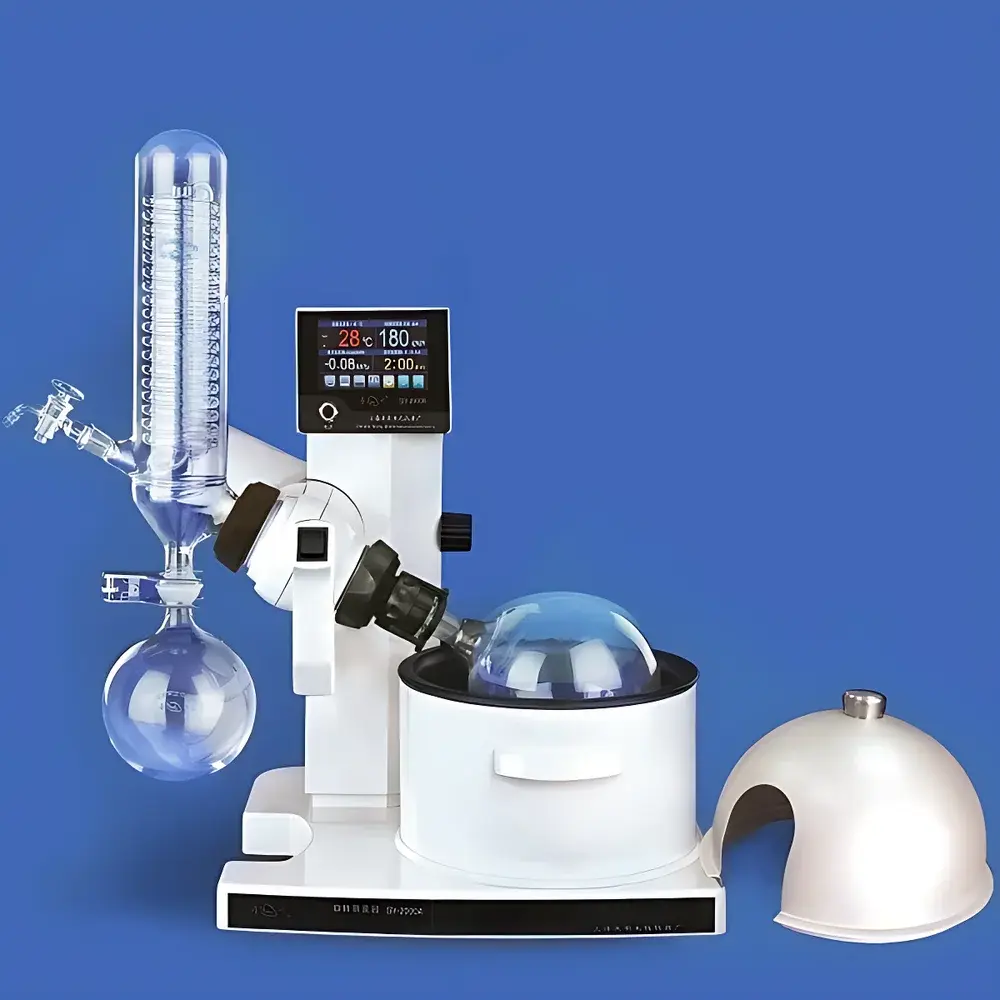
Shanghai Yarong SY-2000A Rotary Evaporator
| Brand | Shanghai Yarong |
|---|---|
| Model | SY-2000A |
| Evaporation Flask Capacity | 50–2000 mL |
| Vacuum Range | −0.01 to −0.095 MPa (built-in vacuum controller, accuracy ±0.2–0.5%) |
| Rotation Speed | 0–200 rpm with forward/reverse switching |
| Temperature Control | PID-controlled heating bath, LED digital display, ambient to 180 °C |
| Temperature Accuracy | ±1 °C (water bath), ±2 °C (oil bath) |
| Condenser Type | Dual-path spherical joint reflux condenser |
| Condensing Area | 0.15 m² |
Overview
The Shanghai Yarong SY-2000A Rotary Evaporator is a precision-engineered laboratory instrument designed for efficient solvent removal, concentration, and gentle sample recovery under reduced pressure. Operating on the principle of rotary evaporation—where simultaneous rotation, controlled heating, and vacuum application lower the boiling point of solvents—the SY-2000A enables rapid, reproducible, and scalable purification across organic synthesis, natural product isolation, pharmaceutical development, and analytical sample preparation workflows. Its modular architecture integrates a high-torque motor-driven rotation system, a dual-mode heating bath (water or oil compatible), an integrated vacuum regulation module, and a large-surface-area spherical-joint condenser to maximize vapor capture efficiency and minimize bumping or foaming risks.
Key Features
- Wide flask compatibility: Accommodates standard ground-glass flasks from 50 mL to 2000 mL, supporting both small-scale screening and preparative-scale processing.
- Precision vacuum control: Built-in vacuum regulator with adjustable setpoint range from −0.01 MPa to −0.095 MPa; typical accuracy within ±0.2–0.5% of full scale ensures consistent distillation kinetics and solvent recovery yield.
- Bi-directional variable-speed drive: 0–200 rpm digitally controlled rotation with forward/reverse switching—optimized for viscous samples, crystallization-prone mixtures, or emulsion stabilization during evaporation.
- PID temperature management: Microprocessor-based PID algorithm delivers stable thermal output across ambient to 180 °C; LED-display interface provides real-time bath temperature readout and setpoint adjustment.
- High-efficiency condensation: Spherical-joint dual-path reflux condenser with 0.15 m² effective cooling surface area ensures near-complete vapor recondensation—even under high-throughput or low-boiling solvent conditions (e.g., diethyl ether, dichloromethane, ethyl acetate).
- Ergonomic vertical lift mechanism: Motor-assisted or manual升降 (depending on configuration) with smooth, repeatable positioning; designed for safe, one-handed flask attachment/detachment without thermal exposure.
Sample Compatibility & Compliance
The SY-2000A is compatible with a broad spectrum of thermally labile and heat-stable compounds—including APIs, polymers, lipids, alkaloids, and synthetic intermediates—provided operating parameters remain within established safety thresholds. Its construction meets general laboratory equipment safety standards per IEC 61010-1 (Electrical Safety for Laboratory Equipment). While not certified for GMP production environments, the unit supports GLP-aligned documentation practices when paired with external loggers or audit-trail-capable data acquisition systems. Vacuum and temperature stability facilitate compliance with common method validation requirements in ASTM D86, ISO 6617, and USP for solvent residue analysis.
Software & Data Management
The SY-2000A operates as a standalone analog-digital hybrid instrument with no embedded software stack or network interface. All operational parameters—temperature setpoint, rotation speed, and vacuum level—are manually configured via front-panel controls and displayed on the integrated LED screen. For traceable process recording, users may integrate external USB data loggers or RS-485-compatible controllers (e.g., Omega CNi3240 or LabVIEW-compatible DAQ modules) to capture time-stamped bath temperature, rotational RPM, and vacuum pressure at user-defined intervals. This configuration satisfies basic 21 CFR Part 11 readiness when combined with validated electronic lab notebook (ELN) systems that enforce user authentication and audit trails.
Applications
- Solvent removal from reaction mixtures post-catalytic hydrogenation or Grignard addition
- Concentration of crude plant extracts prior to HPLC fractionation or TLC analysis
- Recovery and recycling of high-purity solvents in QC laboratories
- Lyophilization pre-concentration steps for protein or peptide samples
- Removal of low-boiling azeotropes in multi-step synthetic sequences
- Preparation of thin films or polymer solutions requiring precise solids content control
FAQ
What is the maximum recommended operating temperature for oil baths?
The SY-2000A supports oil bath operation up to 180 °C; however, sustained use above 150 °C requires silicone-based or high-thermal-stability heat transfer fluids (e.g., Dow Corning PM-1000) and strict adherence to manufacturer-recommended oil change intervals.
Can the condenser be cooled with dry ice/acetone or chilled glycol?
Yes—the condenser accepts standard circulating chiller input (6–10 mm ID tubing); minimum coolant temperature should not fall below −20 °C to prevent freezing of residual moisture or solvent condensate in the jacket.
Is the vacuum controller compatible with external vacuum pumps?
The built-in controller functions as a proportional valve actuator and is fully compatible with diaphragm, scroll, or oil-sealed rotary vane pumps; it does not replace the pump but regulates inlet pressure downstream of the pump’s output.
Does the unit include a vacuum trap or anti-bumping device?
No—these are optional accessories. A glass or PTFE-coated vacuum trap is strongly recommended when evaporating corrosive or particulate-laden solvents to protect both the pump and controller.
What maintenance intervals are advised for long-term reliability?
Daily: Inspect ground-glass joints for grease integrity and condenser coolant flow. Weekly: Verify vacuum seal integrity and clean bath chamber. Annually: Calibrate temperature sensor against NIST-traceable reference and inspect motor brushes if applicable.
Related Products



