
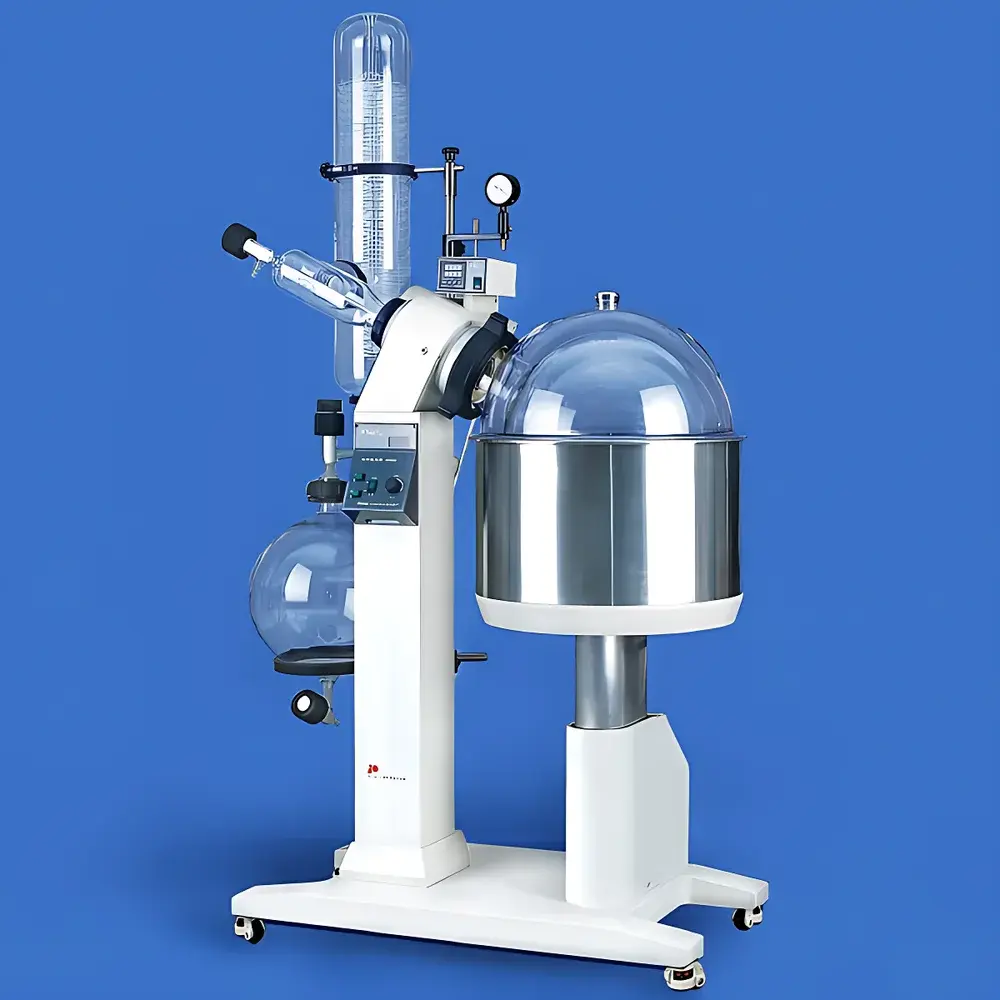
Shanghai Yarong RE-5220 Rotary Evaporator
| Brand | Jinye |
|---|---|
| Origin | Shanghai, China |
| Manufacturer Type | Direct Manufacturer |
| Country of Origin | China |
| Model | RE-5220 |
| Capacity | 20 L |
| Ultimate Vacuum Range | –0.01 to –0.095 MPa (accuracy ±0.2–0.5%) |
| Rotation Speed | 0–120 rpm |
| Temperature Control Range | Ambient to 99 °C (PID digital control with LED display) |
| Temperature Control Accuracy | ±1 °C |
| Condenser Cooling Area | 2.2 m² |
Overview
The Shanghai Yarong RE-5220 Rotary Evaporator is a high-capacity, industrial-grade benchtop system engineered for scalable solvent removal, concentration, and purification in pilot-scale laboratory environments. It operates on the principle of reduced-pressure distillation: by rotating a flask under controlled vacuum and gentle heating, the effective surface area of the liquid film increases while its boiling point decreases—enabling efficient, low-temperature evaporation of heat-sensitive compounds. Designed for reproducible operation across extended duty cycles, the RE-5220 integrates robust mechanical architecture with precise digital process control, making it suitable for applications demanding consistent throughput and thermal stability—including biopharmaceutical intermediate processing, fine chemical synthesis, and natural product isolation.
Key Features
- 20 L evaporation capacity with dual-flask compatibility (standard 20 L receiving flask + optional large-diameter evaporation flask), supporting batch-to-batch continuity in pilot production workflows.
- Variable-frequency drive (VFD) motor enabling smooth, stepless speed regulation from 0 to 120 rpm; rotation speed displayed digitally with real-time feedback for process documentation.
- PID-controlled water bath heater with digital LED interface; temperature setpoint range spans ambient to 99 °C with ±1 °C accuracy at steady state—critical for maintaining compound integrity during thermolabile separations.
- Motorized vertical lift mechanism for automatic water bath elevation (up to 120 mm travel), facilitating safe, repeatable flask engagement and disengagement without manual repositioning.
- High-efficiency vertical condenser with 2.2 m² active cooling surface area, optimized for rapid vapor condensation across diverse solvent polarities (e.g., ethanol, acetone, ethyl acetate, dichloromethane).
- Vacuum control via integrated pressure sensor and proportional valve; programmable vacuum setpoints between –0.01 and –0.095 MPa with measurement repeatability within ±0.2–0.5% of full scale.
- Continuous feed and discharge ports compatible with external peristaltic pumps or gravity-fed inlet lines—enabling semi-continuous operation for multi-liter batch processing.
Sample Compatibility & Compliance
The RE-5220 accommodates a broad spectrum of sample matrices, including aqueous, organic, and mixed-solvent systems commonly encountered in API purification, botanical extract concentration, and polymer solution processing. Its borosilicate glass components (flasks, condenser, vapor duct) comply with ISO 3585 specifications for hydrolytic resistance and thermal shock tolerance. All electrical subsystems meet IEC 61010-1 safety standards for laboratory equipment. While not certified for GMP manufacturing environments out-of-the-box, the system supports GLP-compliant documentation when paired with validated external data loggers and audit-trail-enabled software (see Software & Data Management). Vacuum and temperature profiles can be aligned with ASTM E2912 (Standard Guide for Selection of Solvent Removal Methods) and USP guidelines for method suitability assessment.
Software & Data Management
The RE-5220 operates as a standalone instrument with embedded microcontroller-based logic; no proprietary software is required for basic operation. However, analog output signals (0–10 V DC) are provided for rotation speed, bath temperature, and vacuum pressure—enabling integration into centralized SCADA or LIMS platforms via standard analog-to-digital converters. For regulatory traceability, users may connect third-party compliant data acquisition systems that support 21 CFR Part 11 electronic signatures, audit trails, and user-access-level controls. Optional RS-485 Modbus RTU communication enables remote parameter monitoring and limited setpoint adjustment in networked lab infrastructures.
Applications
- Biopharmaceutical process development: concentration of monoclonal antibody harvests, buffer exchange of protein formulations, and removal of residual solvents post-extraction.
- Fine chemical manufacturing: solvent recovery from reaction mixtures, isolation of chiral intermediates, and crystallization seed preparation via controlled supersaturation.
- Natural products laboratories: large-volume extraction concentrate reduction (e.g., ethanol tinctures, CO₂ supercritical extracts), essential oil fractionation, and polysaccharide precipitation.
- Academic and contract research organizations: scalable method transfer from 1 L to 20 L evaporation volumes, supporting DOE-driven optimization of evaporation rate vs. degradation kinetics.
- Quality control labs: standardized residual solvent testing per ICH Q3C guidelines using validated evaporation protocols.
FAQ
What is the maximum recommended working volume for continuous operation?
For optimal film formation and condensation efficiency, the 20 L receiving flask is rated for up to 15 L of liquid load during sustained operation at 60–90 rpm and ≤85 °C bath temperature.
Is the water bath compatible with silicone oil or other high-boiling-point heating media?
Yes—the stainless steel water bath chamber accepts silicone oil (up to 200 °C flash point) when used with appropriate temperature sensor calibration; however, factory PID tuning is optimized for aqueous media.
Can the RE-5220 be integrated with an inert gas purging system?
Yes—dedicated gas inlet/outlet ports (1/4″ NPT) are provided on the main condenser head for nitrogen or argon blanketing during oxygen-sensitive evaporations.
Does the unit include vacuum pump and chiller?
No—vacuum source and coolant circulation system must be selected and configured separately based on solvent vapor pressure and ambient lab conditions.
What maintenance intervals are recommended for long-term reliability?
Bearing lubrication every 500 operating hours; silicone vacuum tubing replacement every 12 months; condenser cleaning with dilute nitric acid (10% v/v) after each use with high-boiling-point solvents.
Related Products



