
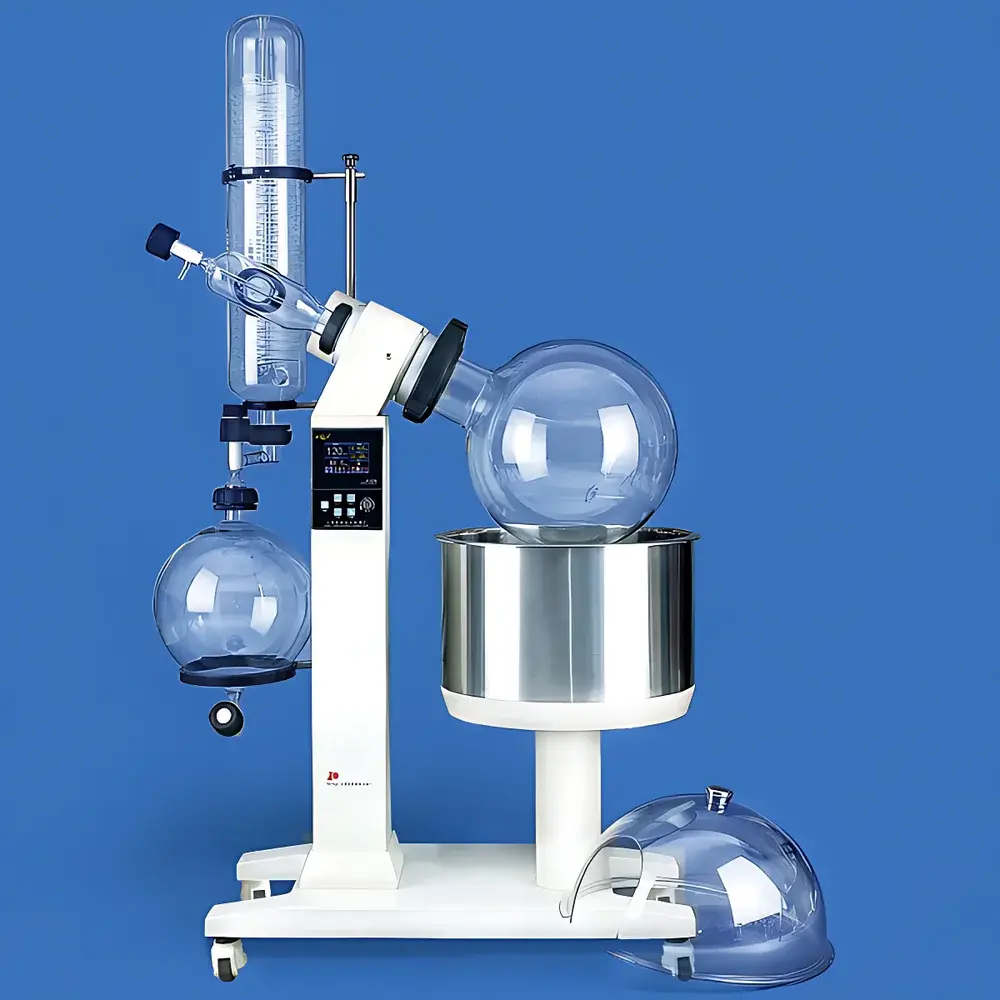
Shanghai Yarong RE-5220A Rotary Evaporator
| Brand | Shanghai Yarong |
|---|---|
| Capacity | 20 L |
| Ultimate Vacuum Range | –0.01 to –0.095 MPa (accuracy: ±0.2–0.5% of setpoint) |
| Rotational Speed | 0–120 rpm (bidirectional, programmable rotation direction and dwell time) |
| Bath Temperature Control | PID-regulated, digital display, ambient to 99 °C (accuracy: ±1 °C) |
| Cooling Surface Area | 2.2 m² |
| Integrated Vacuum Controller | Built-in, pressure-setpoint programmable with real-time digital feedback |
| Drive System | Frequency-converter controlled motor |
| Features | LCD color touchscreen interface, automatic bath lift, continuous feed & discharge ports, timer-based operation scheduling |
Overview
The Shanghai Yarong RE-5220A Rotary Evaporator is an engineered solution for scalable solvent removal, concentration, and purification under reduced pressure in laboratory and pilot-scale environments. Based on the fundamental principle of rotary evaporation—where a rotating flask increases surface area while lowering boiling point via vacuum application—the RE-5220A integrates precise thermal, rotational, and vacuum control to ensure reproducible mass transfer kinetics. Its 20 L evaporation capacity supports transition from benchtop development to early-stage process validation, particularly where thermal sensitivity, batch consistency, or solvent recovery efficiency are critical. Designed for compatibility with standard ISO 8573-compliant vacuum sources and condensate collection systems, the unit operates within defined safety margins for volatile organic solvents (e.g., ethanol, acetone, ethyl acetate) and aqueous matrices across pharmaceutical, fine chemical, and natural product extraction workflows.
Key Features
- Integrated digital vacuum controller with programmable setpoint ranging from –0.01 to –0.095 MPa; real-time pressure monitoring and closed-loop regulation ensure stable distillation conditions.
- Bidirectional rotation capability with independently configurable forward/reverse timing sequences—enabling optimized film formation for viscous or foaming samples.
- Frequency-converter-driven motor delivering smooth, low-vibration speed control from 0 to 120 rpm with digital tachometric feedback.
- PID-regulated water/oil bath system featuring digital temperature display and ±1 °C thermal accuracy across ambient to 99 °C range; auto-lift mechanism synchronizes bath position with flask immersion depth.
- 2.2 m² high-efficiency vertical condenser surface area, constructed from borosilicate glass and stainless-steel jacketing, optimized for rapid vapor condensation and minimal hold-up volume.
- Full-color LCD touchscreen interface supporting multi-step protocol storage, time-stamped operation logging, and parameter recall—designed for traceable, repeatable execution per SOP requirements.
Sample Compatibility & Compliance
The RE-5220A accommodates standard 20 L round-bottom flasks (ISO 22610 compliant neck geometry), as well as optional adapters for fractional distillation or continuous feed configurations. Its construction adheres to IEC 61010-1 safety standards for laboratory electrical equipment, with CE marking confirming conformity with EU Low Voltage and EMC directives. While not certified for GMP manufacturing use out-of-the-box, its programmable parameters, audit-trail-capable interface, and stable thermal/vacuum performance support alignment with GLP documentation practices and FDA 21 CFR Part 11 data integrity expectations when deployed with validated software protocols. All wetted parts are chemically resistant to common organic solvents and mild aqueous bases/acids per ASTM D543 testing guidelines.
Software & Data Management
The embedded control firmware records operational metadata—including timestamped vacuum setpoints, actual bath temperature, rotational speed, and cycle duration—for each run. Data export is supported via USB interface in CSV format, enabling integration with LIMS or electronic lab notebook (ELN) platforms. No cloud connectivity or remote access functionality is included; all data remains local to preserve network security and regulatory compliance in controlled environments. The system supports up to 99 user-defined methods, each with independent vacuum ramp profiles, rotation sequencing, and temperature hold steps—facilitating method transfer between development and quality control laboratories.
Applications
- Pharmaceutical process development: Solvent exchange during API intermediate purification, lyophilization pre-concentration, and extractive workup of botanical actives.
- Fine chemical synthesis: Removal of low-boiling solvents post-reaction (e.g., THF, dichloromethane), concentration of catalytic reaction mixtures, and isolation of thermolabile intermediates.
- Food & flavor chemistry: Gentle concentration of volatile aroma fractions, ethanol reduction in botanical infusions, and recovery of heat-sensitive essential oils.
- Academic research: Teaching instrumentation principles of phase equilibria and mass transfer; supporting graduate-level projects in green chemistry solvent optimization.
FAQ
What vacuum source is recommended for optimal performance with the RE-5220A?
A two-stage oil-sealed rotary vane pump capable of achieving ≤0.005 MPa absolute pressure is recommended; diaphragm pumps may be used for less demanding applications but will limit ultimate vacuum range.
Can the RE-5220A operate continuously for extended periods (e.g., >8 hours)?
Yes—its industrial-grade motor, sealed bearing assembly, and thermal overload protection enable unattended operation within specified ambient temperature (15–30 °C) and humidity (<70% RH) limits.
Is the water bath compatible with silicone oil or other heating media?
Yes; the bath chamber accepts any non-corrosive, thermally stable liquid medium with viscosity suitable for circulation at operating temperatures up to 99 °C.
Does the unit include a chiller interface for condenser cooling?
No; external recirculating chillers must be connected manually to the condenser inlet/outlet ports using standard 10 mm ID tubing.
How is calibration verified for temperature and vacuum sensors?
Temperature sensor calibration is performed using NIST-traceable PT100 reference probes; vacuum transducer verification requires a calibrated digital manometer meeting ISO 5725 accuracy criteria.



