
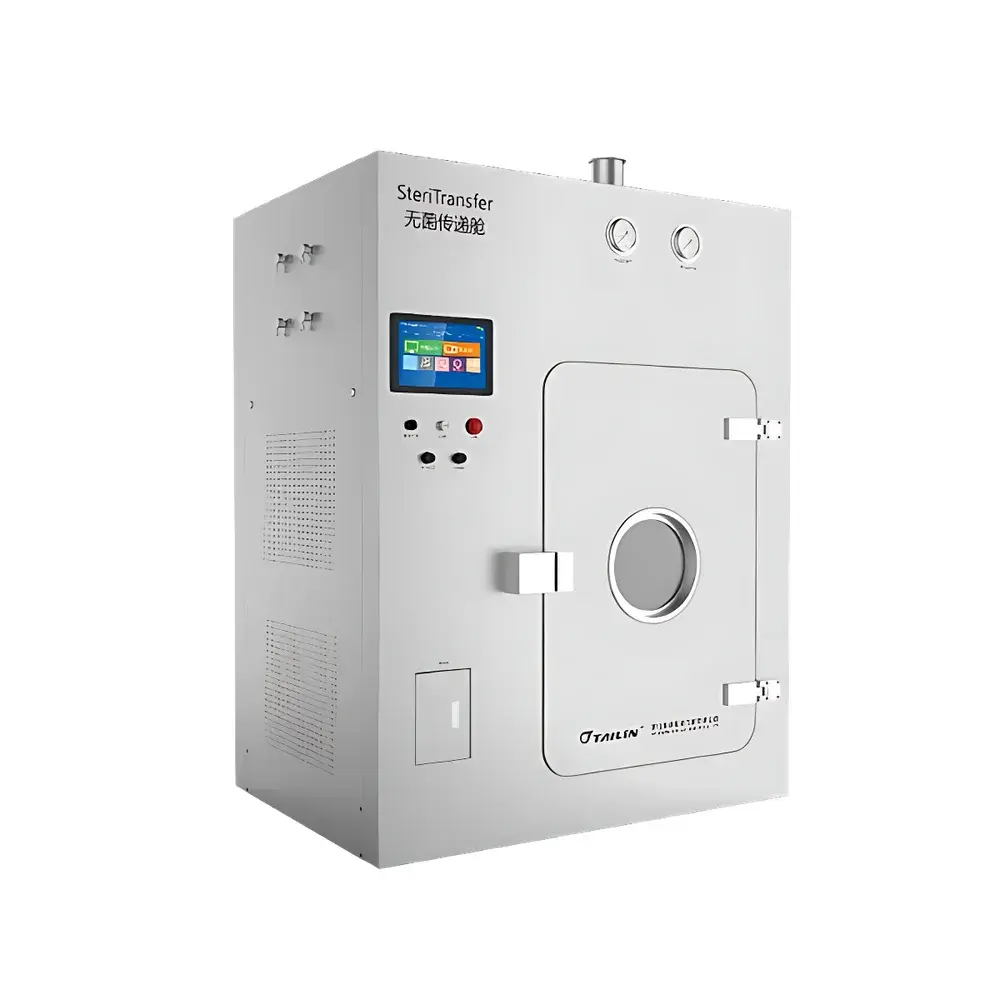
Tailin STP Series Sterile Transfer Pass-Through Chamber
| Brand | Tailin |
|---|---|
| Origin | Zhejiang, China |
| Manufacturer Type | OEM Manufacturer |
| Regional Category | Domestic (China) |
| Model | STP |
| Pricing | Upon Request |
Overview
The Tailin STP Series Sterile Transfer Pass-Through Chamber is an engineered solution for controlled, aseptic material transfer between classified cleanroom environments—specifically designed to bridge non-sterile (e.g., C/D grade) and critical sterile zones (ISO Class 5 / A/B-grade). It operates on the principle of vaporized hydrogen peroxide (VHP®-compatible VHPS™ technology) bio-decontamination under ambient temperature and atmospheric pressure conditions. Unlike thermal sterilization methods, this low-temperature process preserves heat-sensitive materials—including active pharmaceutical ingredients (APIs), pre-sterilized tools, vials, syringes, filters, and diagnostic components—without compromising integrity or functionality. The chamber integrates a built-in VHPS generator and Siemens S7-1200 PLC-based control architecture, enabling fully automated, unattended decontamination cycles with deterministic log6 microbial reduction across surfaces and internal air volume. Its design complies with core principles of Annex 1 (2022 revision) to EU GMP, USP , and ISO 14644-1 for cleanroom classification integrity.
Key Features
- Integrated VHPS™ (Vaporized Hydrogen Peroxide Sterilization) system delivering ≥6-log10 reduction of Geobacillus stearothermophilus spores on stainless-steel surfaces and chamber air phase;
- Dual interlocked, pneumatically actuated stainless-steel doors with tempered glass viewing panels and positive-pressure air sealing—ensuring visual monitoring without compromising containment;
- H14-class HEPA filtration (≥99.995% @ 0.1 µm) on all incoming and recirculated airflow paths during both decontamination and aeration phases;
- Real-time environmental monitoring of internal temperature (±0.5 °C), relative humidity (±3% RH), and differential pressure (±1 Pa) via calibrated digital sensors;
- PLC-driven cycle sequencing with configurable parameters (VHP concentration, exposure time, aeration duration, dwell steps), full audit trail, and electronic signature support per FDA 21 CFR Part 11 requirements;
- Pre-validated DQ/IQ/OQ/PQ documentation package available; on-site qualification support provided by certified validation engineers.
Sample Compatibility & Compliance
The STP chamber accommodates standard pharmaceutical transfer payloads: stainless-steel tool trays (up to 600 × 400 × 300 mm), nested aluminum carriers, Tyvek-wrapped components, and pre-filled glass vials. It is compatible with common cleanroom-compatible packaging materials including gamma-irradiated polyethylene bags, medical-grade pouches, and rigid plastic containers. All wetted parts are electropolished 316L stainless steel (Ra ≤ 0.4 µm); gaskets meet USP Class VI biocompatibility standards. The system conforms to ISO 14644-3:2019 (cleanroom testing), EN 17172:2020 (VHP safety), and supports compliance with EU GMP Annex 1 (2022), PIC/S PI 032-2, and WHO TRS 986 Annex 2 for aseptic processing isolators.
Software & Data Management
The embedded Siemens HMI interface provides intuitive cycle setup, real-time graphical trend display (T/RH/ΔP/VHP ppm), and exportable CSV logs timestamped to UTC. All operational data—including sensor readings, alarm events, door status, and cycle step progression—are stored locally with 12-month retention. Optional Ethernet/IP or OPC UA connectivity enables integration into MES/SCADA platforms. Electronic records include user ID, timestamp, parameter set version, and digital signature fields—fully traceable and compliant with ALCOA+ (Attributable, Legible, Contemporaneous, Original, Accurate, Complete, Consistent, Enduring, Available) data integrity principles.
Applications
- Transfer of raw materials, excipients, and APIs from non-sterile storage into B-grade background areas prior to aseptic filling;
- Introduction of pre-sterilized equipment (e.g., filling nozzles, stopper bowls, crimping heads) into A/B-grade isolator interfaces;
- Pass-through of environmental monitoring swabs, contact plates, and media-filled units for sterility testing preparation;
- Decontamination of maintenance tools entering Grade A laminar flow hoods or RABS enclosures;
- Supporting closed-system manufacturing workflows in cell and gene therapy (CGT) facilities where pyrogen-free, low-residue transfer is essential.
FAQ
What is the typical VHP exposure concentration range supported by the STP system?
Standard operation uses 100–300 ppm VHPS at 25–40% RH; precise setpoints are programmable based on load configuration and bioburden profile.
Does the STP chamber support remote monitoring or integration with facility SCADA?
Yes—via optional Modbus TCP or OPC UA protocol; HMI also supports web-based visualization through secure HTTPS access.
Can the system be validated for specific microorganisms other than Geobacillus stearothermophilus?
Yes—custom biological indicator (BI) challenge studies (e.g., Bacillus atrophaeus, Aspergillus niger) can be executed during PQ with client-defined acceptance criteria.
Is the chamber suitable for use in facilities operating under FDA 21 CFR Part 11 compliance?
Yes—the system includes role-based access control, electronic signatures, audit trail logging, and data encryption features aligned with Part 11 Subpart B requirements.
What is the maximum recommended load volume for optimal decontamination uniformity?
Maximum effective payload is 85% of internal chamber volume (e.g., 320 L chamber → ≤272 L occupied volume) to ensure consistent VHP distribution and condensation control.





