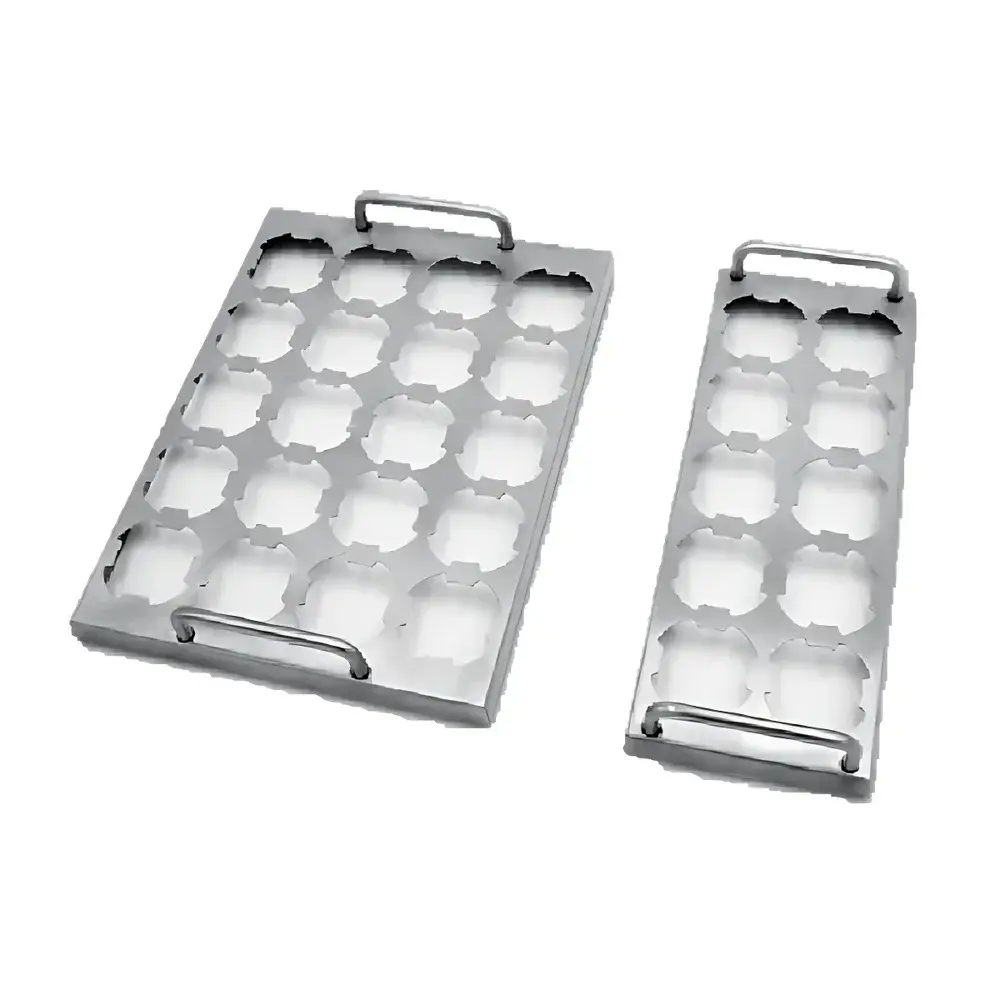
Tailin Biotech Culture Vessel Holder
| Brand | Tailin Biotech |
|---|---|
| Origin | Zhejiang, China |
| Manufacturer Type | Direct Manufacturer |
| Country of Origin | China |
| Model | Culture Vessel Holder |
| Price | USD 0.12 (FOB) |
| Material | ASTM F138-certified 316L stainless steel |
| Dimensions (10-position) | 315 × 120 × 20 mm (H) / 50 mm (stacking height) |
| Dimensions (20-position) | 315 × 230 × 20 mm (H) / 50 mm (stacking height) |
| Stackable | Yes |
| Handle | Integrated ergonomic stainless-steel handle |
| Compliance | Designed for ISO 13408-1 sterile processing environments and USP <71> sterility testing workflows |
Overview
The Tailin Biotech Culture Vessel Holder is an engineered accessory designed exclusively for integration into membrane filtration-based sterility testing systems—specifically those compliant with USP , Ph. Eur. 2.6.1, and ISO 13408-1 standards. It functions as a precision-machined support platform for standard 50 mL or 100 mL sterile culture vessels (e.g., Millipore Steritest™, Sartorius Minisart™, or equivalent filter housings) during incubation post-filtration. Unlike generic lab racks, this holder employs a fixed-hole geometry calibrated to maintain consistent vessel alignment, vertical orientation, and thermal contact uniformity across all positions—critical parameters for minimizing thermal gradient-induced growth artifacts in aerobic/anaerobic incubators. Its passive thermal management architecture leverages high-conductivity 316L stainless steel (ASTM F138 certified for implantable device-grade biocompatibility) to ensure rapid equilibration with incubator ambient conditions and eliminate localized condensation buildup beneath vessels.
Key Features
- Monolithic 316L stainless steel construction with electropolished surface finish (Ra ≤ 0.4 µm), ensuring non-porous, corrosion-resistant, and autoclavable (121°C, 30 min, saturated steam) durability for repeated use in Grade A/B cleanroom environments.
- Patented dual-diameter aperture design: each hole features a stepped inner profile—precision-machined to secure both 25 mm and 47 mm diameter filter assemblies without slippage or tilt, preserving membrane integrity and preventing seal failure during handling.
- Ergonomically integrated handle formed from the same 316L billet, enabling single-handed transfer between laminar flow hoods, isolators, and incubators without gloves slipping or vessel misalignment.
- Stackable modular footprint: standardized 50 mm vertical stacking height enables vertical consolidation of up to 6 tiers in standard 600 mm deep incubators—increasing throughput capacity by 300% per unit floor area without compromising airflow uniformity (validated per ISO 14644-1 Class 5 airflow mapping).
- No fasteners, welds, or adhesives: fully machined from solid stock to eliminate crevices where microbial ingress or biofilm formation could occur—meeting the design-for-cleanability requirements of EU GMP Annex 1 (2022) Section 8.32.
Sample Compatibility & Compliance
The holder accommodates industry-standard sterile culture vessels used in regulatory-compliant sterility testing, including but not limited to: Merck Millipore Steritest™ SQ, Sartorius Minisart™ NML, Pall Pallflex™ ELD, and Thermo Scientific Nalgene™ Rapid-Flow units. All apertures are dimensionally verified against ISO 8536-4 (infusion containers) and ISO 8536-5 (injection containers) reference gauges. The device itself carries no CE marking or FDA 510(k) clearance, as it is classified as a Class I non-invasive accessory under MDR 2017/745 Annex VIII and 21 CFR §862.2100—intended solely for mechanical support and thermal coupling, not direct patient contact or diagnostic interpretation. Documentation includes material traceability certificates (EN 10204 3.1), surface roughness test reports, and autoclave cycle validation summaries.
Software & Data Management
As a purely mechanical, non-electronic component, the Culture Vessel Holder requires no embedded firmware, drivers, or software integration. However, its dimensional consistency and repeatable positioning directly support ALCOA+ data integrity principles when used within validated sterility test workflows. When deployed alongside electronic incubators (e.g., Memmert INE series) or automated colony counters (e.g., ProtoCOL 3), the holder’s uniform vessel spacing ensures consistent imaging field-of-view registration and temperature logging correlation across batches. Full audit trail compatibility is maintained through standard operating procedures (SOPs) referencing its unique item code (TV-HLD-10 / TV-HLD-20) in equipment logs per FDA 21 CFR Part 11-compliant LIMS platforms.
Applications
- Sterility testing of parenteral drugs, ophthalmic solutions, and medical device extracts per USP and EP 2.6.1 protocols.
- Environmental monitoring sample incubation in pharmaceutical cleanrooms (ISO 14644-1 Class 5–8) where spatial efficiency and thermal homogeneity are critical.
- Validation studies requiring precise replicate positioning—e.g., comparative incubation trials assessing media performance or filter compatibility.
- GMP manufacturing support for batch release testing where equipment qualification (IQ/OQ/PQ) mandates documented mechanical stability and material compliance.
FAQ
Is this holder compatible with vacuum-assisted or pressure-driven filtration manifolds?
Yes—its open-bottom design allows unimpeded air evacuation and pressure equalization beneath vessels during filtration; no modification to manifold gasket interfaces is required.
Can it be used in CO₂ incubators without corrosion risk?
Yes—316L stainless steel exhibits full resistance to 5% CO₂ / 95% air humidified atmospheres at 37°C, per ASTM G31 immersion testing protocols.
Does the manufacturer provide calibration or metrology services?
No—dimensional verification is performed at time of manufacture using CMM (Zeiss CONTURA G2); end users may re-verify aperture diameters annually using grade AA plug gauges per ISO 19902.
What is the maximum recommended autoclave cycle count before replacement?
Based on accelerated aging per ASTM F1980, the holder maintains structural integrity for ≥500 cycles at 121°C; visual inspection for surface pitting or handle deformation is advised after 300 cycles.