
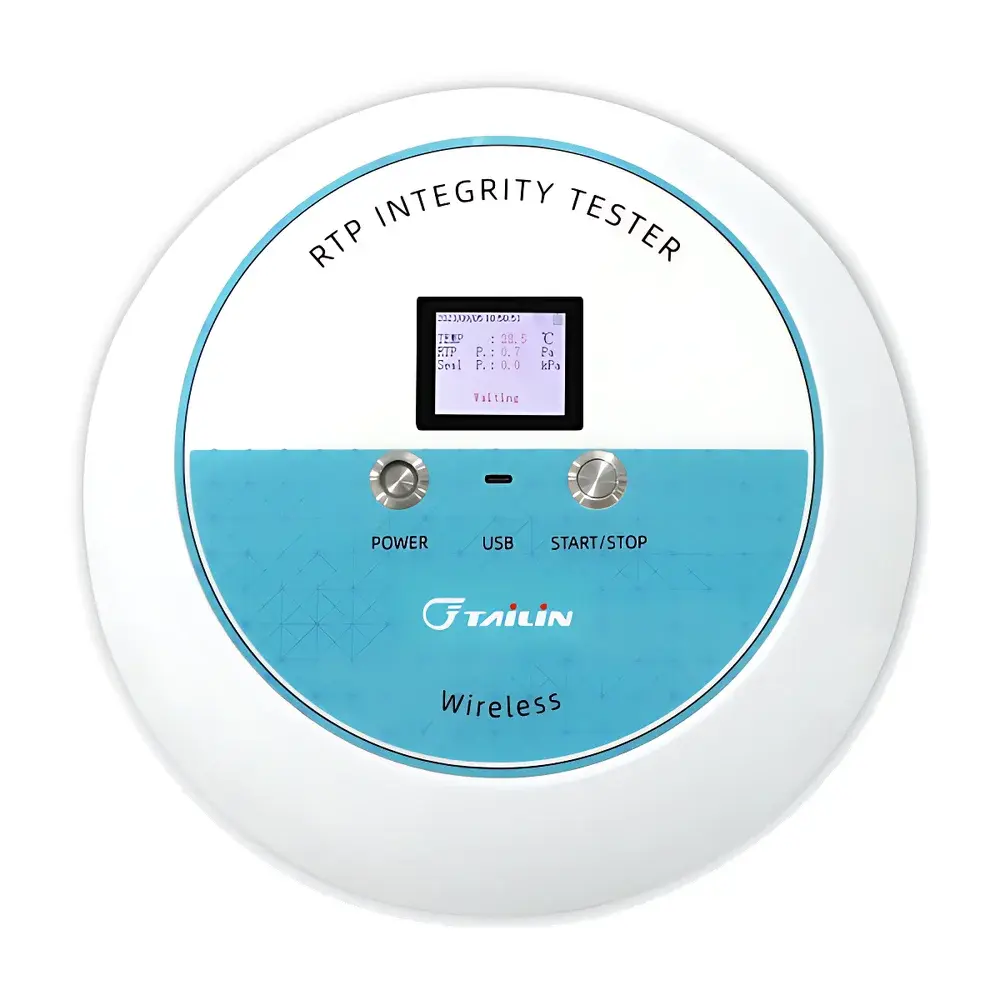
Tailin RTP Alpha/Beta Port Integrity Tester
| Brand | Tailin |
|---|---|
| Origin | Zhejiang, China |
| Manufacturer Type | Manufacturer |
| Product Category | Domestic |
| Model | RTP |
| Pricing | Upon Request |
Overview
The Tailin RTP Alpha/Beta Port Integrity Tester is a purpose-built, portable pressure decay integrity testing system engineered for the qualitative and quantitative assessment of sealed connections in Restricted Access Barrier Systems (RABS) and Isolator Rapid Transfer Ports (RTPs). It operates on the principle of controlled pressurization or evacuation of the RTP port cavity—either at the Alpha (operator-side) or Beta (process-side) interface—followed by high-resolution monitoring of pressure change over time. The instrument applies either positive or negative differential pressure (±4000 Pa) across the sealed interface and calculates the rate of pressure decay, which serves as an objective metric for detecting micro-leakage paths that compromise containment integrity. This method aligns with the fundamental physical basis of pressure hold/decay testing as defined in ISO 14644-7:2015, Annex B, and supports risk-based verification of barrier system performance during transfer operations in aseptic manufacturing environments.
Key Features
- Compact, handheld form factor with ergonomic design optimized for use inside Grade A/B cleanrooms—no external power supply required due to integrated rechargeable battery operation;
- Dual-mode pressure control: configurable for positive-pressure (inflation) or negative-pressure (vacuum) testing protocols;
- On-device digital differential pressure display with real-time visualization of test progress and decay curve;
- Wireless data transmission capability (Wi-Fi/Bluetooth) to PC-based analysis software—eliminates manual transcription and supports ALCOA+ data integrity principles;
- Customizable port adapters engineered to match OEM-specific Alpha and Beta port geometries—including flange dimensions, sealing surface profiles, and gasket compatibility;
- Automated sequence execution: fully manages seal ring inflation, system pressurization, stabilization, decay measurement, and pass/fail evaluation per user-defined acceptance criteria;
- Pre-loaded test method library with editable parameters (e.g., target pressure, stabilization time, decay duration, pass threshold) to support multiple RTP configurations and process requirements;
- Cleanroom-compatible housing: smooth, non-porous surfaces; IP54-rated enclosure; autoclavable or VHP-compatible components where applicable;
- FDA 21 CFR Part 11-compliant software architecture with electronic signatures, audit trail, role-based access control, and immutable record retention;
- Designed to support Installation Qualification (IQ), Operational Qualification (OQ), and Performance Qualification (PQ) documentation packages aligned with GMP Annex 1 and EU GMP Annex 15 expectations.
Sample Compatibility & Compliance
The tester is validated for use with standard RTP designs compliant with ISO 14644-7 and ASTM E2983-14 (Standard Practice for Leak Testing of Isolators and RABS). It accommodates both single-use and reusable RTP systems, including those with silicone, EPDM, or fluoropolymer sealing interfaces. All test procedures are repeatable, traceable, and reproducible under defined environmental conditions (temperature: 18–26°C; relative humidity: ≤60%). The system meets the regulatory expectations outlined in FDA Guidance for Industry: Sterile Drug Products Produced by Aseptic Processing (2004), EMA’s Annex 1 (2022 revision), and PIC/S PI 032-2 for computerized system validation. Calibration is performed against NIST-traceable pressure standards, and certificate of calibration is provided with each unit.
Software & Data Management
The embedded firmware and companion desktop application provide full lifecycle data management—from test initiation through reporting. Each test generates a timestamped, digitally signed PDF report containing raw pressure vs. time data, calculated decay rate (Pa/s), pass/fail status, operator ID, equipment ID, and environmental metadata. Audit trails log all user actions—including parameter changes, result overrides, and software updates—with immutable timestamps. Electronic signatures comply with 21 CFR Part 11 Subpart B requirements, including identity verification, intent confirmation, and linkage to associated records. Data export supports CSV, XML, and PDF formats for integration into LIMS or MES platforms. System validation documentation includes URS, FRS, DQ/IQ/OQ/PQ protocols, and risk assessments per ICH Q9.
Applications
- Pre-transfer verification of RTP integrity prior to material or component transfer between classified zones;
- Post-maintenance requalification of RTP seals following gasket replacement or port servicing;
- Periodic routine integrity checks as part of preventive maintenance programs;
- Supporting contamination control strategy (CCS) development and continuous improvement initiatives;
- Facilitating root cause analysis during investigations of potential bioburden excursions linked to barrier breaches;
- Enabling compliance with regulatory inspections requiring documented evidence of barrier system reliability.
FAQ
What pressure ranges does the RTP Integrity Tester support?
It delivers precise differential pressure control from –4000 Pa to +4000 Pa, covering the full operational envelope required for RTP integrity verification per ISO 14644-7.
Can the device be used inside a Grade A laminar airflow workstation?
Yes—the battery-powered design, absence of external cables, and smooth, non-shedding housing make it suitable for direct use within ISO Class 5 environments.
Is the software validated for GxP environments?
Yes—software qualification follows GAMP 5 principles and includes full 21 CFR Part 11 compliance, electronic signature functionality, and complete audit trail generation.
Does the system support IQ/OQ/PQ protocol execution?
Yes—predefined templates and configurable test sequences enable seamless execution of qualification protocols, with all outputs meeting ALCOA+ data integrity criteria.
How is calibration maintained and verified?
Calibration is performed using NIST-traceable reference instruments; users receive a calibration certificate valid for 12 months, with optional annual recalibration services available.






