
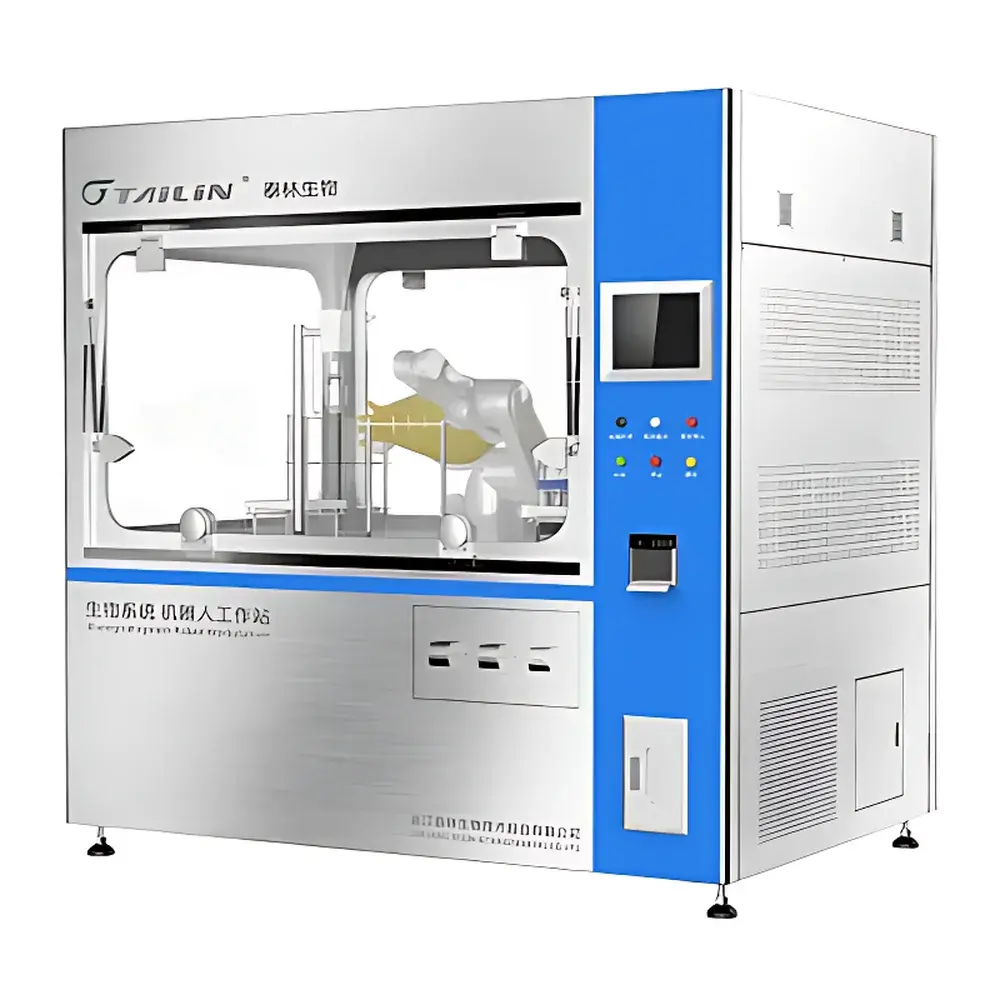
Tailin BioSystem Robotic Workstation – Sterile Isolator with VHPS® Decontamination and 6-Axis Robot
| Brand | Tailin |
|---|---|
| Origin | Zhejiang, China |
| Manufacturer Type | OEM Manufacturer |
| Regional Category | Domestic (China) |
| Model | Robotic Isolator |
| Price Range | USD 70,000 – 140,000 |
Overview
The Tailin BioSystem Robotic Workstation is an integrated sterile isolator platform engineered for high-containment, aseptic processing in life science and bioengineering applications. It operates on the principle of physical separation combined with dynamic environmental control—utilizing unidirectional laminar airflow (ISO Class 5 / A-grade air), vaporized hydrogen peroxide (VHP™/VHPS®) bio-decontamination, and fully automated robotic manipulation to eliminate human intervention from critical unit operations. Unlike conventional glovebox-style isolators, this system embeds a validated 6-axis industrial robot within a rigid, welded stainless-steel chamber designed to maintain positive pressure differentials and prevent ingress of ambient particulates or microorganisms. Its architecture complies with core regulatory expectations for aseptic processing environments as outlined in EU Annex 1 (2022), USP , and ISO 14644-1 Class 5, making it suitable for GMP-compliant cell therapy manufacturing, viral vector production, and handling of cytotoxic or sensitizing compounds.
Key Features
- Structural integrity: Rigid hard-wall isolator constructed from electropolished 316L stainless steel with welded seams and IP65-rated internal surfaces—resistant to VHPS® exposure, corrosion, and routine CIP/SIP protocols.
- VHPS® decontamination integration: Onboard VHPS® generator enables rapid (<60 min), residue-free, sporicidal bio-decontamination cycles validated per ISO 14644-3 and PDA TR#56, achieving ≥6-log reduction of Geobacillus stearothermophilus spores.
- Laminar airflow management: Dual-stage HEPA-filtered (H14, 99.995% @ 0.3 µm) supply air maintains uniform 0.45 m/s vertical laminar flow across the work area, ensuring continuous ISO Class 5 conditions during operation.
- Robotics subsystem: Custom-engineered 6-axis articulated robot with sealed joints, VHPS®-compatible lubricants, and non-shedding surface finish; repeatability ±0.05 mm; payload capacity up to 5 kg; fully programmable via ISO 20218-compliant motion control interface.
- Environmental monitoring suite: Integrated real-time sensors for particle count (0.3/0.5/5.0 µm), differential pressure (±0.1 Pa resolution), temperature (±0.2 °C), relative humidity (±2% RH), and H2O2 concentration (0–1000 ppm).
- Modular functional expansion: Pre-engineered mounting interfaces support seamless integration of centrifuges, bioreactor ports, liquid handlers, spectrophotometers, or cryo-transfer modules without compromising containment integrity.
Sample Compatibility & Compliance
The workstation accommodates standard aseptic containers—including T-flasks, bioreactor bags (up to 2 L), vials (2–50 mL), microtiter plates (96-/384-well), and custom-fit process vessels—via programmable end-effectors (gripper, pipetting, magnetic stirrer). All material contact surfaces comply with USP and cytotoxicity and extractables testing. The system supports qualification under GMP frameworks: IQ/OQ/PQ documentation packages are provided; audit trails meet FDA 21 CFR Part 11 requirements for electronic records and signatures; data integrity conforms to ALCOA+ principles. It is routinely deployed in facilities operating under EU GMP Annex 1 (sterile manufacture), ISO 13485 (medical device production), and CLIA-certified diagnostic development labs.
Software & Data Management
Control is managed through a validated Windows-based HMI with role-based access control (RBAC), encrypted local database (SQL Server Express), and optional OPC UA connectivity for MES/SCADA integration. The software logs all operational events—including robot trajectories, decon cycle parameters, environmental excursions, and user actions—with time-stamped, immutable records. Audit trail functionality includes automatic capture of operator ID, timestamp, action type, and pre-/post-values. Raw sensor data and robot position logs are exportable in CSV/Excel format compliant with 21 CFR Part 11 Annex B. Remote diagnostics and firmware updates are supported via secure TLS 1.2 tunneling; no cloud storage or external telemetry is enabled by default.
Applications
- Aseptic cell culture: Automated passaging, media exchange, and cryopreservation of primary cells, iPSCs, and CAR-T lines under continuous ISO Class 5 conditions.
- Viral vector manufacturing: Closed-process handling of lentiviral/AAV vectors during transfection, harvest, and purification prep—minimizing biosafety level 2 (BSL-2) operator exposure.
- Toxicology & radiopharmaceuticals: Manipulation of alpha/beta-emitting isotopes or highly potent compounds (HPAPIs) without personnel shielding or glove degradation risks.
- Regenerative medicine: Scaffold seeding, bioreactor inoculation, and 3D tissue construct assembly under monitored hypoxic or normoxic atmospheres.
- Process development: Rapid iteration of aseptic unit operations (e.g., filtration, dilution, aliquoting) with full traceability for tech transfer to commercial-scale cleanrooms.
FAQ
Is the robot certified for use inside ISO Class 5 environments?
Yes—the robot’s mechanical design, materials, and motion profile have undergone particle emission testing per ISO 14644-1 and are qualified to operate continuously within A-grade laminar flow without compromising air cleanliness.
Can the VHPS® decontamination cycle be validated for my specific process load?
Absolutely. Cycle development services include thermographic mapping, biological indicator placement studies, and cycle parameter optimization per ISO 15883-1 and PDA TR#56 guidelines.
Does the system support integration with existing LIMS or MES platforms?
Yes—OPC UA server implementation allows bidirectional data exchange with major LIMS vendors (e.g., LabVantage, Thermo Fisher SampleManager) and MES systems (Siemens Opcenter, Rockwell FactoryTalk).
What maintenance intervals are recommended for the robot and VHPS® generator?
Preventive maintenance is scheduled every 1,000 operational hours for robot kinematic calibration and every 500 hours for VHPS® catalyst replacement; full service logs are stored in the audit trail.
Is remote support available outside China?
Yes—Tailin provides 24/7 remote diagnostics and engineering support via secure TeamViewer sessions with GDPR- and HIPAA-compliant data handling protocols.



