
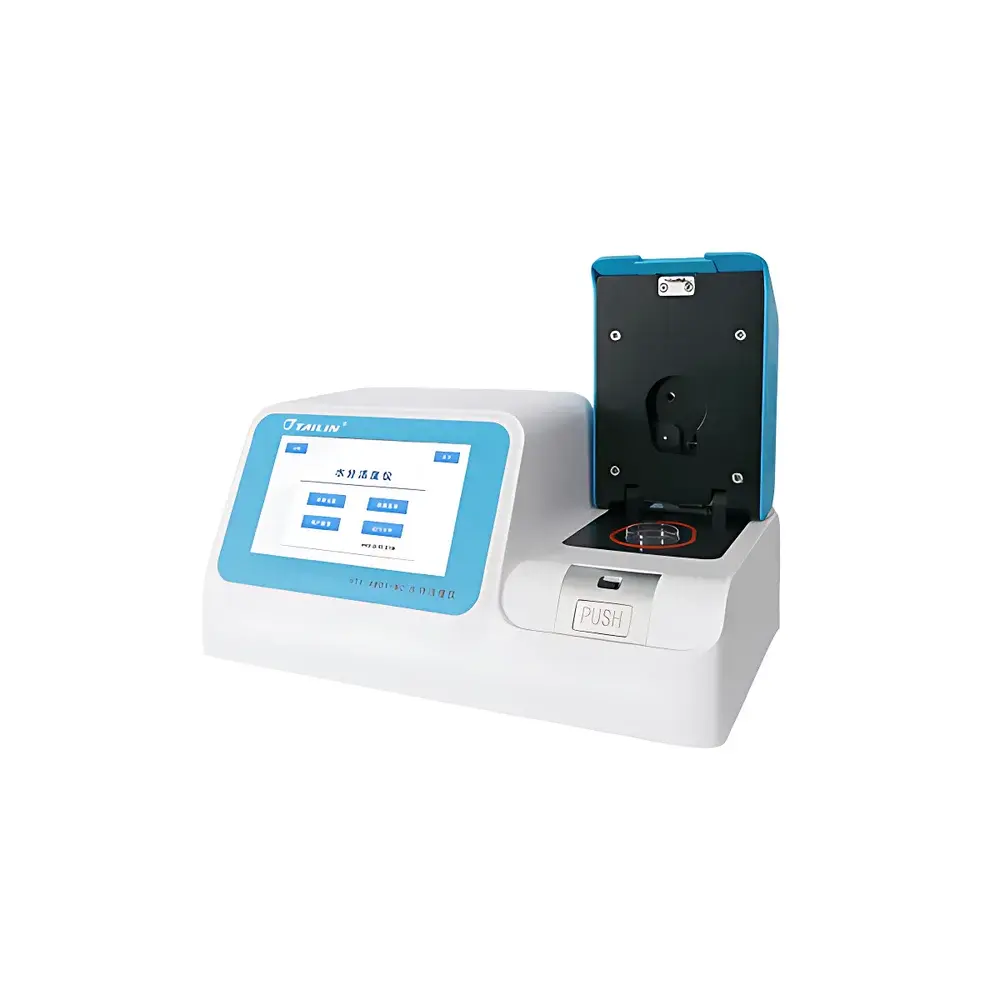
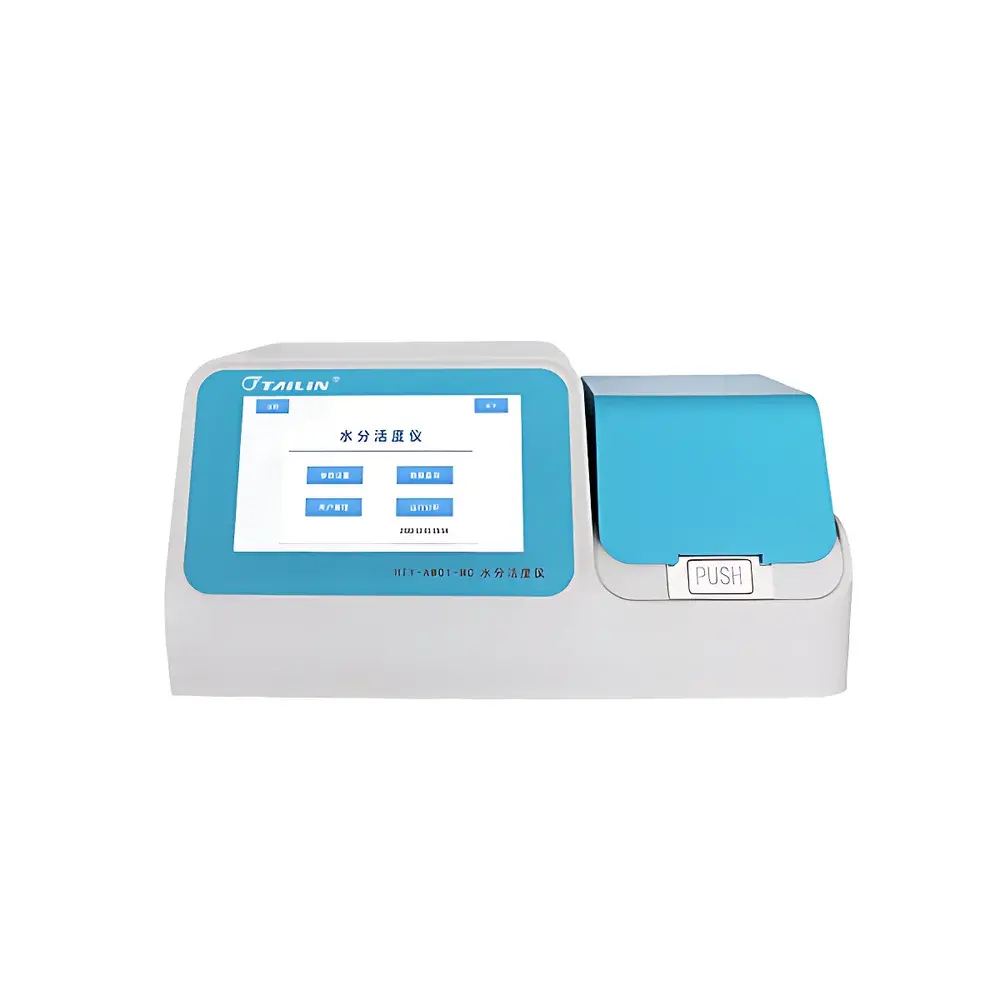
Tailin HTY-AW01-MC Mirror Condensation Water Activity Analyzer
| Brand | Tailin |
|---|---|
| Origin | Zhejiang, China |
| Manufacturer Type | Manufacturer |
| Regional Classification | Domestic (China) |
| Model | HTY-AW01-MC |
| Instrument Form Factor | Benchtop Laboratory Analyzer |
| Detection Range | 0.030–1.000 aw |
| Maximum Permissible Error | ±0.003 aw |
| Resolution | ±0.0001 aw |
| Repeatability Error | ≤3% |
| Measurement Time | 6–8 min |
| Temperature Control Range | 10–50 °C |
| Temperature Control Accuracy | ±0.2 °C |
| Sample Temperature Range | 10–50 °C (Accuracy: ±0.2 °C |
| Resolution | 0.01 °C) |
| Operating Environment | 4–50 °C, RH 0–90% (non-condensing) |
| Power Supply | 100–240 VAC ±10%, 50/60 Hz |
| Power Consumption | ≤100 W |
| Sample Cup Capacity | 7 mL |
| Data Storage Duration | ≥10 years (capacity-dependent |
Overview
The Tailin HTY-AW01-MC Mirror Condensation Water Activity Analyzer is a benchtop laboratory instrument engineered for high-precision determination of water activity (aw) in food, pharmaceutical, cosmetic, and agricultural products. It operates on the fundamental principle of chilled-mirror dew point detection: a polished mirror surface is cooled until condensation forms, and the corresponding dew point temperature is measured with a high-stability platinum resistance thermometer. This physical measurement—directly traceable to thermodynamic equilibrium—is inherently more accurate and less prone to drift than capacitance- or tunable diode laser-based alternatives. The system integrates an active Peltier-driven temperature control module that enables rapid thermal stabilization of both the mirror and sample chamber, ensuring consistent measurement conditions across diverse matrix types—from hygroscopic powders to viscous pastes.
Key Features
- Mirror-based dew point detection: Delivers thermodynamically rigorous aw values with a maximum permissible error of ±0.003 aw and resolution of ±0.0001 aw, meeting requirements for method validation under ISO 21807 and ASTM F1879.
- Active dual-zone temperature control: Independently regulates mirror temperature (10–50 °C, ±0.2 °C accuracy) and sample environment, minimizing thermal lag and enabling reproducible equilibration in 6–8 minutes—even for low-moisture, slow-equilibrating samples such as dried herbs or freeze-dried APIs.
- Robust architecture for routine QC use: Sealed optical path and corrosion-resistant stainless-steel sample chamber reduce maintenance frequency; no consumable sensors requiring periodic recalibration or replacement—only routine mirror cleaning and verification with certified saturated salt standards (e.g., LiCl, NaCl, KCl).
- Integrated sample temperature monitoring: Built-in Pt100 sensor measures actual sample temperature (10–50 °C, ±0.2 °C accuracy, 0.01 °C resolution), critical for reporting aw at defined thermal conditions per USP <1112> and ICH Q5C guidelines.
- Benchtop form factor with low power demand: Compact footprint (≤300 × 300 × 250 mm), <100 W consumption, and universal 100–240 VAC input enable deployment in shared labs, cleanrooms, or mobile QA units without dedicated HVAC support.
Sample Compatibility & Compliance
The HTY-AW01-MC accommodates standard 7 mL aluminum or glass sample cups, supporting solids, semi-solids, and homogenized suspensions. Its sealed chamber design prevents cross-contamination between runs and maintains stable humidity during measurement—essential for low-aw samples (<0.30) where ambient moisture ingress would compromise validity. The instrument complies with core regulatory expectations for water activity testing: data integrity is enforced via time-stamped, operator-logged records stored internally for ≥10 years (configurable storage capacity); all parameters—including aw, sample temperature, dew point, timestamp, operator ID, and sensor status—are retained per record. While not pre-certified for 21 CFR Part 11, its audit trail structure aligns with GLP/GMP documentation requirements when paired with controlled access protocols and periodic backup procedures.
Software & Data Management
Data output is accessible via USB interface or optional RS-232 connection. Each measurement generates a structured record containing water activity value, sample temperature, mirror temperature, equilibration time, date/time stamp, operator identifier, and sensor diagnostic flag. Internal flash memory ensures retention without external dependency; storage duration exceeds 10 years based on typical usage (≈500 tests/year). Exported files are CSV-formatted for direct import into LIMS, statistical process control (SPC) platforms, or Excel-based trending analysis. No proprietary software installation is required—raw data is human-readable and compatible with automated parsing scripts used in regulated environments.
Applications
- Food safety & shelf-life prediction: Quantifying aw to inhibit microbial growth (e.g., molds at aw >0.80, Staphylococcus aureus at aw >0.86) per FDA Food Code and Codex Alimentarius standards.
- Pharmaceutical stability assessment: Supporting excipient compatibility studies, lyophilized product characterization, and moisture sorption isotherm generation per ICH Q1A(R2) and Q5C.
- Quality control of hygroscopic materials: Monitoring desiccant performance, packaging seal integrity, and raw material acceptance (e.g., lactose, cellulose derivatives, spray-dried proteins).
- Research & development: Enabling precise formulation optimization where small aw shifts (<±0.01) correlate strongly with caking, crystallization, or enzymatic degradation kinetics.
FAQ
What calibration standards are recommended for routine verification?
Certified saturated salt solutions (e.g., LiCl, MgCl₂, NaCl, KCl) covering the full 0.11–0.84 aw range are advised for daily or per-shift verification. NIST-traceable reference standards are available from accredited suppliers.
Is the instrument suitable for measuring high-fat or oily samples?
Yes—provided the sample is homogenized and placed in a sealed cup with minimal headspace, the mirror condensation method remains unaffected by oil volatility or surface film formation, unlike capacitance sensors.
How does the active temperature control improve repeatability compared to passive systems?
By eliminating reliance on ambient lab temperature, the Peltier module ensures identical thermal gradients across measurements, reducing inter-run variability—particularly critical for samples with high thermal mass or low thermal conductivity.
Can data be exported to comply with 21 CFR Part 11 requirements?
The instrument provides complete audit-ready data fields; full Part 11 compliance requires integration with validated third-party software for electronic signatures, role-based access control, and secure backup—functions outside the device’s native scope.
What maintenance is required beyond mirror cleaning?
Annual verification of temperature sensor accuracy using a calibrated dry-block calibrator and periodic inspection of Peltier cooling efficiency are recommended. No optical alignment or sensor replacement is needed during normal operation.




