
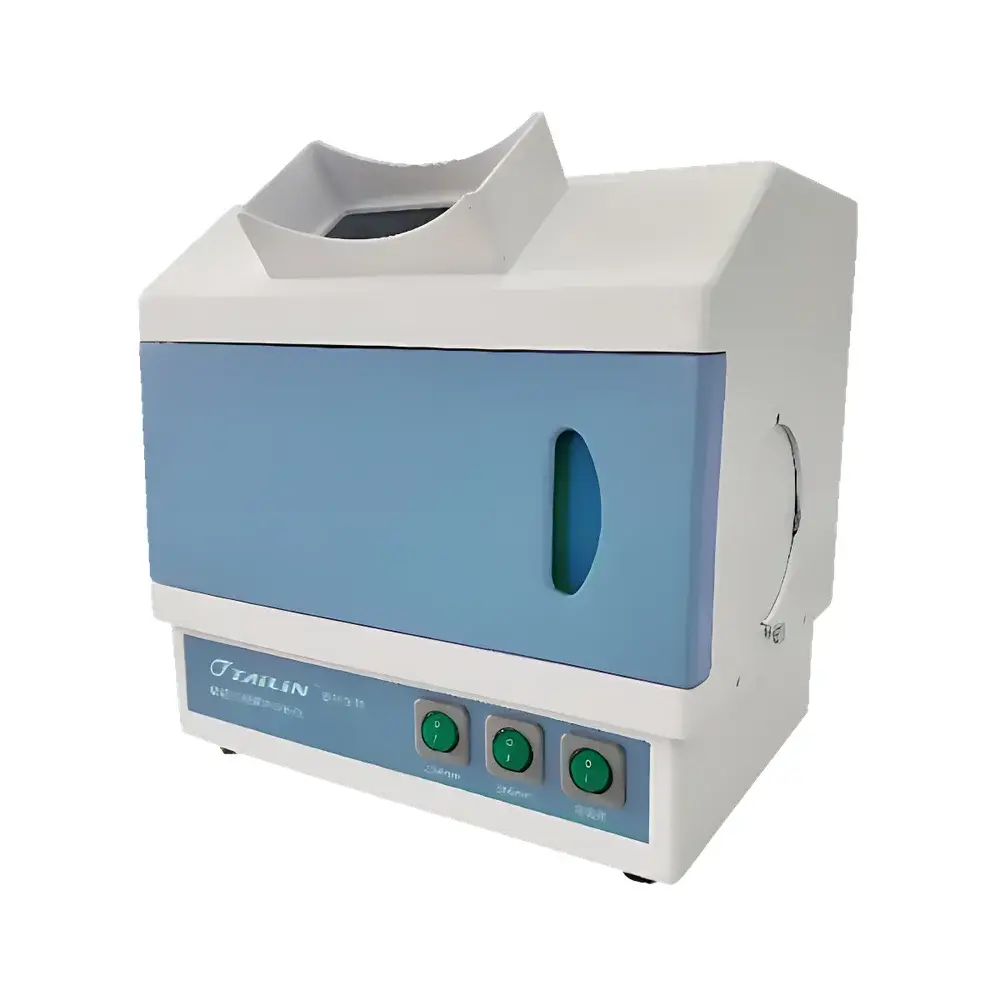
Tailin Biotech HTY-UVB01 Triple-Function UV Transilluminator
| Brand | Tailin Biotech |
|---|---|
| Origin | Zhejiang, China |
| Manufacturer Type | Direct Manufacturer |
| Model | HTY-UVB01 |
| UV Wavelengths | 254 nm (short-wave) & 366 nm (long-wave) |
| Lamp Voltage | 50 V ± 10 V |
| Operating Temperature | 5–40 °C |
| Relative Humidity | ≤75% RH |
| Dimensions (L×W×H) | 320 × 240 × 320 mm |
| Weight | 3.8 kg |
| Power Supply | AC 220 V ± 10%, 50 Hz |
| Design Features | Integrated UV housing with magnetic sample door, dual-side access ports, UV-shielded operation |
Overview
The Tailin Biotech HTY-UVB01 Triple-Function UV Transilluminator is a purpose-engineered instrument for rapid, non-invasive fluorescent detection and visualization of microbiological indicators—specifically Escherichia coli and total coliforms—in water quality testing workflows. It operates on the principle of ultraviolet-induced fluorescence, leveraging two discrete, spectrally isolated UV emission bands: 254 nm for nucleic acid visualization (e.g., DNA/RNA staining with ethidium bromide or SYBR dyes) and 366 nm for optimized excitation of fluorogenic substrates used in membrane filtration or defined substrate technology (DST) assays, such as those specified in ISO 9308-1 and EPA Method 1604. Unlike general-purpose UV cabinets, the HTY-UVB01 is configured specifically for quantitative microbial enumeration using commercially available IDEXX Colilert® or similar quanti-tray systems, where fluorescence intensity under 366 nm illumination correlates directly with viable cell concentration. Its compact, benchtop architecture supports GLP-aligned laboratory practices by minimizing operator UV exposure while maintaining optical consistency across repeated observations.
Key Features
- Dual-wavelength UV source: Independently controlled 254 nm (short-wave) and 366 nm (long-wave) fluorescent lamps, each calibrated to deliver stable irradiance output within ±5% over 1,000 hours of cumulative use.
- Integrated safety enclosure: Fully shielded UV chamber with interlocked magnetic latching door—automatically deactivates UV emission upon door opening per IEC 61010-1 safety requirements.
- Dual-side access design: Symmetrical lateral openings allow unobstructed positioning, rotation, and annotation of multi-well quanti-trays without removing the tray from the observation field.
- Optimized optical geometry: Reflective aluminum interior coating ensures uniform UV distribution across the 240 × 320 mm viewing area, reducing edge falloff to <8% intensity variance (measured per ISO/IEC 17025 calibration protocol).
- Thermally stable operation: Passive heat dissipation system maintains lamp junction temperature below 65 °C during continuous 30-minute operation, preserving wavelength fidelity and lamp longevity.
Sample Compatibility & Compliance
The HTY-UVB01 is validated for use with standard 51-well and 97-well quanti-trays (e.g., IDEXX Quanti-Tray®, Colilert®-18), as well as conventional agarose gels stained with UV-compatible dyes (e.g., GelRed™, Midori Green). It complies with key regulatory frameworks governing environmental microbiology laboratories, including ISO/IEC 17025:2017 (clause 6.4.3 on equipment suitability), US EPA Standard Methods for the Examination of Water and Wastewater (Method 9223B), and CNAS-CL01:2018 requirements for instrument verification. The 366 nm channel meets spectral tolerance criteria outlined in ASTM D511-22 for coliform fluorescence screening, and the unit’s electrical safety conforms to GB 4793.1–2019 (equivalent to IEC 61010-1). No external UV-blocking goggles are required during routine operation due to full cabinet shielding and door-interlock redundancy.
Software & Data Management
As a standalone optical visualization platform, the HTY-UVB01 does not incorporate embedded software or digital imaging modules. However, it is fully compatible with third-party documentation systems: its consistent illumination profile enables reproducible image capture using DSLR or scientific CMOS cameras equipped with UV-pass filters (e.g., Baader-U filter). Laboratories implementing electronic lab notebooks (ELNs) or LIMS platforms—including LabVantage, Thermo Fisher SampleManager, and Waters Empower—can integrate captured fluorescence images with metadata (date/time, operator ID, sample ID) via standardized DICOM or TIFF export protocols. Audit trails for instrument usage may be maintained manually or through facility-wide access logs, satisfying basic FDA 21 CFR Part 11 record-keeping expectations for non-automated qualitative assessment tools.
Applications
- Routine compliance monitoring of drinking water, groundwater, and recreational water per WHO Guidelines for Drinking-water Quality and EU Directive 2020/2184.
- Verification of disinfection efficacy in wastewater treatment effluents using DST-based viability endpoints.
- Field-deployable support for mobile environmental labs conducting rapid coliform screening in disaster-response scenarios (operable within standard AC-powered temporary shelters).
- Educational use in university microbiology and environmental engineering curricula for hands-on demonstration of fluorescence-based microbial detection principles.
- Reference method support in accredited testing laboratories performing ISO 9308-1:2014 (coliforms in water) and ISO 16266:2003 (E. coli in water) analyses.
FAQ
Is the HTY-UVB01 suitable for use with UV-sensitive fluorescent dyes other than those specified for coliform detection?
Yes—it supports common nucleic acid stains (e.g., ethidium bromide, SYBR Safe) under 254 nm excitation and enzyme-substrate fluorophores (e.g., MUG, ONPG derivatives) under 366 nm, provided appropriate safety filtering is applied during imaging.
Does the unit require annual recalibration?
No formal recalibration is mandated; however, users should perform quarterly intensity verification using a NIST-traceable UV radiometer (e.g., International Light ILT2400) per internal SOPs aligned with ISO/IEC 17025 clause 6.5.2.
Can the HTY-UVB01 be integrated into automated water testing lines?
It is designed as a manual observation station—not a process-integrated analyzer—and lacks communication interfaces (RS-232, USB, Ethernet); integration requires external robotic handling and vision systems.
What maintenance is required to sustain optimal performance?
Lamp replacement every 1,000 operating hours; periodic cleaning of quartz viewing window with ethanol-dampened lint-free cloth; inspection of magnetic latch integrity every six months.







