
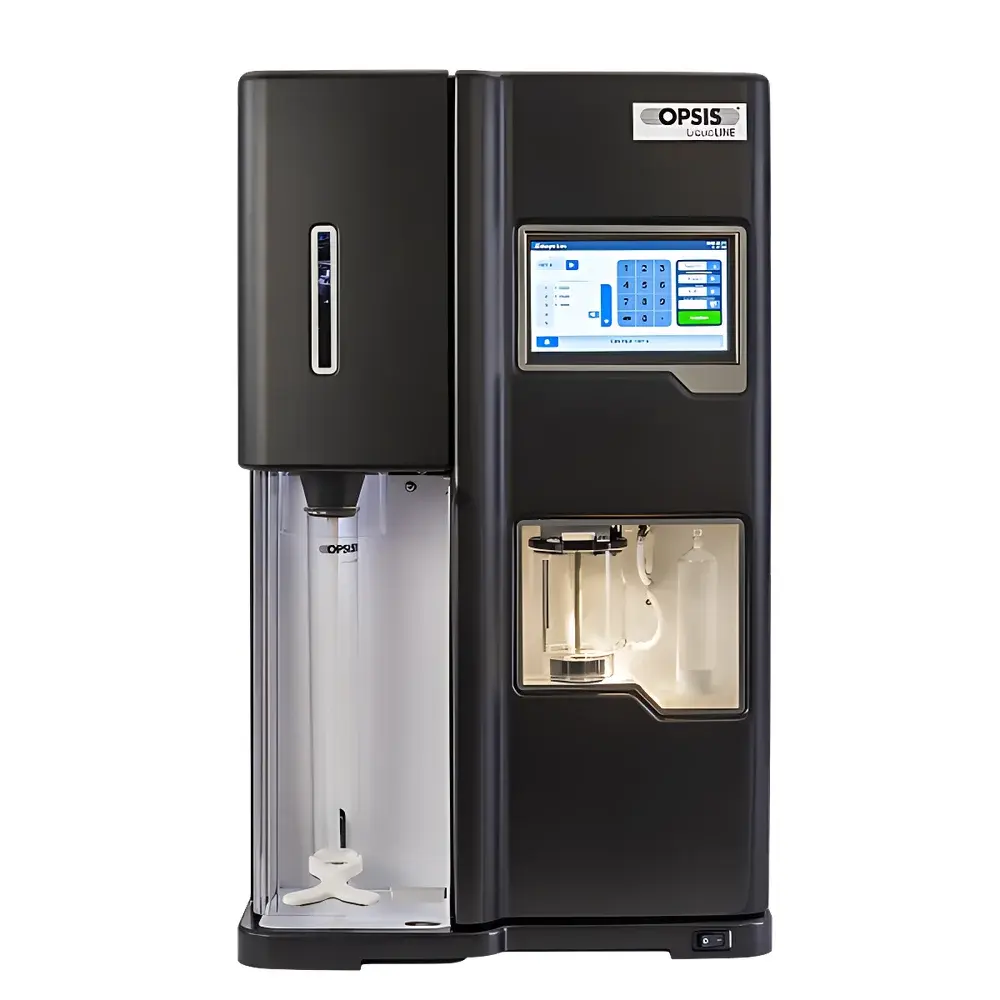
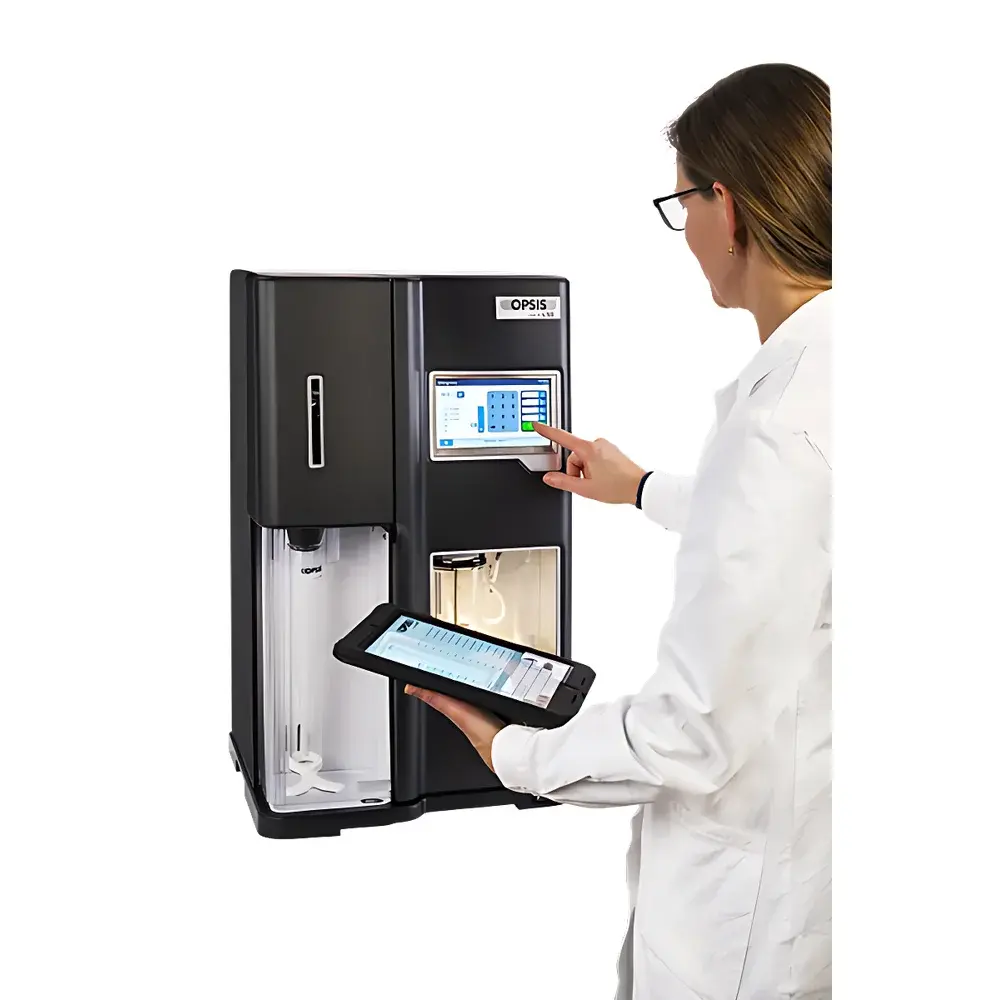
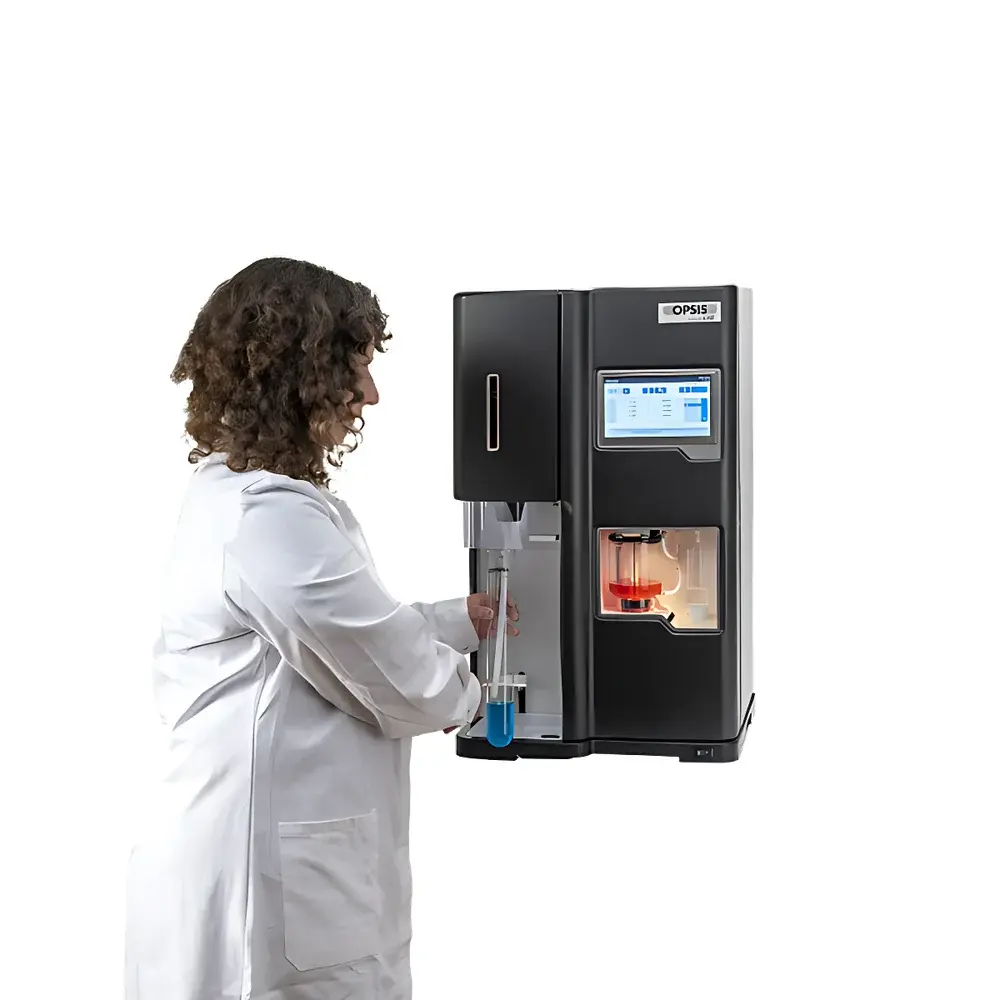
OPSIS KD-310 Fully Automated Kjeldahl Nitrogen Determinator
| Brand | OPSIS |
|---|---|
| Origin | Sweden |
| Model | KD-310 |
| Instrument Type | Kjeldahl Nitrogen Determinator |
| Automation Level | Fully Automated |
| Nitrogen Determination Range | 0.05–240 mg N |
| Distillation Time | 2–4 min per sample |
| Repeatability | RSD ≤ 0.5% |
| Sample Weight Capacity | ≤ 5 g (solid) or ≤ 20 mL (liquid) |
| Recovery Rate | ≥ 99.5% |
| Power Consumption | 2200 W |
| Dimensions (L×W×H) | 430 mm × 330 mm × 700 mm |
Overview
The OPSIS KD-310 Fully Automated Kjeldahl Nitrogen Determinator is a CE-marked, ISO 17025–aligned benchtop analyzer engineered for precision, safety, and regulatory compliance in high-throughput food, feed, agricultural, and environmental laboratories. It implements the classical Kjeldahl method—comprising acid digestion (H₂SO₄), alkaline steam distillation, boric acid trapping, and photometric endpoint detection—within a single, integrated platform. Unlike semi-automated systems, the KD-310 executes the entire analytical sequence autonomously: reagent dosing (NaOH, H₃BO₃, dilution water), steam generation and delivery, condensate collection, colorimetric titration, stoichiometric calculation, and result reporting. Its core innovation lies in patented pre-titration technology, which minimizes baseline drift and reagent consumption variability—directly contributing to sub-0.5% RSD performance across wide nitrogen concentration ranges (0.05–240 mg N). The system operates under strict thermal and fluidic control: real-time effluent temperature monitoring ensures consistent ammonia transfer efficiency; intelligent cooling water management activates flow only during active distillation, reducing utility costs by up to 40% versus continuous-cooling designs.
Key Features
- Patented pre-titration algorithm with automatic 50 mL burette refill—enabling uninterrupted analysis of samples spanning orders-of-magnitude nitrogen content without acid concentration changes.
- High-resolution titration drive: 1.95 µL/step (standard); optional 0.8 µL/step with 20 mL burette for ultra-trace applications.
- Steam generator with adjustable output (10–100% power), stainless-steel construction, and dry-run protection—requiring no routine descaling or maintenance.
- Delay-distillation mode: programmable sequence initiates brief steam exposure *before* NaOH addition to homogenize viscous digests and moderate exothermic reaction kinetics—critical for high-fat or polymer-rich matrices.
- Integrated safety architecture: interlocked access door, digestion tube presence sensors, overtemperature/overpressure cut-offs, level monitoring for reagents and waste, and auto-emptying receiver cup.
- 7-inch capacitive touchscreen with multilingual GUI (English, Swedish, German, Chinese); supports custom workflow scripting via on-device editor.
- PTFE-lined acid delivery tubing and user-replaceable splash guards (glass or polypropylene) minimize carryover and bubble formation—ensuring metrological integrity across >10,000 analyses.
Sample Compatibility & Compliance
The KD-310 accommodates solid samples up to 5 g and liquid samples up to 20 mL—compatible with standard Kjeldahl digestion tubes (e.g., 100–300 mL borosilicate). Its validated methodology conforms to AOAC Official Methods 981.10, 984.27, and 991.20; ISO 8968-1 (milk), ISO 1871 (cereals), ISO 5983-1 (feed), DIN 10492, EPA Method 350.1, and GB/T 5009.5 (China). All critical parameters—including reagent volumes, steam pressure profiles, distillation duration, and titration thresholds—are fully configurable and stored with timestamped audit trails. Data files include embedded QR codes linking to component-level traceability logs (per ISO/IEC 17025:2017 Clause 6.4.10), user ID stamps, LIMS-compatible metadata fields, and digital signatures compliant with FDA 21 CFR Part 11 requirements for electronic records and signatures.
Software & Data Management
Data exchange employs open, vendor-neutral protocols: CSV export via FTP or Wi-Fi (IEEE 802.11b/g), direct USB mass storage, and RS-232 serial interface. No proprietary software license is required—raw output files are human-readable and importable into Excel, SQL databases, or LIMS without conversion utilities. The instrument’s embedded file system maintains three synchronized log categories: (1) analysis history (sample ID, weight, N%, recovery %, timestamps), (2) system diagnostics (burette calibration cycles, sensor health, steam generator runtime), and (3) performance verification logs from daily/weekly standard solution checks (apparent performance tracking per ISO/IEC 17025 Annex A.3). Remote firmware updates and service diagnostics are supported via encrypted SSH sessions. User access levels (Operator, Supervisor, Administrator) enforce role-based restrictions on method editing, calibration, and audit log deletion—fully aligned with GLP and GMP documentation practices.
Applications
The KD-310 delivers certified nitrogen quantification for diverse regulated sectors: crude protein determination in dairy products (ISO 8968), cereal grains (ISO 20483), animal feed (ISO 5983), meat and fish meal (AOAC 992.15), wastewater (EPA 350.1), soil extracts (ISO 11261), and pharmaceutical excipients (USP ). Its extended dynamic range eliminates manual dilution steps for both low-protein botanicals (45% N). The delay-distillation protocol significantly improves reproducibility for challenging matrices such as chocolate, soy lecithin, and spent grain—where incomplete digestion or localized overheating commonly causes bias. Routine QC workflows integrate seamlessly with balance interfaces (Mettler Toledo, Sartorius, Gerber) for automated mass capture and error-proof sample registration.
FAQ
Does the KD-310 require external cooling water? Why is its cooling system considered intelligent?
No external chiller is needed—the system uses ambient tap water with an integrated flow controller that halts water supply during idle periods and resumes only upon distillation initiation. This reduces average water consumption by 35–45% while maintaining condenser outlet temperature within ±0.5°C of setpoint.
How does the pre-titration technology improve accuracy compared to conventional colorimetric titration?
Pre-titration establishes a stable baseline pH before formal endpoint detection, compensating for minor variations in indicator concentration, ambient light, or cuvette optical path length. This reduces systematic error sources that dominate RSD in traditional systems—enabling consistent ≤0.5% RSD even across heterogeneous sample batches.
Can the KD-310 be integrated into a laboratory information management system (LIMS)?
Yes—via open-format CSV export over Wi-Fi/FTP, or direct RS-232/USB connection. All exported files contain mandatory traceability fields (user ID, instrument serial, calibration certificate IDs, sample weights) and support custom metadata injection (e.g., LIMS accession numbers, project codes).
What safety certifications does the KD-310 hold?
It complies with IEC 61010-1 (electrical safety), IEC 61326-1 (EMC), and carries CE marking for the European Economic Area. Mechanical interlocks, thermal fuses, and redundant liquid-level sensors satisfy EN 61000-6-2/6-4 immunity/emission requirements.
Is routine maintenance required for the steam generator?
The stainless-steel steam boiler is designed for maintenance-free operation over 5+ years under typical lab use (≤200 analyses/day). No descaling, gasket replacement, or pressure-vessel inspection is specified in the manufacturer’s service schedule.






