
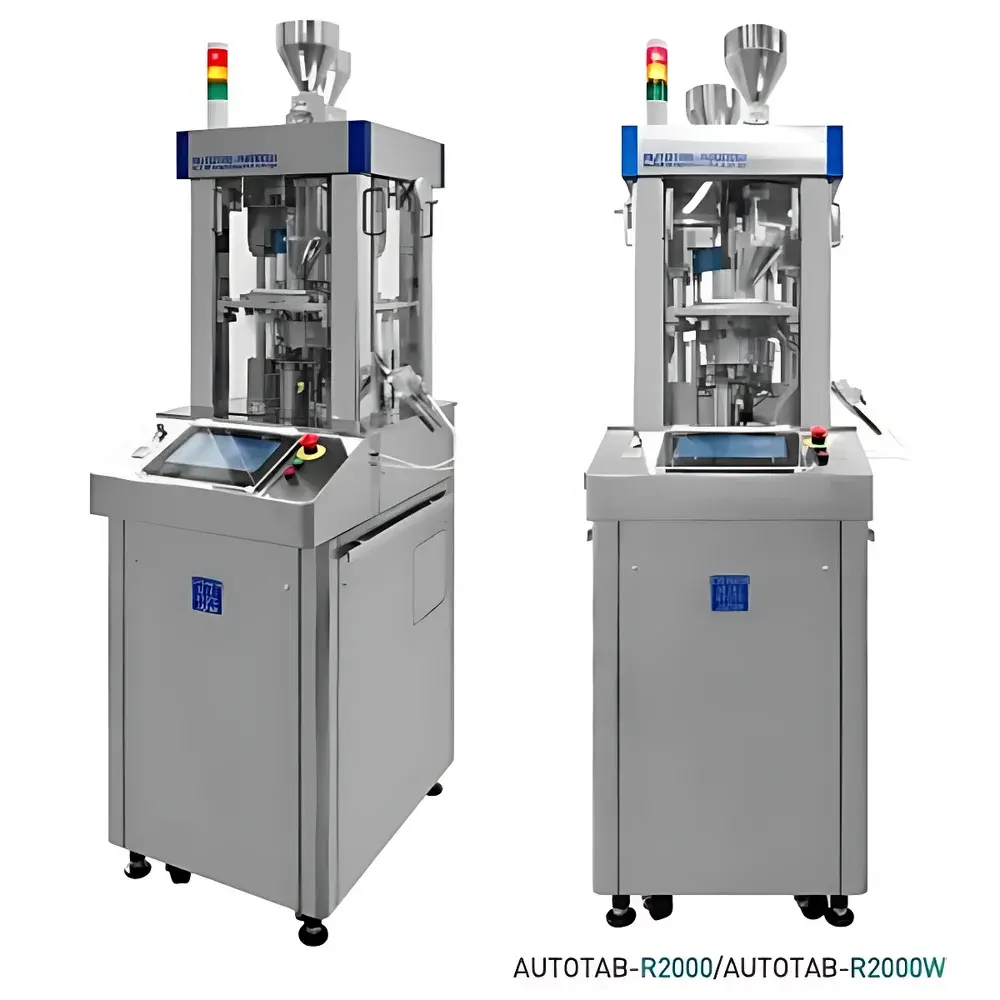
Ichihashi Seiki Autotab-R2000W Fully Automatic Dual-Layer Rotary Tablet Press
| Brand | Ichihashi Seiki |
|---|---|
| Origin | Japan |
| Model | Autotab-R2000W |
| Maximum Compression Force | 12 kN (pre-compression) / 40 kN (main compression) |
| Max. Tablet Diameter | 20 mm (Layer 1), 16 mm (Layer 2) |
| Max. Fill Depth | 18 mm (Layer 1), 8 mm (Layer 2) |
| Max. Production Speed | 16,200 tablets/hour |
| Turret Diameter | 200 mm |
| Punch Standard | TSM/IPT (EU-D & EU-B) |
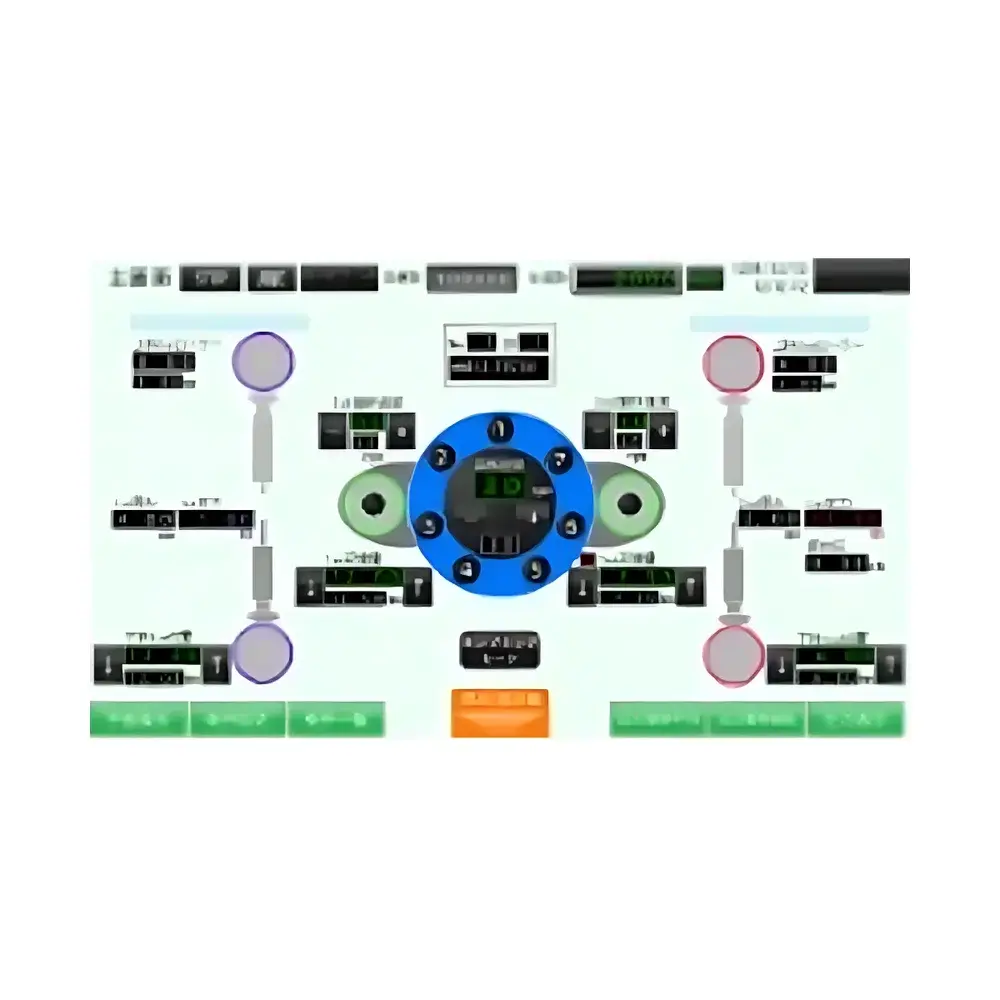
| Control Interface | 10-inch touchscreen HMI |
| Weight | 600 kg |
| Dimensions (W×D×H) | 620 × 870 × 1930 mm |
| Motor Power | 2.2 kW |
| Voltage | 3-phase 380 V |
Overview
The Ichihashi Seiki Autotab-R2000W is a fully automatic dual-layer rotary tablet press engineered for precision, reproducibility, and operational flexibility in R&D laboratories and pilot-scale pharmaceutical manufacturing. Based on the proven mechanical architecture of the Autotab-R2000 series, the R2000W variant integrates forced-feed auger filling, real-time weight control via closed-loop compression force monitoring, and synchronized dual-layer dosing—all within a compact 200 mm turret diameter. Its design adheres to fundamental principles of powder compaction mechanics: consistent die cavity fill, uniform pre-compression consolidation, and controlled main compression under defined dwell time and pressure profiles. The system operates under deterministic process logic—each tablet cycle is governed by programmable cam timing, servo-regulated turret speed (up to 30 rpm), and adaptive fill-depth adjustment—ensuring compliance with critical quality attributes (CQAs) required for regulatory submissions.
Key Features
- Forced-Fill Auger Feeding System: Integrated auger-driven powder delivery ensures consistent volumetric fill even for low-density, cohesive, or poorly flowing materials; continuous agitation during feeding minimizes segregation and improves fill uniformity across all 79 stations.
- Dual-Layer Compression Architecture: Independent pre-compression and main compression rollers enable precise layer separation; Layer 2 fill depth is adjustable up to 8 mm, supporting asymmetric bilayer formulations with distinct release profiles.
- Real-Time Weight Control: Load cells monitor main compression force in real time; deviations trigger automatic adjustment of fill volume via auger rotation angle, maintaining target tablet weight within ±2.5% RSD across extended runs.
- NG Tablet Rejection: Pressure signature analysis identifies out-of-spec tablets (e.g., under/over-compressed units); rejected tablets are diverted to a dedicated NG chute without interrupting production flow.
- 20-Program Parameter Memory: Stores complete processing recipes—including turret speed, fill depth, pre/main compression force, dwell time, and ejection height—with timestamped version control and user-ID binding.
- Audit-Trail Enabled Operation: Role-based login (admin/operator) logs all parameter changes, program executions, and maintenance events; data export supports CSV and PDF formats compliant with ALCOA+ principles.
- Modular Dust Management Interface: Dedicated port for connection to external dust collectors (e.g., HEPA-filtered cyclonic units), essential for maintaining cross-contamination control during bilayer processing per ISO 14644-1 Class 7 cleanroom requirements.
Sample Compatibility & Compliance
The Autotab-R2000W accommodates powders ranging from free-flowing API-excipient blends to high-viscosity granules and direct-compression formulations. It accepts standard TSM/IPT punch tooling (EU-D: 7-station, max 20 mm; EU-B: 9-station, max 16 mm), ensuring compatibility with industry-standard tooling libraries and facilitating rapid changeover. The system meets mechanical safety requirements per ISO 13857 and electrical safety per IEC 60204-1. While not GMP-certified as a standalone unit, its design supports qualification under ASTM E2500-13 (science-based approach) and aligns with FDA’s Process Validation Guidance (Stage 2: Process Qualification). Data integrity features—including electronic signatures, audit trails, and secure user authentication—support compliance with 21 CFR Part 11 when deployed in validated environments.
Software & Data Management
The 10-inch capacitive touchscreen HMI runs embedded Linux-based firmware with intuitive graphical workflow navigation. All operational parameters are configured via tabbed menus—no coding or external software required. Process data (compression force, fill depth, cycle count, rejection log) is stored locally on industrial-grade SD card with write-protection options. USB export enables transfer to LIMS or statistical process control (SPC) platforms. Firmware updates are performed via encrypted firmware packages with SHA-256 verification. Optional OPC UA server integration allows real-time telemetry to MES systems for batch record linkage and OEE calculation.
Applications
This press serves diverse solid-dose development needs: bilayer tablets for sequential drug release (e.g., immediate + sustained release), coated-core tablets, taste-masked pediatric formulations, and functional food tablets containing heat-sensitive probiotics or enzymes. It is routinely used for formulation screening (DoE studies), stability batch preparation, and clinical trial material manufacturing up to 50 kg/batch. Non-pharma applications include catalyst pelletization (e.g., Ni/Al₂O₃), ceramic green-body formation, and fertilizer microgranule compaction—where controlled density and mechanical strength are critical.
FAQ
What punch standards does the Autotab-R2000W support?
It accepts TSM/IPT-compliant punches in both EU-D (7-station, Ø ≤ 20 mm) and EU-B (9-station, Ø ≤ 16 mm) configurations.
Is the system compatible with 21 CFR Part 11 requirements?
Yes—when operated with enabled user authentication, audit trail logging, and electronic signature functionality, it satisfies core technical controls outlined in Part 11 Subpart B.
Can the forced-feed auger handle moisture-sensitive powders?
Yes; the auger housing is sealed and optionally inert-gas purgable (N₂), minimizing oxidation and hydration during feeding.
What is the maximum allowable variation in tablet weight during continuous operation?
Under validated conditions with stable powder flow, typical weight RSD remains ≤ 2.0% for batches exceeding 10,000 tablets.
Does the system provide raw force vs. time waveform data?
Yes—the embedded load cell captures full compression profile data at 1 kHz sampling rate; waveforms are exportable for compaction modeling (e.g., Heckel analysis).



