
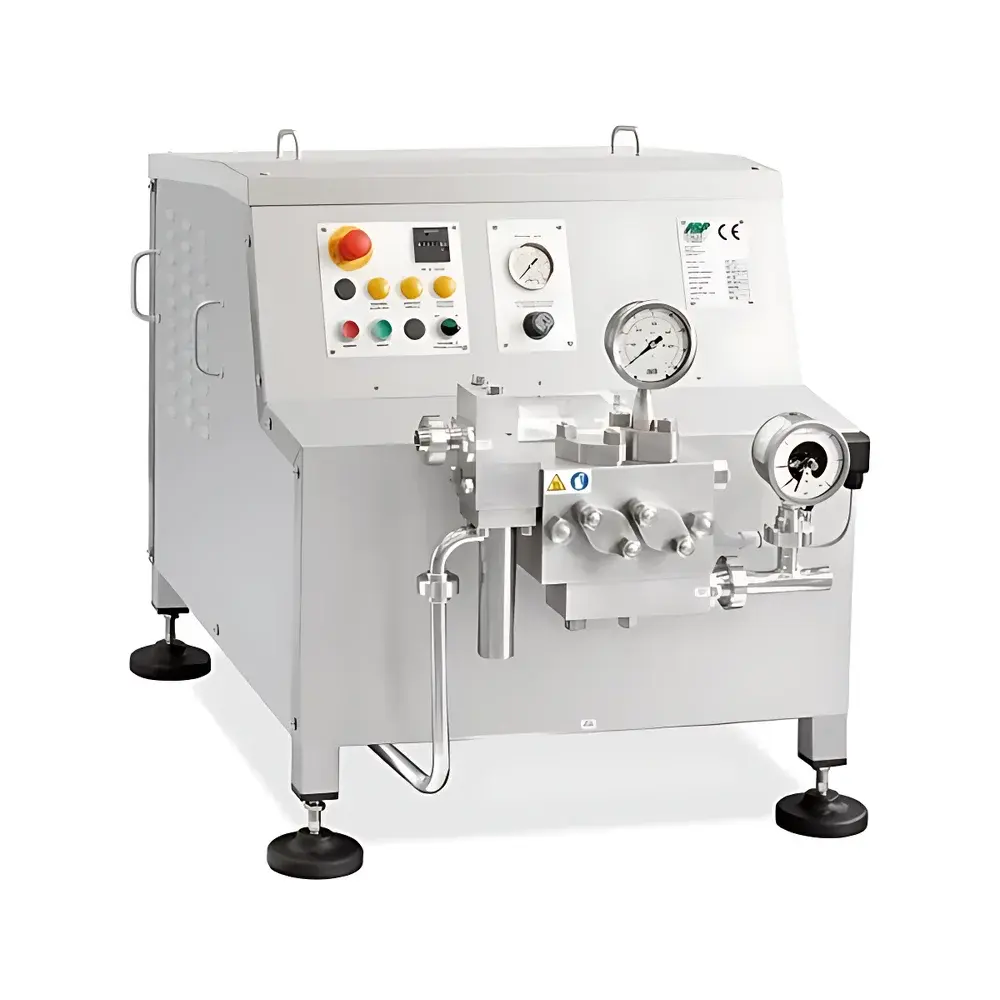
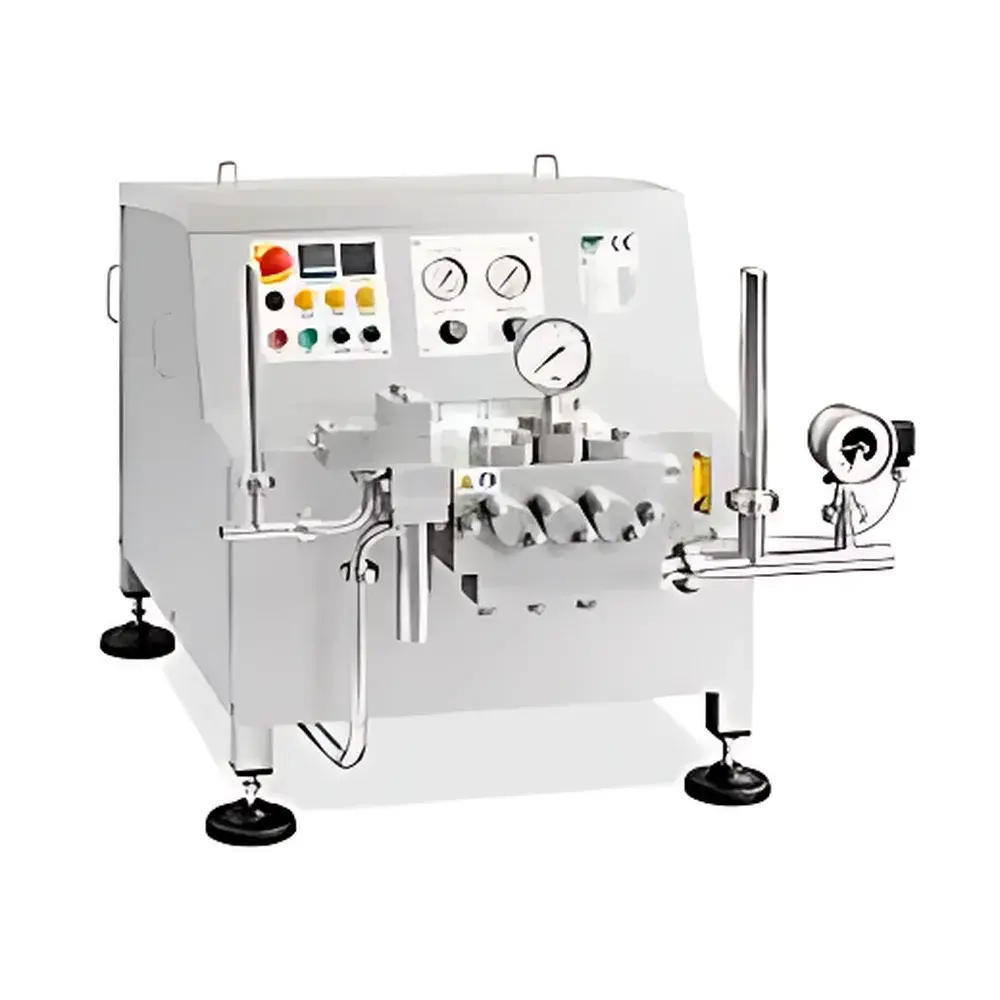

FBF FBF2003 Pilot-Scale High-Pressure Homogenizer
| Brand | FBF |
|---|---|
| Origin | Italy |
| Model | FBF2003 |
| Flow Rate | 150 L/h (fixed), variable via VFD option |
| Primary Homogenization Pressure | up to 350 bar (adjustable) |
| Secondary Homogenization Pressure | up to 50 bar (optional) |
| Plunger Diameter | 20 mm |
| Plunger Speed | 136 rpm |
| Max. Sample Viscosity | 500 cP |
| Max. Inlet Particle Size | 500 µm |
| Max. Operating Temperature | 90 °C |
| Cleaning-in-Place (CIP) Time | 30 min |
| Sterilization-in-Place (SIP) Temperature | up to 145 °C |
| Cooling Water Requirement | 2–6 bar, 350 L/h |
| Lubrication System | Integrated oil pump (0.37 kW, IP55) |
| Main Motor | 2.2 kW, IP55 |
| Power Supply | 3.0 kW, 380 V / 50 Hz |
| Dimensions (W×D×H) | 85 × 115 × 92 cm |
| Weight | 360 kg |
Overview
The FBF FBF2003 Pilot-Scale High-Pressure Homogenizer is an engineered solution for translational process development in pharmaceutical, biotechnology, nutraceutical, and advanced materials laboratories. Designed and manufactured in Italy by FBF S.r.l., this system operates on the principle of controlled high-pressure cavitation, shear, and impact forces to achieve sub-micron particle size reduction, cell disruption, emulsification, and nano-dispersion. Unlike benchtop homogenizers, the FBF2003 bridges laboratory feasibility studies and industrial-scale manufacturing—supporting GMP-aligned scale-up with reproducible, scalable process parameters. Its dual-stage pressure architecture enables precise control over primary homogenization (up to 350 bar) and secondary stabilization (up to 50 bar), ensuring consistent droplet or particle size distribution across batches. The unit meets EU Machinery Directive 2006/42/EC and carries full CE marking, reflecting compliance with essential health, safety, and environmental protection requirements.
Key Features
- Robust two-plunger reciprocating pump assembly with 20 mm diameter plungers operating at 136 rpm—engineered for long-term stability under cyclic high-pressure loads.
- Plunger surfaces coated with Diamond-Like Carbon (DLC) for exceptional wear resistance and extended service life in abrasive or high-viscosity applications.
- Homogenization valve assembly constructed from hardened stainless steel with precision-ground seating; designed for minimal thermal drift and zero vibration during operation.
- Hygienic spring-loaded safety relief valve compliant with 3-A Sanitary Standards, featuring replaceable seats and seals for routine maintenance and audit readiness.
- Integrated mechanical lubrication system (0.37 kW oil pump, IP55 rating) ensures continuous, monitored lubrication of all critical motion components.
- Full CIP/SIP capability: validated cleaning-in-place cycle completes in ≤30 minutes at ≤90 °C; sterilization-in-place supports temperatures up to 145 °C for terminal sterilization validation per ISO 13408-1.
- Optional second-stage homogenization valve controlled by independent hydraulic actuation—enabling fine-tuning of post-primary dispersion stability without altering primary pressure settings.
Sample Compatibility & Compliance
The FBF2003 accommodates a broad range of sample types including microbial lysates, liposomal suspensions, protein aggregates, polymeric nanoparticles, oil-in-water emulsions, and ceramic slurries. Maximum inlet particle size is 500 µm; maximum viscosity tolerance is 500 cP at processing temperature (±5 bar triggers automatic shutdown), batch record generation, and audit-trail-enabled operation logs.
Software & Data Management
While the base FBF2003 operates via analog controls and calibrated mechanical gauges, optional digital instrumentation includes programmable logic controller (PLC)-based interfaces with HMI touchscreen panels. These support real-time monitoring of inlet/outlet pressure, homogenization pressure, flow rate (via turbine flow meter), temperature, and CIP/SIP cycle status. All pressure transducers meet IEC 61508 SIL2 functional safety standards. Data export is available in CSV format for integration into LIMS or MES platforms. Optional time-based valve sequencing allows automated start/stop cycles synchronized with upstream/downstream unit operations—critical for closed-system bioprocessing validation.
Applications
- Pre-formulation development of lipid nanoparticles (LNPs) and mRNA delivery systems requiring narrow PDI (<0.1) and mean particle size <100 nm.
- Cell lysis of E. coli, yeast, and mammalian cells for recombinant protein recovery—validated across >10⁹ CFU/mL densities.
- Stabilization of nanoemulsions for topical and oral delivery, including curcumin, coenzyme Q10, and omega-3 formulations.
- Production of uniform pigment dispersions for high-performance coatings and inkjet inks.
- Scale-down modeling of production-scale homogenization processes per ICH Q5A(R2) comparability guidelines.
- Process characterization studies supporting Quality-by-Design (QbD) frameworks, including design space mapping of pressure–flow–temperature interactions.
FAQ
What regulatory certifications does the FBF2003 hold?
The unit carries full CE marking per EU Machinery Directive 2006/42/EC and Electromagnetic Compatibility Directive 2014/30/EU. Optional configurations support FDA 21 CFR Part 11 compliance with electronic signature and audit trail functionality.
Can the FBF2003 be integrated into aseptic processing lines?
Yes—optional sterile barrier design includes ISO 5-compatible isolator interfaces, SIP-capable fluid paths, and steam-trap-free drain geometry validated per ISO 13408-2.
Is remote monitoring supported?
Via optional Ethernet/IP or Modbus TCP connectivity, the system supports SCADA-level integration for centralized supervision and predictive maintenance alerts.
What maintenance intervals are recommended for the homogenization valve?
Under typical operation at 250 bar and 150 L/h, valve inspection is recommended every 500 operational hours; full replacement intervals range from 1,000–2,000 hours depending on slurry abrasivity and particle load.
Does the system support variable flow rates without compromising pressure stability?
Yes—VFD-controlled motor drive enables continuous flow adjustment from 50–200 L/h while maintaining ±2 bar pressure regulation accuracy across the full operating range.



