
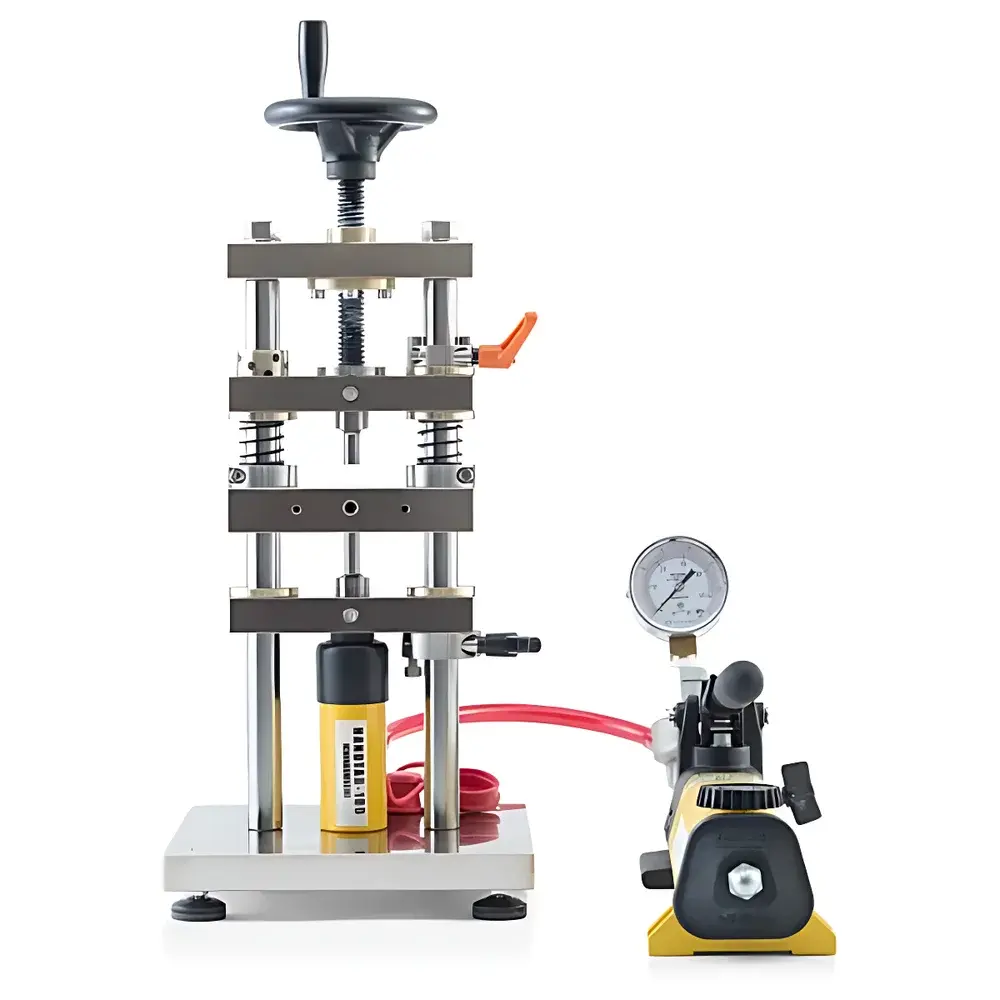
Ichihashi Seiki HANDTAB-100T15 Manual Single-Punch Tablet Press
| Brand | Ichihashi Seiki |
|---|---|
| Origin | Japan |
| Model | HANDTAB-100T15 |
| Max Compression Force | 150 kN (15 tf) |
| Max Tablet Diameter | 50 mm |
| Max Fill Depth | 46 mm |
| Upper/Lower Punch Stroke | Adjustable |
| Pressure Display | Analog Gauge (optional digital pressure sensor available) |
| Construction | Stainless Steel with Optional Electroless Nickel Plating |
| Dimensions (H×W×D) | 620 × 200 × 200 mm |
| Weight | 35.5 kg (main unit), 10 kg (hydraulic pump) |
| Punch Compatibility | TSM Standard (IPT-B/D), interchangeable |
| Safety Design | Dual-hand operation interlock, pressure relief valve, mechanical stop limit |
Overview
The Ichihashi Seiki HANDTAB-100T15 is a precision-engineered manual single-punch tablet press designed for low-volume formulation development, preclinical dosage form screening, and quality control in regulated laboratory environments. Operating on a pure mechanical-hydraulic principle—without electrical power—the system delivers reproducible compaction force through a manually actuated hydraulic pump, enabling precise control over compression pressure, dwell time, and fill depth. Its core architecture follows the classical single-station die cavity configuration: powder is filled into a stationary die bore; the lower punch sets fill depth; the upper punch descends under controlled hydraulic load to compress the powder column; and ejection occurs via upward movement of the lower punch. This deterministic mechanical pathway ensures high batch-to-batch repeatability and eliminates variability introduced by servo-motor timing or pneumatic fluctuations—critical for early-phase formulation studies where minimal material (as little as one gram) must yield representative tablets.
Key Features
- Manual hydraulic operation: No electricity required—ideal for cleanrooms, gloveboxes, or mobile lab setups.
- 150 kN (15 metric ton-force) maximum compression capacity with calibrated analog pressure gauge; optional digital pressure transducer enables traceable, audit-ready force logging (0.5% FS accuracy).
- Adjustable fill depth mechanism with engraved scale (0–46 mm range), facilitating systematic investigation of density–porosity relationships.
- TSM-standard punch compatibility (IPT-B/D interface) allows seamless integration with industry-standard tooling—including center-hole, multi-layer, and embossed configurations.
- Corrosion-resistant construction: Base model uses electropolished stainless steel (SUS316L); optional electroless nickel plating provides enhanced resistance against acidic, hygroscopic, or reactive powders (e.g., metal oxides, lithium salts, halogenated APIs).
- Integrated safety features: Mechanical overload stop, automatic pressure bleed valve, dual-hand pump activation requirement, and rigid frame design compliant with ISO 13857 clearance requirements.
Sample Compatibility & Compliance
The HANDTAB-100T15 accommodates diverse powder systems including pharmaceutical actives and excipients (microcrystalline cellulose, lactose monohydrate, mannitol), ceramic precursors (alumina, zirconia), catalyst supports (silica gel, activated carbon), and nutraceutical blends. Its fully demountable die cavity and punch assembly support rapid cleaning validation per ICH Q5A and USP . The device meets mechanical safety requirements per ISO 12100 and carries CE marking under Machinery Directive 2006/42/EC. When equipped with the optional digital pressure sensor and timestamped data export, it supports ALCOA+ data integrity principles and can be integrated into GLP/GMP workflows requiring 21 CFR Part 11-compliant electronic records (with validated third-party software).
Software & Data Management
While the base unit operates without software, the optional digital pressure sensor outputs analog 4–20 mA or RS-485 Modbus RTU signals compatible with LabVIEW, MATLAB, or custom SCADA systems. Data acquisition packages (sold separately) provide real-time force–displacement curve plotting, peak force annotation, cycle count logging, and CSV export. Audit trails include operator ID, timestamp, punch serial number, and environmental metadata (if linked to ambient sensors). All firmware updates are delivered via secure USB key with cryptographic signature verification.
Applications
- Pharmaceutical R&D: Screening binder efficacy, evaluating lubricant sensitivity, generating dissolution test tablets from limited API batches.
- Materials science: Compacting battery electrode slurries for half-cell testing; forming solid electrolyte pellets for impedance spectroscopy.
- Catalysis: Preparing shaped catalyst bodies (e.g., extrudates, tablets) for fixed-bed reactor evaluation under controlled density conditions.
- Academic research: Teaching powder compaction mechanics, Heckel analysis, and Kawakita modeling in graduate-level pharmaceutics labs.
- Quality assurance: Reconstituting historical tablet specifications during vendor qualification or stability protocol revalidation.
FAQ
What is the minimum powder quantity required to produce a valid tablet?
Typically 100–300 mg, depending on die diameter and target tablet thickness. With the 50 mm die option, even sub-50 mg samples can be compressed using custom shallow-die inserts.
Can the HANDTAB-100T15 be used for sustained-release matrix tablet development?
Yes—its precise fill-depth control and dwell-time consistency (via manual pump hold duration) enable reproducible preparation of hydrophilic polymer-based matrices for in vitro release profiling.
Is calibration certification included with purchase?
Each unit ships with a factory-verified pressure calibration certificate traceable to JCSS (Japan Calibration Service System); annual recalibration services are available through Ichihashi Seiki’s authorized service centers in Europe and North America.
How does the electroless nickel plating improve performance with corrosive powders?
It forms a uniform, pore-free Ni–P alloy layer (typical thickness: 25–30 µm) that resists chloride-induced pitting and acid leaching—extending tooling life when processing sodium stearate, ammonium persulfate, or transition-metal nitrates.
Are replacement punches and dies supplied with dimensional tolerances certified to ISO 8502-1?
Yes—standard TSM-B/D punches are manufactured to ±2 µm diameter tolerance and surface roughness Ra ≤ 0.2 µm, with full metrology reports provided per lot.






