
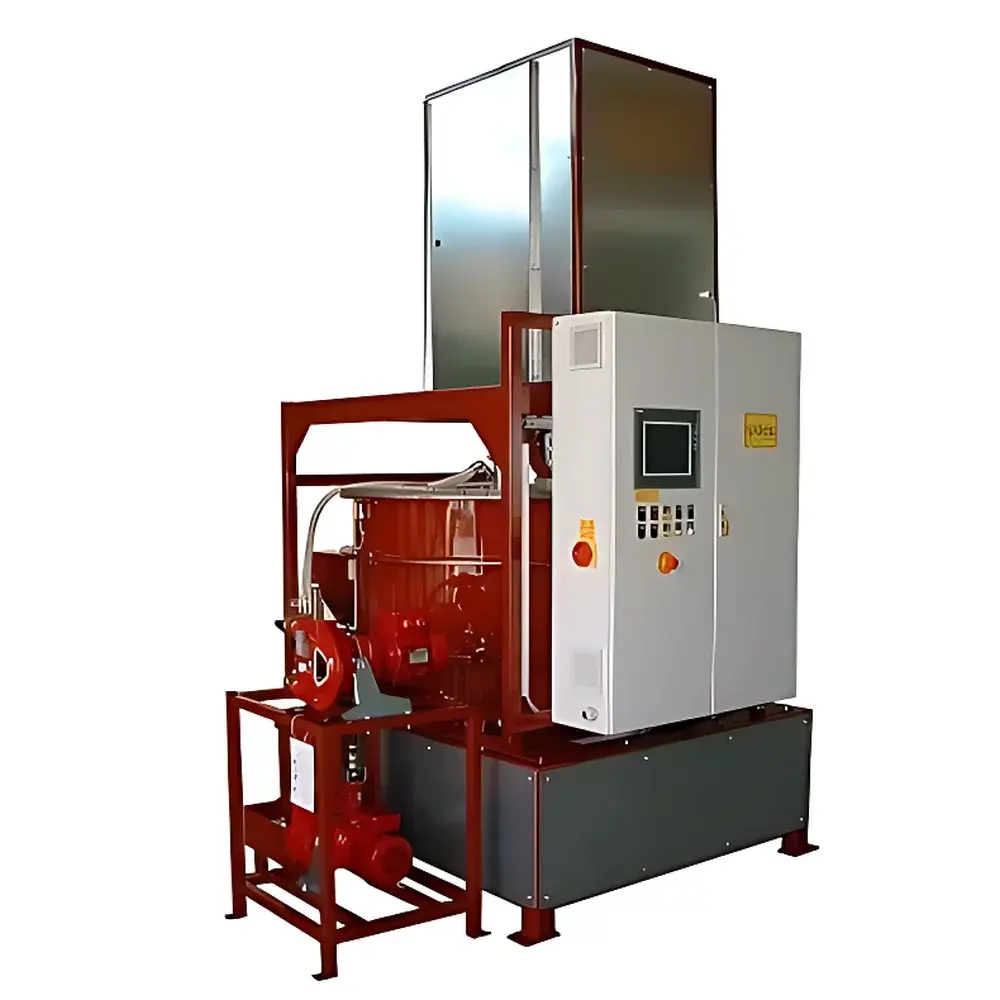
Niklas W.N.5/50 Industrial-Scale Seed Coater & Pelletizer
| Brand | Niklas |
|---|---|
| Origin | Germany |
| Model | W.N.5/50 |
| Batch Capacity | 25–70 L |
| Throughput | 9 t/h |
| Control System | Integrated PLC with Weight- and Time-Based Dosing |
| Liquid Dosing | Precision Metering Pump with 20 L Weighing System |
| Powder Dosing | Synchronized Volumetric Feeder |
| Spray Nozzle | Fine-Mist Atomizer Positioned at Parabolic Seed Trajectory Center |
| Compliance | Designed for ISO 22000-aligned food-grade seed processing environments |
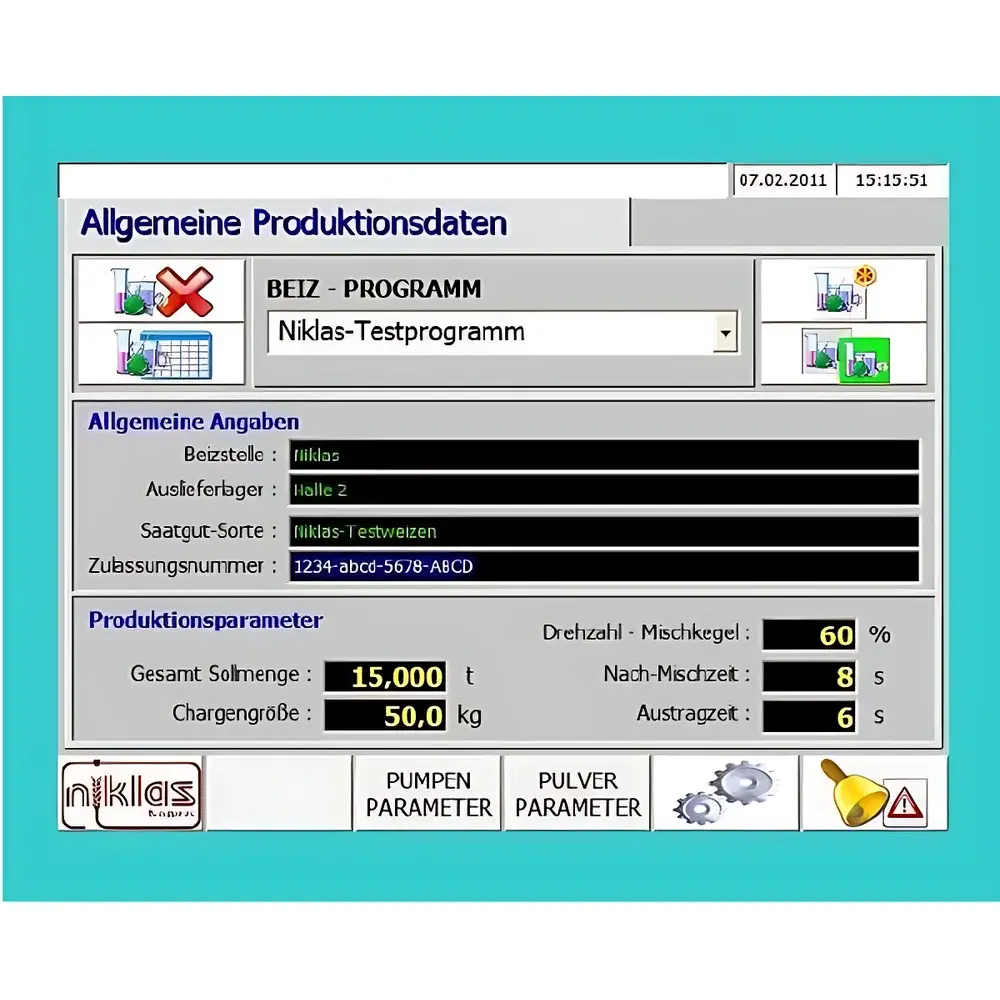
| Software | Recipe-Driven Batch Management with Storage for Multiple Seed Types and Formulations |
Overview
The Niklas W.N.5/50 Industrial-Scale Seed Coater & Pelletizer is a precision-engineered, continuous-batch processing system designed for high-volume, repeatable surface modification of agricultural and horticultural seeds. Unlike laboratory-scale coaters or gravity-fed drum systems, the W.N.5/50 employs a dynamically balanced conical mixing chamber with an eccentric rotational axis—generating a controlled elliptical seed trajectory that ensures uniform exposure to liquid or slurry coatings. This motion creates a stable, vertically oriented parabolic seed curtain at the chamber’s center, where a calibrated fine-mist atomizer delivers chemically precise droplets directly onto the moving seed stream. The system operates on the principle of *controlled collision dynamics*: seeds repeatedly ascend along the rotating cone wall under centrifugal force, then descend via curved baffle guidance—passing through the spray zone multiple times per rotation. This multi-pass exposure, combined with real-time dosing feedback, enables consistent film formation, active ingredient adhesion, and minimal overspray—critical for regulatory compliance in food-grade seed treatment applications.
Key Features
- Conical mixing chamber with adjustable rotational speed (10–60 rpm) and programmable eccentricity to accommodate both free-flowing and cohesive seed types—including small granules (e.g., lettuce), irregular shapes (e.g., carrot), and high-moisture seeds (e.g., brassicas).
- Integrated dual-dosing architecture: a gravimetrically controlled liquid metering pump (with 20 L load-cell weighing system) synchronized with a volumetric powder feeder—ensuring stoichiometric consistency between liquid carriers and solid additives (e.g., fungicides, micronutrients, biochar).
- Center-mounted, pressure-stabilized atomizer delivering <50 µm median droplet size (Dv50), optimized for rapid solvent evaporation and uniform surface wetting without agglomeration.
- PLC-based control unit with HMI touchscreen interface supporting recipe-driven operation: preloaded parameters include seed density, target coating weight gain (% w/w), viscosity compensation curves, and dwell time calibration per formulation.
- Stainless-steel construction (AISI 304 contact surfaces), IP65-rated enclosure, and modular hose routing compliant with EN 1672-2 for food-processing equipment safety.
Sample Compatibility & Compliance
The W.N.5/50 processes seeds ranging from 0.1 mm (e.g., celery) to 8 mm (e.g., maize kernels) without mechanical damage, validated per ISTA Standard 5.3 (Seed Coating Uniformity Assessment). It supports aqueous suspensions, oil-based emulsions, and polymer dispersions with viscosities up to 500 mPa·s. All fluid-contact components meet FDA 21 CFR §177.2600 requirements for indirect food additives. The system is engineered for integration into ISO 22000-certified seed production lines and supports audit-ready electronic batch records—including timestamped dosing logs, weight deviation alerts (<±0.5%), and operator authentication trails—fully traceable for GLP/GMP documentation.
Software & Data Management
The embedded Siemens S7-1200 PLC executes deterministic cycle control (10 ms scan time) and stores ≥1,000 recipes with version history. Each batch generates a structured CSV log containing: start/end timestamps, total mass processed, cumulative liquid/powder dispensed (kg), average rotational velocity, and real-time weight deviation from setpoint. Data export is compatible with LIMS platforms via OPC UA (IEC 62541) and supports 21 CFR Part 11-compliant digital signatures when paired with enterprise identity management. No cloud dependency—the system operates in air-gapped mode by default.
Applications
- Commercial vegetable seed coating: application of thiram, metalaxyl, or biocontrol agents (e.g., Trichoderma harzianum) with ≤3% coefficient of variation in active ingredient distribution (measured by HPLC-UV post-coating extraction).
- Grain legume pelletization: binding clay, lime, and rhizobial inoculants into 2–4 mm spherical pellets for precision planting and enhanced nodulation efficiency.
- Organic certification support: closed-loop handling of OMRI-listed inputs with zero cross-contamination risk between batches via automated chamber purge cycles.
- Seed priming: low-viscosity osmotic solutions (e.g., KNO3, PEG-8000) applied under controlled humidity conditions to induce pre-germination metabolic activation.
FAQ
What seed throughput accuracy does the W.N.5/50 guarantee across its 25–70 L batch range?
The system maintains ±0.8% mass repeatability (RSD) across all batch sizes, verified using NIST-traceable load cells and certified test weights per ISO 7500-1.
Can the W.N.5/50 handle abrasive mineral-based coatings without wear-related performance drift?
Yes—ceramic-coated impeller surfaces and tungsten-carbide metering pump heads are standard; mean time between maintenance exceeds 1,200 operating hours under continuous use with kaolin or diatomaceous earth formulations.
Is remote diagnostics supported without compromising data security?
Field service access requires dual-factor authentication and initiates only upon explicit user consent; no inbound ports are open by default, and firmware updates are signed and validated offline.
How is cleaning validation performed between incompatible chemistries?
The system includes an integrated CIP protocol with programmable rinse cycles (water volume, temperature, duration), and residue detection is verified via ATP bioluminescence swab testing per ISO 14644-1 Class 8 cleanroom standards.




