
FBF FBF1002 Pilot-Scale High-Pressure Homogenizer
| Brand | FBF |
|---|---|
| Origin | Italy |
| Model | FBF1002 |
| Flow Rate | 60–2000 L/h |
| Operating Pressure | 100–600 bar |
| Primary Homogenization Pressure | ≤300 bar (adjustable) |
| Secondary Homogenization Pressure | ≤50 bar (optional, hydraulically controlled) |
| Pump Type | Dual-plunger positive displacement pump |
| Plunger Diameter | 20 mm |
| Speed | 136 rpm |
| Max. Viscosity | 500 cP |
| Max. Inlet Particle Size | 500 µm |
| Max. Fluid Temperature | 90 °C |
| Cleaning Temperature | ≤90 °C |
| Sterilization Temperature | ≤145 °C |
| Cooling Water Requirement | 50–60 L/h at 2–6 bar |
| Air Supply | >3 bar, 0.3 L/min |
| Motor | 2.2 kW, IP55, 380 V / 50 Hz |
| Power Consumption | 3.0 kW |
| Dimensions (W×D×H) | 58 × 85 × 77 cm |
| Weight | 170 kg |
| Lubrication System | Integrated oil pump (0.37 kW, IP55) |
Overview
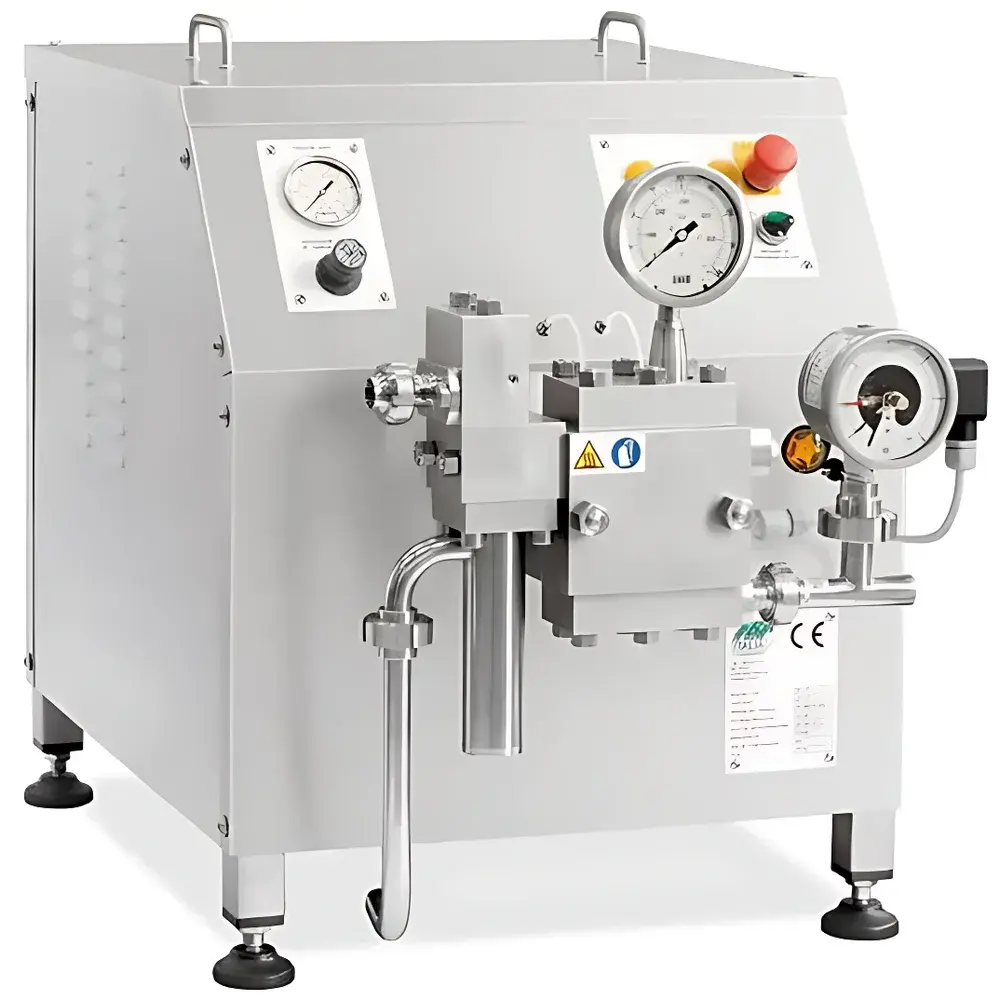
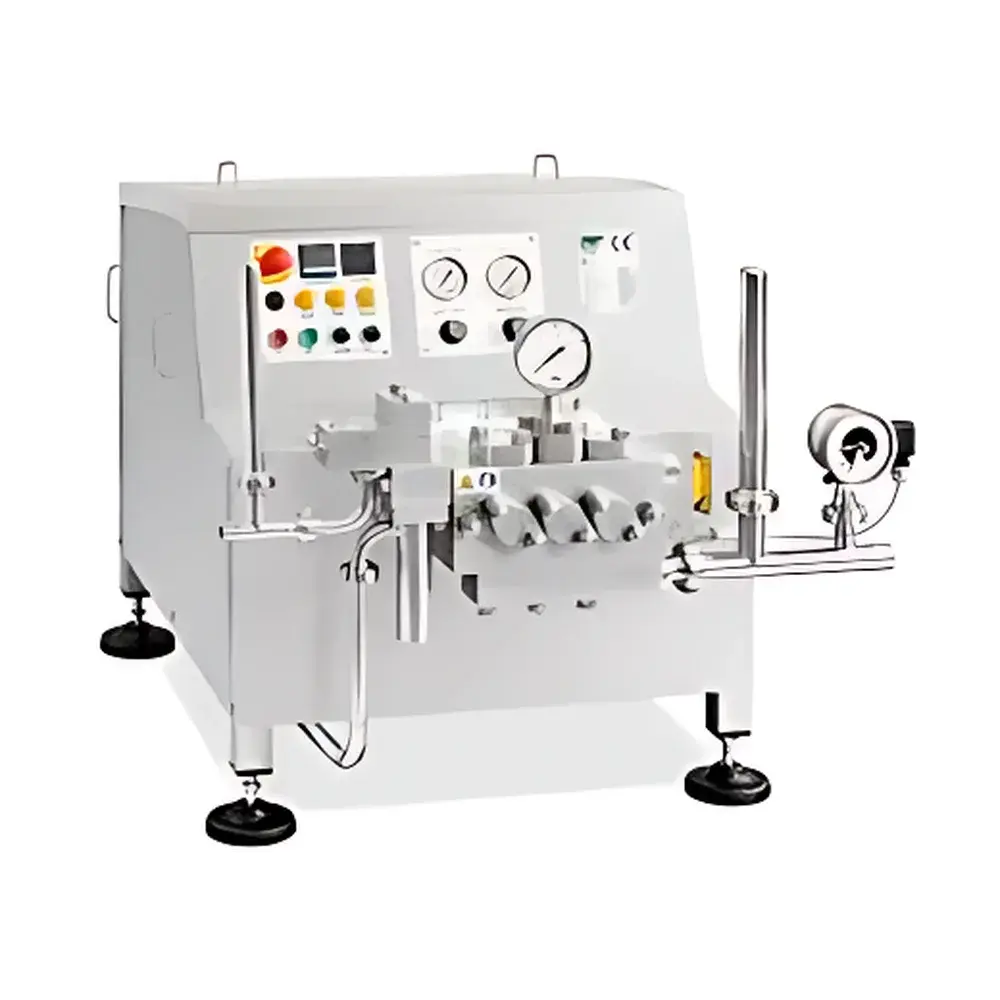
The FBF FBF1002 is a CE-certified pilot-scale high-pressure homogenizer engineered for reproducible, scalable processing of suspensions, emulsions, liposomes, nano-dispersions, and biopharmaceutical formulations. It operates on the principle of controlled turbulent shear, cavitation, and particle impact—generated by forcing fluid through a precisely engineered homogenizing valve under ultra-high pressure. Designed for technology transfer from lab to production, the FBF1002 bridges the gap between benchtop R&D units and full-scale manufacturing systems. Its dual-plunger pump architecture ensures pulse-free flow delivery, critical for consistent droplet or particle size reduction across batch and continuous modes. The system supports both single-stage (primary) and optional two-stage homogenization—where secondary pressure modulation enables fine-tuning of interfacial energy input, essential for stabilizing sensitive colloidal systems without excessive thermal load or mechanical degradation.
Key Features
- Robust dual-plunger pump with 20 mm diameter ceramic-coated plungers rotating at 136 rpm; plunger surfaces feature diamond-like carbon (DLC) coating for exceptional wear resistance and extended service life.
- Homogenizing valve assembly constructed from high-grade stainless steel with precision-machined alignment geometry—guaranteed against cracking or deformation for five years under normal operating conditions.
- Hygienic spring-loaded safety relief valve compliant with EHEDG and 3-A sanitary standards; fully replaceable valve seat and poppet for routine maintenance and validation traceability.
- Energy-efficient homogenizing valve design minimizing vibration transmission and ensuring stable pressure profiles during extended operation.
- Integrated mechanical lubrication system with dedicated 0.37 kW oil pump (IP55 rated), maintaining optimal bearing and seal performance under continuous duty cycles.
- CIP/SIP compatibility: validated cleaning-in-place and sterilization-in-place protocols achievable in ≤30 minutes, with maximum cleaning temperature of 90 °C and sterilization up to 145 °C using saturated steam.
- Optional second-stage homogenization module, hydraulically actuated and independently pressure-regulated (≤50 bar), enabling precise control over post-primary dispersion stabilization.
Sample Compatibility & Compliance
The FBF1002 accommodates aqueous and organic-based formulations with viscosities up to 500 cP and inlet particle sizes up to 500 µm. Its wetted parts—including compression head, valves, and fluid path—are fabricated from electropolished AISI 316L stainless steel meeting ISO 8503-2 and ASME BPE surface finish requirements (Ra ≤ 0.4 µm). The system complies with EU Machinery Directive 2006/42/EC and carries the CE marking. It supports GMP-aligned operations through configurable process logging, alarm-triggered pressure cutoffs, and time-stamped event records—facilitating compliance with FDA 21 CFR Part 11 when integrated with validated SCADA or MES platforms. All elastomeric seals are USP Class VI certified and compatible with SIP conditions.
Software & Data Management
While the base FBF1002 operates via analog controls, digital instrumentation options include calibrated 4–20 mA output pressure transducers, programmable timers for valve activation/deactivation sequences, and analog pressure gauges with audible/visual overpressure alarms. When paired with third-party PLC or HMI systems, the unit supports automated batch reporting, pressure ramp profiling, and audit-trail generation. Optional data acquisition modules enable real-time monitoring of inlet/outlet pressures, cooling water flow, and motor current—supporting root-cause analysis during process qualification (e.g., per ICH Q5A or Q5C) and equipment suitability assessments.
Applications
- Nanoparticle synthesis and size reduction for mRNA-LNP, lipid nanoparticles, and polymeric micelles.
- Cell disruption for intracellular protein extraction (e.g., inclusion bodies, enzymes) while preserving structural integrity.
- Emulsion stabilization in pharmaceutical suspensions, topical formulations, and nutraceutical delivery systems.
- Microbial inactivation and homogenization of vaccine adjuvants requiring tight PDI control.
- Preparation of standardized reference materials for particle sizing method development (e.g., laser diffraction, DLS).
- Process validation studies supporting regulatory filings (EMA, PMDA, Health Canada) where scalability and parameter mapping are required.
FAQ
What is the maximum allowable viscosity for processing on the FBF1002?
The system is rated for fluids up to 500 cP at operating temperature; higher viscosities may require pre-heating or dilution to maintain stable plunger sealing and valve responsiveness.
Can the FBF1002 be used for sterile processing?
Yes—when equipped with “sterile barrier” configuration, SIP-capable valves, and validated CIP/SIP cycles, it meets ISO 13408-1 requirements for aseptic processing equipment.
Is remote pressure monitoring supported?
Standard analog pressure gauges can be upgraded to digital transducers with 4–20 mA output, enabling integration into centralized control rooms or LIMS environments.
What maintenance intervals are recommended for the DLC-coated plungers?
Under typical operation (≤8 h/day, 5 days/week), inspection is advised every 1,500 operating hours; replacement frequency depends on abrasive load but generally exceeds 6,000 hours.
Does the unit support variable flow rate control?
Yes—via optional inverter-driven motor control, allowing continuous adjustment of throughput between 60 and 2000 L/h while maintaining constant pressure setpoints.
Related Products



