
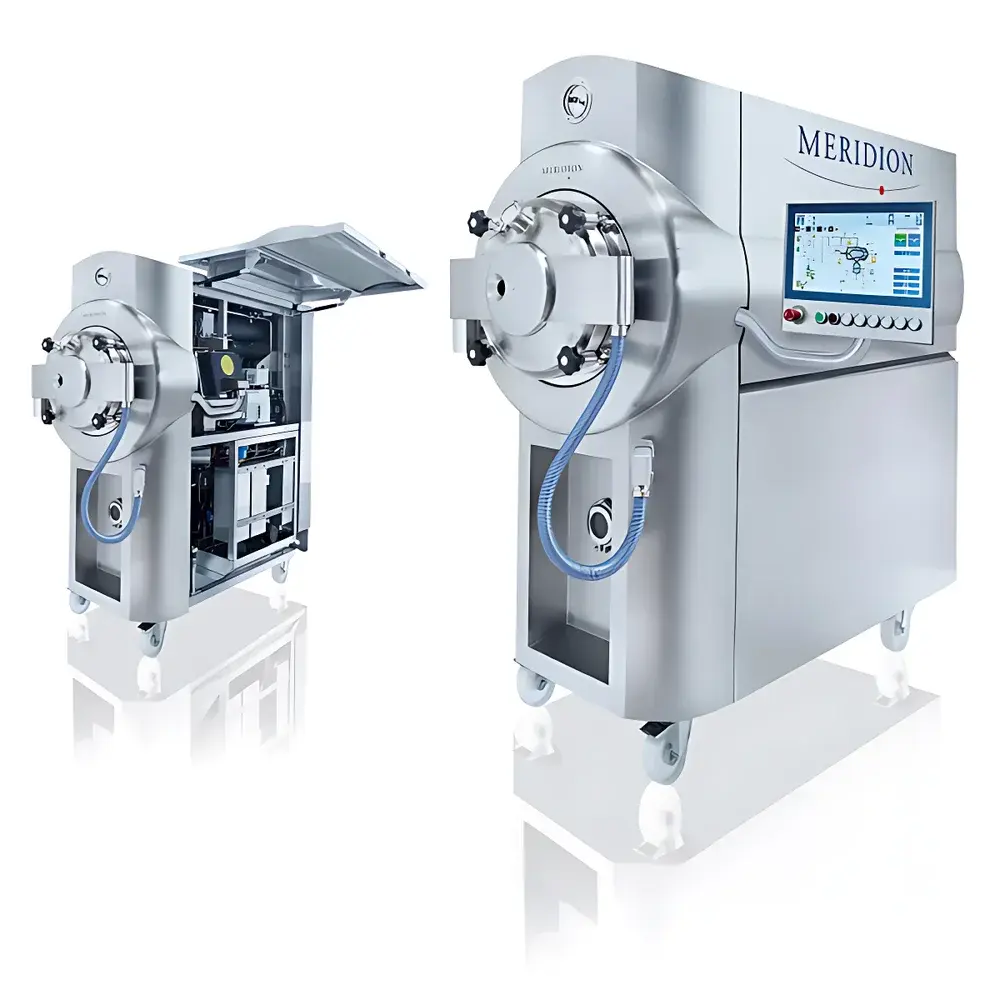

Meridion LyoMotion LAB Dynamic Freeze Dryer
| Brand | Meridion |
|---|---|
| Origin | Germany |
| Model | LyoMotion LAB |
| Type | Dynamic Spray Freeze-Drying System (Rotating Drum Configuration) |
| Application | Laboratory-Scale Pharmaceutical & Biotech R&D |
| Vacuum Level | < 0.1 mbar |
| Condensation Capacity (24h) | < 5 kg |
| Chamber Volume | 0.3–2 L |
| Overall Dimensions | 790 × 2200 × 1990 mm |
| Weight | 950 kg |
| Power Supply | 230 V, 3 kW |
| Compressed Air Consumption | 5 m³/h @ 6 bar |
| Cooling Water Consumption | 5 L/min |
| Condenser Temperature | –75 °C |
| Drum Temperature Range | –50 °C to +50 °C |
| Control System | HMI-based PLC with Touchscreen Interface |
Overview
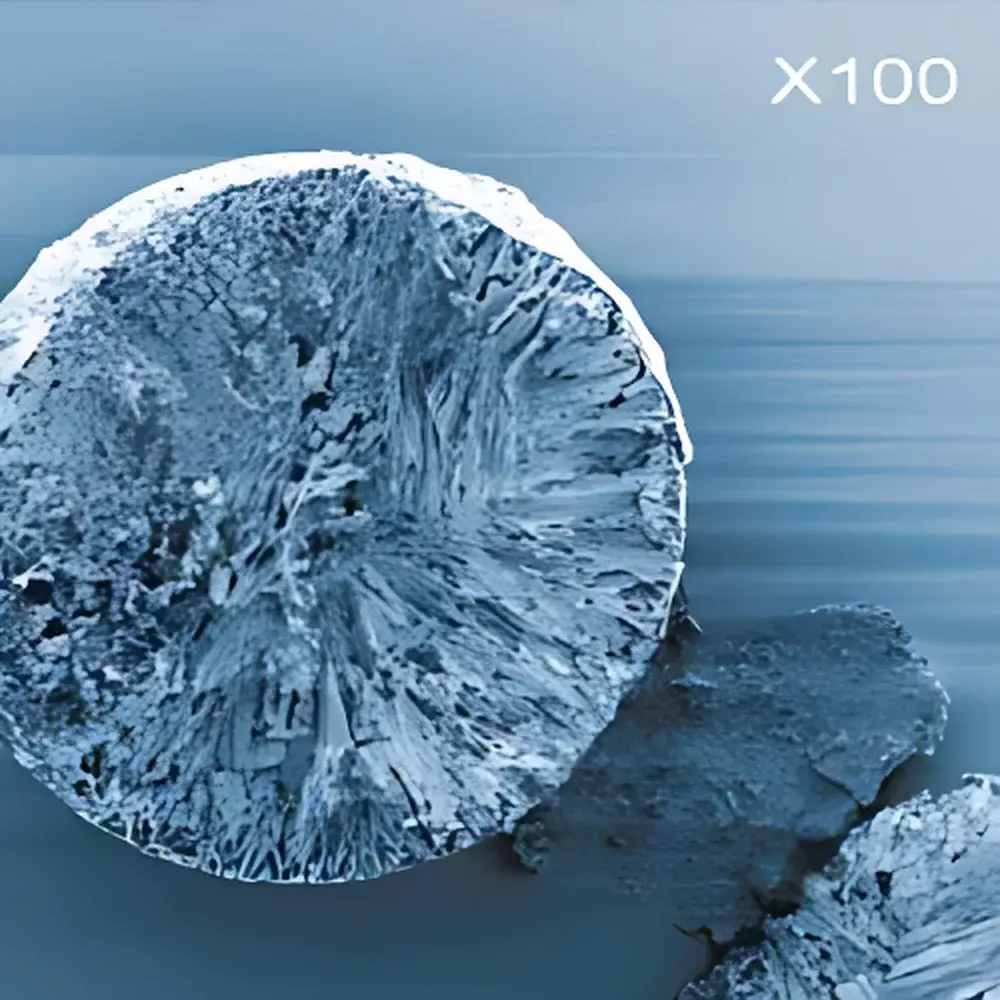
The Meridion LyoMotion LAB is a laboratory-scale dynamic freeze dryer engineered for advanced spray freeze-drying (SFD) of thermolabile biopharmaceuticals, peptides, vaccines, and functional excipients. Unlike conventional shelf-based lyophilizers relying on static batch freezing, the LyoMotion LAB employs a continuously rotating dual-wall drum cooled to –75 °C, enabling rapid, uniform cryogenic solidification of atomized droplets under controlled vacuum conditions. This process leverages principles of convective heat transfer and nucleation kinetics in free-fall geometry—where liquid feed is precisely nebulized via high-precision nozzles, then solidified mid-air before contacting the chilled drum surface. The resulting microspheres exhibit narrow particle size distribution (200–800 µm), high sphericity, excellent flowability, and minimal aggregation—critical attributes for downstream processing such as direct compression, inhalation formulation, or oral disintegrating tablet (ODT) development.
Key Features
- Dynamic rotary drum architecture eliminates need for vial loading/unloading mechanisms—enabling continuous, gravity-fed sample introduction and collection
- Integrated two-stage refrigeration system with –75 °C condenser and independently controllable drum temperature (–50 °C to +50 °C) for process flexibility across freezing, primary drying, and secondary drying phases
- HMI-driven PLC control system with real-time monitoring of vacuum pressure (< 0.1 mbar), chamber temperature, drum rotation speed, and condenser load
- Infrared radiation heating elements ensure precise, non-contact energy delivery during drying—minimizing thermal stress on sensitive APIs
- Modular design supports optional SCADA integration (15″ touchscreen), automated WIP/CIP cleaning cycles, and vacuum-integrated sampling ports compliant with ISO 13485 and FDA 21 CFR Part 11 data integrity requirements
- No requirement for pre-filled vials or rigid primary packaging—supports flexible final container formats including glass vials, polymer tubes, or bulk collection vessels
Sample Compatibility & Compliance
The LyoMotion LAB accommodates aqueous, organic, and co-solvent-based formulations—including protein solutions, mRNA-LNPs, nanosuspensions, and amorphous solid dispersions. Its open-drum configuration allows handling of viscous feeds up to 15 cP without nozzle clogging. All wetted surfaces are electropolished AISI 316L stainless steel, certified to meet ASME BPE-2022 surface finish standards (Ra ≤ 0.4 µm). The system complies with ICH Q5C (stability of biotechnological/biological products), USP (characterization of freeze-dried products), and ISO 22000–2018 hygiene design principles. Full audit trail functionality, electronic signature support, and configurable user access levels satisfy GLP/GMP documentation requirements for regulatory submissions.
Software & Data Management
Standard control firmware includes time-stamped event logging, parameter trending, and alarm history with export capability in CSV and PDF formats. Optional SCADA package adds remote monitoring via Ethernet/IP, OPC UA server integration, and automated report generation aligned with Annex 11 validation protocols. All process parameters—including vacuum ramp rate, drum angular velocity, IR power modulation, and condenser frost accumulation—are recorded at ≥1 Hz resolution. Data storage adheres to ALCOA+ principles (Attributable, Legible, Contemporaneous, Original, Accurate, Complete, Consistent, Enduring, Available) for regulatory inspection readiness.
Applications
- Rapid screening of lyoprotectant matrices for monoclonal antibodies and viral vectors
- Development of multi-component solid dosage forms—e.g., layered microspheres containing incompatible actives for sequential release
- Manufacture of spherical freeze-dried powders optimized for dry powder inhalers (DPIs) per EMA/CHMP/QWP/300513/2021 guidelines
- Process characterization studies supporting Quality by Design (QbD) frameworks and design space definition per ICH Q8(R2)
- Scale-down modeling for tech transfer to Meridion’s industrial LyoMotion PRO platforms (≥50 kg/hr throughput)
- Stability-indicating method development for accelerated degradation studies under controlled humidity and temperature gradients
FAQ
What distinguishes dynamic spray freeze-drying from conventional lyophilization?
Dynamic SFD avoids ice crystal growth artifacts associated with slow shelf freezing; instead, it achieves ultra-rapid solidification (< 100 ms) yielding amorphous or metastable crystalline structures with higher surface area and improved reconstitution profiles.
Can the LyoMotion LAB be validated for GMP use?
Yes—its modular architecture, full sensor coverage, and electronic record capabilities support IQ/OQ/PQ execution per ASTM E2500-13 and EU GMP Annex 15. Validation packages include FAT/SAT documentation and traceable calibration certificates.
Is the system compatible with sterile processing?
While not Class A-certified out-of-the-box, the unit may be integrated into isolator or RABS environments using its WIP/CIP-ready interface and HEPA-filtered air purge option (optional).
What sample volumes can be processed per cycle?
Batch capacity ranges from 0.3 L to 2 L of liquid feed, corresponding to ~50–300 g of dried product depending on solids content and excipient density.
Does Meridion provide application support for formulation development?
Yes—Meridion’s Application Lab in Basel offers collaborative feasibility studies, DOE-based process optimization, and comparative analysis against static lyophilization using identical API/excipient systems.
Related Products



