
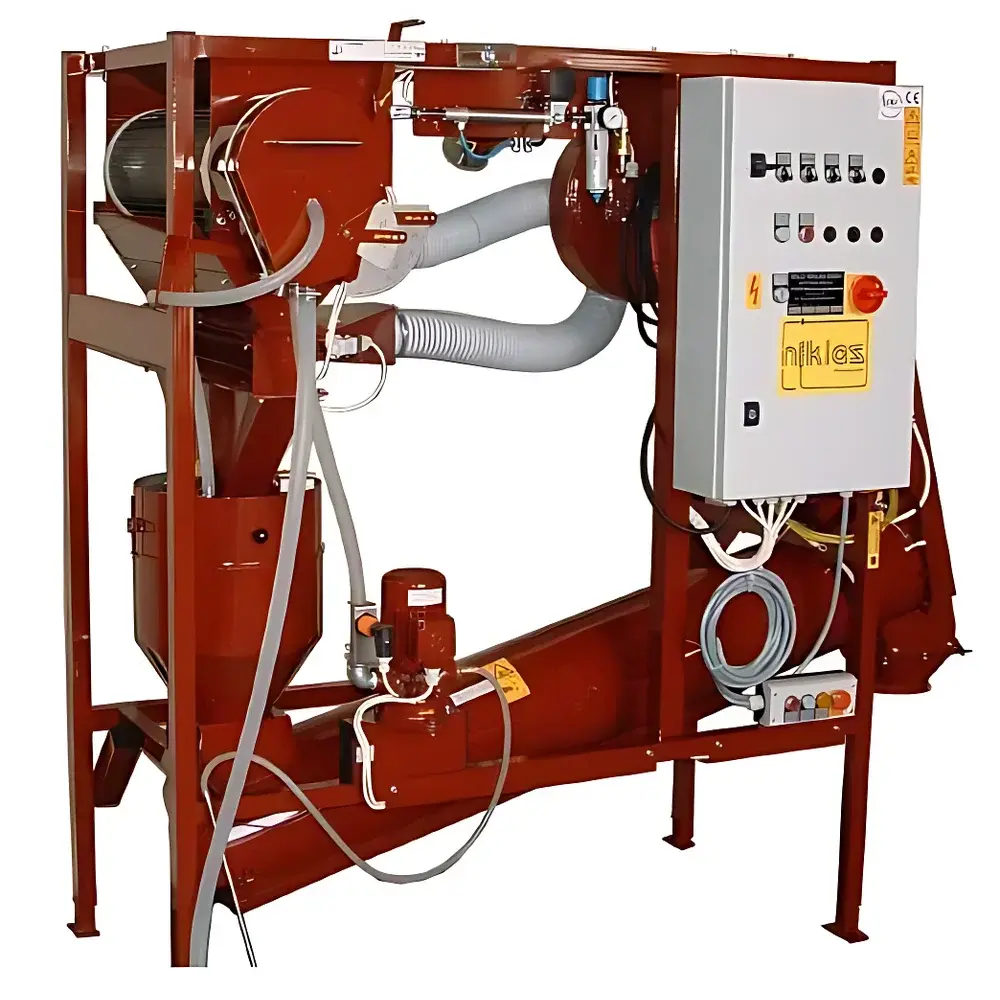
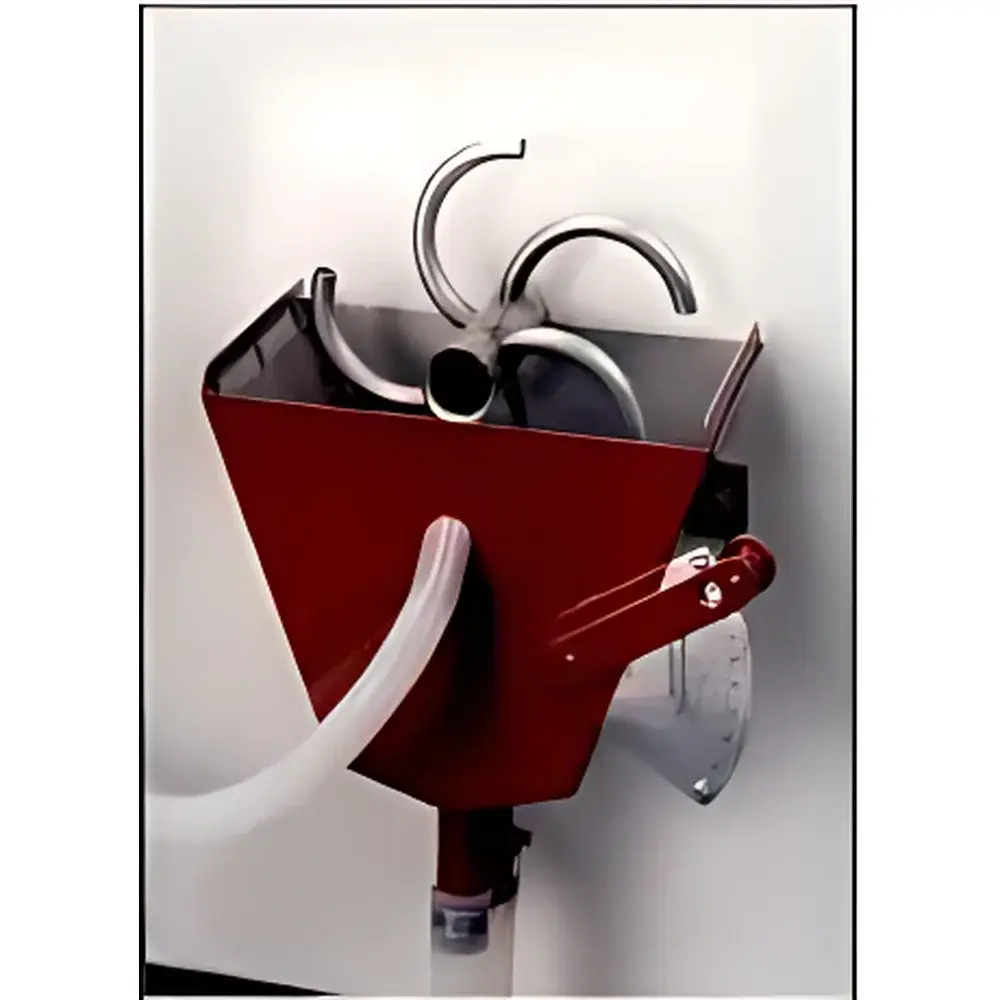
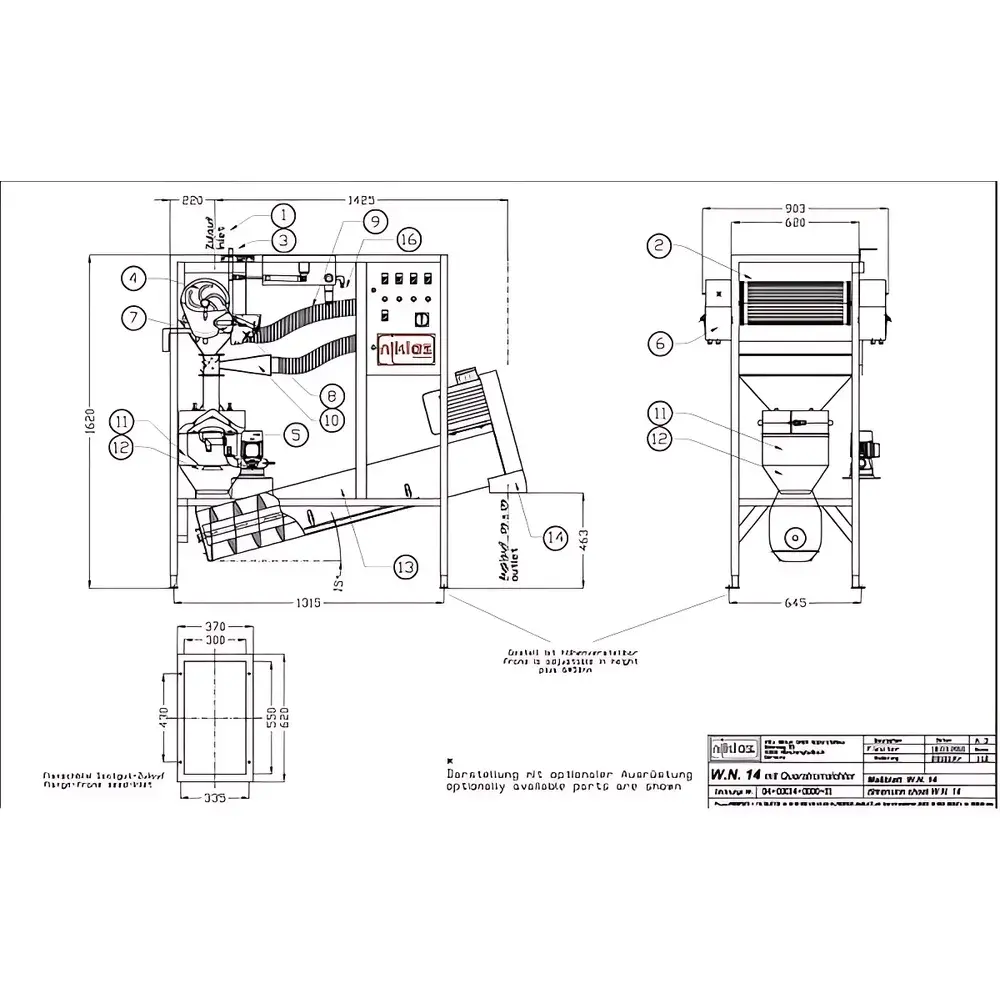
Niklas W.N. 14 Continuous Seed Coater
| Brand | Niklas |
|---|---|
| Origin | Germany |
| Model | W.N. 14 |
| Coating Capacity | 2–14 t/h |
| Liquid Dosing Range | 0.3–2.6 mL/kg, 0.9–4.2 mL/kg, 2.7–6.3 mL/kg, 3.7–8.6 mL/kg |
| Dual-Liquid Capability | Yes |
| Compliance | JKI Federal Research Centre Certified |
| Construction | Stainless Steel Mixing Drum with Nylon-Brush Auger |
| Dosing Principle | Patented Niklas Metering System (Mechanical Seed Roller + Precision Liquid Metering Wheel) |
| Liquid Delivery | Centrifugal Pump with Overflow-Regulated Metering Trough and Recirculation Loop |
| Optional Features | Dust Extraction Unit, Cross-Flow Sieve, Compressed Air Interface (for Pneumatic Actuation), Dual-Bagging Nozzle Adapter (DN 150 mm) |
Overview
The Niklas W.N. 14 Continuous Seed Coater is an industrial-grade, precision-engineered system designed for high-throughput, repeatable seed treatment in agricultural seed processing facilities, contract coating services, and certified seed production units. It operates on a continuous-flow principle grounded in mechanical volumetric metering—combining a pressure-driven seed metering roller with a synchronized, gear-coupled liquid metering wheel. This patented Niklas dosing architecture eliminates reliance on electronic flow sensors or closed-loop feedback for baseline operation, ensuring intrinsic reproducibility across shifts, operators, and seasonal seed lots. The system is validated and officially approved by the Julius Kühn-Institut (JKI), Germany’s Federal Research Centre for Cultivated Plants, confirming compliance with national regulatory frameworks governing phytosanitary seed treatment efficacy and operator safety. Constructed entirely from food-grade stainless steel (AISI 304), the W.N. 14 integrates a helical nylon-brush auger within its mixing drum—engineered to deliver uniform coating distribution without mechanical damage to delicate seeds such as peas, lentils, or soybeans, while maintaining robust performance on dense grains like maize and wheat.
Key Features
- Patented dual-mechanical metering: Seed mass flow regulated via adjustable rubber-tubed pressure roller; liquid volume per kg seed precisely set by interchangeable metering wheels and overflow-controlled trough geometry.
- Four calibrated liquid dosing ranges (0.3–2.6, 0.9–4.2, 2.7–6.3, 3.7–8.6 mL/kg) accommodate diverse formulations—from low-volume fungicides to high-viscosity polymer-based film coatings.
- Dual-liquid capability supports sequential or co-application of two active ingredients without cross-contamination, using independent metering troughs and recirculating pump circuits.
- Integrated cross-flow sieve and optional dust extraction unit remove fines, chaff, and surface dust pre-coating—critical for achieving consistent adhesion and minimizing nozzle clogging.
- Pneumatically actuated isolation valves automatically interrupt seed feed when liquid supply is paused, preventing dry-seed passage and ensuring process traceability.
- Stainless steel spray chamber with high-speed rotating conical atomizer ensures laminar, non-turbulent雾化—producing fine, evenly distributed droplets across the entire seed stream cross-section.
- Modular discharge interface (DN 150 mm) compatible with downstream conveyors, bagging lines, or pneumatic transfer systems; optional dual-bagging nozzles enable parallel packaging.
Sample Compatibility & Compliance
The W.N. 14 accommodates a broad spectrum of agricultural seeds—including cereals (wheat, barley, rye), coarse grains (maize, sorghum), legumes (peas, beans, lentils), and oilseeds (rapeseed, sunflower)—without hardware modification. Volumetric weight calibration is performed manually via graduated scale adjustment on the seed metering roller, enabling rapid changeover between species differing significantly in 1000-kernel weight. All wetted components comply with EU Regulation (EC) No 1935/2004 on materials intended to come into contact with foodstuffs. The system meets JKI’s technical requirements for seed treatment equipment (JKI Guideline “Zulassung von Saatgutbehandlungsgeräten”, Version 2021), including minimum coating uniformity (CV ≤ 15% per batch), maximum overspray loss (< 3%), and documented repeatability across ≥10 consecutive 1-ton test runs. It supports GLP-aligned operational documentation when integrated with external data loggers.
Software & Data Management
The W.N. 14 is a mechanically governed system with no embedded microprocessor or proprietary software. All adjustments—seed flow rate, liquid dosage, overflow threshold, and pneumatic sequencing—are executed via calibrated mechanical levers, knurled dials, and fixed-position stops. This architecture eliminates firmware dependencies, cybersecurity vulnerabilities, or validation overhead associated with electronic control systems. Process parameters are recorded manually in batch logs compliant with ISO 9001:2015 Clause 8.5.2 (Identification and Traceability) and EU Directive 2002/53/EC Annex I (Seed Marketing). Optional analog output signals (4–20 mA) for seed flow and liquid pressure can be interfaced with third-party SCADA or MES platforms for centralized monitoring, provided external signal conditioning is implemented per IEC 61000-6-2 EMC standards.
Applications
- Commercial-scale application of fungicides, insecticides, nematicides, and biological inoculants under contract manufacturing agreements.
- Production of certified pre-treated seed meeting OECD Seed Schemes and National Variety Listing requirements.
- R&D trials requiring precise, repeatable dosing across multiple formulation variants (e.g., comparative efficacy studies per EPPO PP 1/212(1)).
- Organic seed treatment using approved natural compounds (e.g., thyme oil, chitosan), where low-shear mixing and minimal thermal input preserve bioactivity.
- Integration into fully automated seed conditioning lines—paired with optical sorters, moisture analyzers, and weight checkers—under harmonized HACCP-based food safety plans.
FAQ
Does the W.N. 14 require electrical power for core metering functions?
No. Primary seed and liquid metering are fully mechanical and self-powered by seed feed pressure; only optional features (dust extraction fan, pneumatic solenoids, analog outputs) require auxiliary power.
Can it handle highly viscous polymer binders or suspension concentrates?
Yes. The centrifugal pump and overflow-regulated metering trough maintain stable delivery up to 2,500 mPa·s viscosity; metering wheel geometry is selected based on formulation rheology.
Is calibration traceable to national standards?
Yes. JKI certification includes annual verification of roller circumference, wheel pitch diameter, and overflow weir height against DIN EN ISO 17025-accredited dimensional metrology.
What maintenance intervals are recommended for continuous operation?
Daily visual inspection of brush auger wear and nozzle clearance; bi-weekly lubrication of gear couplings; quarterly verification of rubber tube elasticity on the seed roller.
How is cleaning validated between different seed species or chemical treatments?
A documented dry-run protocol (minimum 15 minutes at 30% capacity with inert carrier) followed by visual inspection of mixing drum and spray cone surfaces satisfies JKI-defined cleaning verification criteria.





