
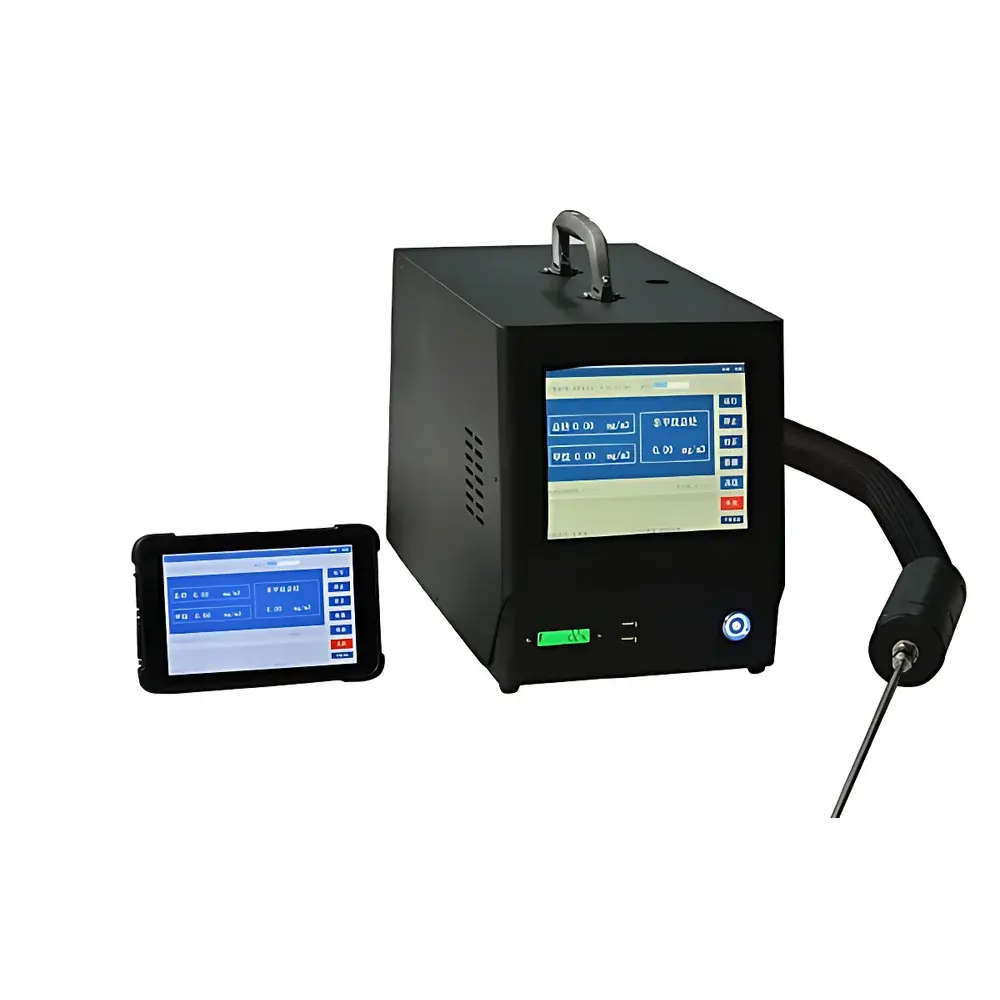
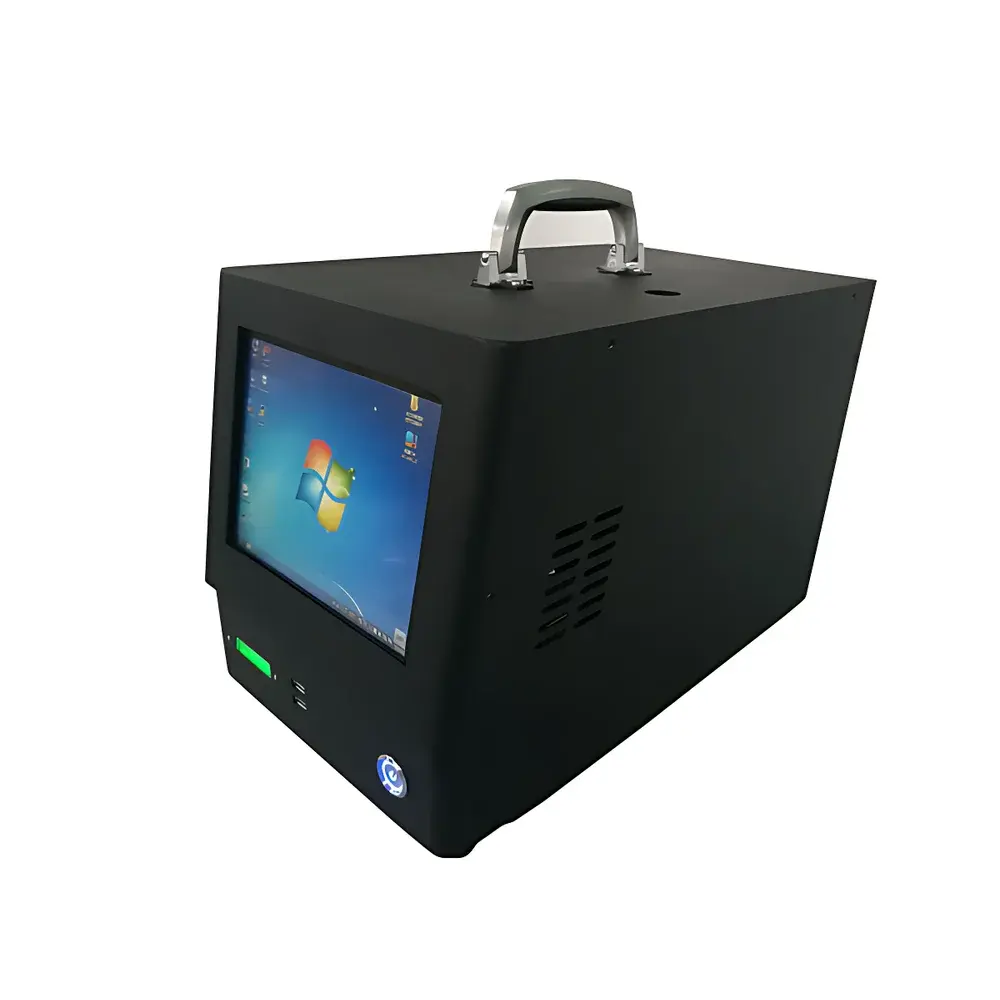
Synpec P200GC Portable Gas Chromatograph
| Brand | Synpec |
|---|---|
| Origin | Shanghai, China |
| Manufacturer Type | OEM Manufacturer |
| Region of Origin | Domestic (China) |
| Model | P200GC |
| Price Range | USD 14,000 – 43,000 |
| Dimensions | 410 mm (L) × 280 mm (W) × 235 mm (H) |
| Weight | ≤10 kg |
| Analysis Cycle | NMHC: ≥1 min |
| BTEX | ≥5 min |
| Measurement Range | 0–50,000 ppm |
| LOD | 0.05 ppm |
| Repeatability | RSD ≤1% |
| Accuracy | ±1% of full scale |
| Power Supply | Integrated rechargeable battery, >6 h runtime |
| Operating Temperature | 10–45 °C |
| Detection Principle | Flame Ionization Detection (FID) with capillary column separation |
| Sample Path | Fully heated from inlet to detector (up to 220 °C) |
| Connectivity | Industrial-grade Wi-Fi, USB, Ethernet, optional thermal printer interface |
| Compliance | Designed for field deployment in accordance with EPA Method 25A, ASTM D6348, and ISO 11843-2 for trace hydrocarbon quantification |
Overview
The Synpec P200GC Portable Gas Chromatograph is a field-deployable analytical instrument engineered for real-time, on-site quantification of volatile organic compounds (VOCs), with validated performance for methane (CH₄), non-methane hydrocarbons (NMHC), and aromatic compounds including benzene, toluene, ethylbenzene, and xylenes (BTEX). Based on gas chromatographic separation coupled with flame ionization detection (FID), the system delivers laboratory-grade precision under ambient outdoor conditions. Its core architecture integrates a temperature-controlled capillary column oven, a high-stability FID detector, and a fully heated sample pathway — from the probe inlet through transfer lines to the detector jet — eliminating condensation artifacts in humid or low-temperature environments. Unlike benchtop GC systems requiring external gas supplies and climate-controlled labs, the P200GC operates autonomously via its internal lithium-ion battery and integrated zero-air/H₂ fuel generation, enabling uninterrupted operation for over six hours during continuous monitoring campaigns.
Key Features
- Fully Heated Sample Pathway: All critical components — sampling probe, heated transfer line (up to 220 °C), injection valve, column oven, and detector — maintain active temperature control to prevent adsorption, condensation, or fractional loss of polar or high-boiling VOCs.
- Integrated Field Power & Gas Management: Built-in rechargeable battery and electrochemical hydrogen generator eliminate dependency on external gas cylinders or AC mains, supporting true walk-up operation at remote sites.
- Modular Column Configuration: Pre-configured capillary columns optimized for either NMHC screening (C₁–C₆) or BTEX resolution (using 60 m × 0.32 mm ID, 1.0 µm film thickness DB-624 or equivalent); column switching is software-selectable without hardware intervention.
- Single-Hand Portability: Compact footprint (410 × 280 × 235 mm) and mass ≤10 kg allow rapid transport across industrial facilities, stack access platforms, or roadside emission checkpoints without auxiliary lifting equipment.
- Automated Workflow Engine: Embedded firmware handles sequence-based auto-calibration, peak integration, retention time locking, and linear range correction — reducing operator dependency and minimizing field data interpretation errors.
- Industrial-Grade Human Interface: Detachable ruggedized touchscreen workstation with IP65-rated enclosure; supports local parameter configuration, real-time chromatogram visualization, and offline method editing via standard USB-C or Wi-Fi.
Sample Compatibility & Compliance
The P200GC is validated for direct analysis of undiluted ambient air, stack effluent, and fugitive emissions across diverse matrices — including high-humidity exhaust streams (RH up to 95%), low-concentration urban air (sub-ppb to ppm levels), and high-concentration process gases (up to 50,000 ppm). It meets functional equivalency requirements of U.S. EPA Method 25A for total gaseous organic concentration, ASTM D6348 for determination of VOCs in emissions using GC-FID, and ISO 11843-2 for estimation of detection capability in instrumental analysis. While not certified as a Class I Div 1 device, its design incorporates intrinsic safety considerations for use in non-hazardous zones per IEC 60079-0. Data integrity complies with ALCOA+ principles; audit trails, electronic signatures, and method versioning are supported in optional GLP/GMP-compliant software mode aligned with FDA 21 CFR Part 11 expectations.
Software & Data Management
Synpec’s GCControl™ v3.2 firmware provides embedded acquisition, processing, and reporting capabilities. Raw chromatograms and processed results (peak area, concentration, retention time) are stored in vendor-neutral .csv and .cdf formats. The workstation supports direct export to LIMS via TCP/IP or secure FTP, and enables batch report generation compliant with ISO/IEC 17025 documentation standards. Optional cloud synchronization allows centralized fleet monitoring, remote diagnostics, and over-the-air firmware updates. All calibration curves, integration parameters, and instrument logs are timestamped and digitally signed to satisfy regulatory traceability requirements for environmental compliance reporting.
Applications
- Real-time stack emission monitoring for combustion sources (boilers, incinerators, flare stacks)
- Leak detection and repair (LDAR) surveys in petrochemical and refining facilities
- VOC screening in automotive paint booths and coating application zones
- Methane leakage verification along natural gas transmission pipelines and distribution networks
- Mobile ambient air quality mapping in urban and industrial boundary zones
- Emergency response screening following chemical spills or accidental releases
- QA/QC verification of fixed CEMS installations during commissioning or maintenance outages
FAQ
What carrier gas does the P200GC use?
It employs internally generated high-purity hydrogen (≥99.999%) as both fuel for the FID and carrier gas — eliminating the need for external helium or nitrogen supplies.
Can the instrument be calibrated in the field without lab support?
Yes. Onboard multi-point calibration is performed using certified permeation tubes or dynamic dilution of certified gas standards; all calibration events are logged with metadata including date, operator ID, and uncertainty estimates.
Is method validation documentation available for regulatory submissions?
Synpec provides a comprehensive Instrument Qualification Package (IQ/OQ/PQ protocols), method validation reports per ISO/IEC 17025, and raw data audit packages upon request.
How is data security handled during wireless transmission?
Wi-Fi communication uses WPA3-Enterprise encryption; all remote sessions require dual-factor authentication and are terminated after 15 minutes of inactivity.
What consumables require periodic replacement?
FID jet cleaning kit (every 200 runs), column (typical lifetime >1,000 injections), and O-rings/seals (recommended annually or after 500 hours of heated operation).




