
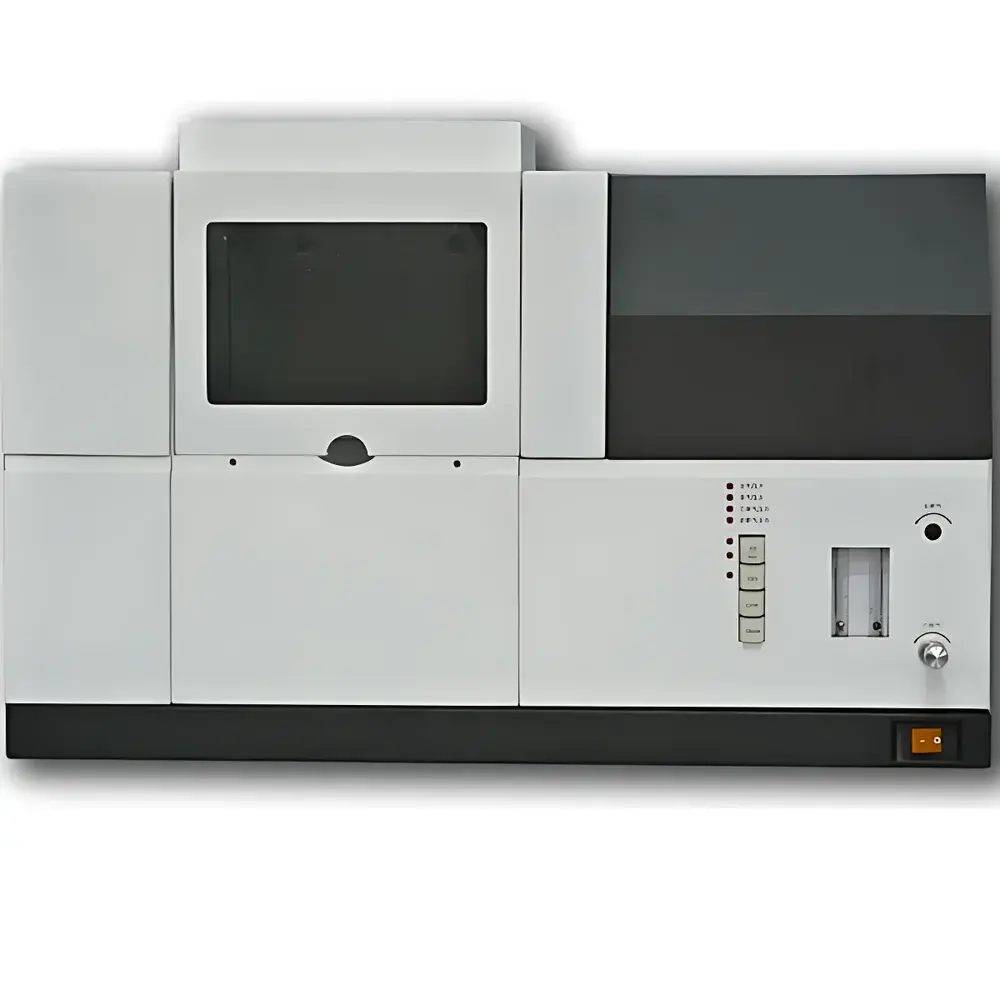
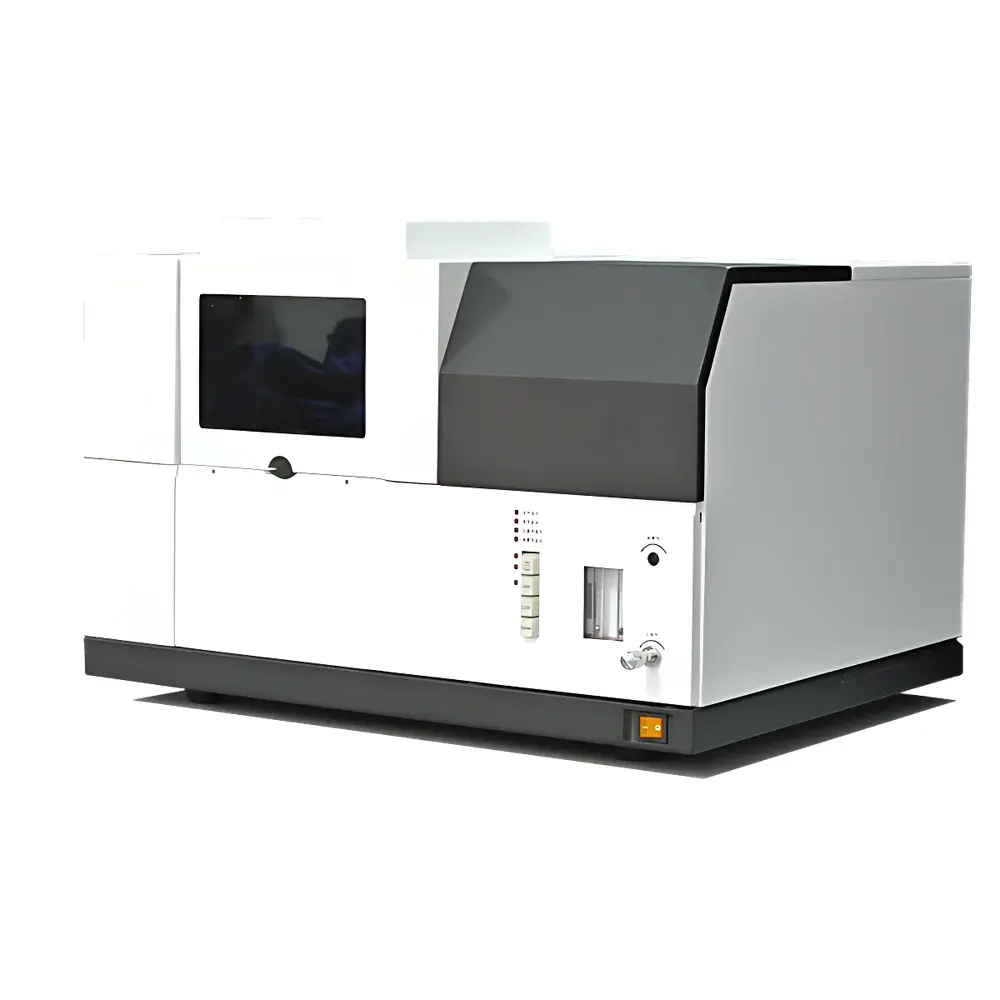
Synpec AA3510 Single-Flame Atomic Absorption Spectrometer
| Brand | Synpec |
|---|---|
| Origin | Shanghai, China |
| Manufacturer Type | Manufacturer |
| Instrument Type | Flame AAS |
| Model | AA3510 |
| Wavelength Range | 190–900 nm |
| Light Source | 4/6-lamp turret |
| Wavelength Repeatability | ±0.1 nm |
| Wavelength Accuracy | ±0.2 nm across full range |
| Spectral Bandwidth Options | 0.1, 0.2, 0.4, 1.0, 1.2, 2.0 nm |
| Resolution | 0.2 nm (resolves Mn doublet at 279.5/279.8 nm, valley-to-peak energy ratio <30%) |
| Monochromator | Plane grating (1800 lines/mm) |
| Optical System | Single-beam |
| Detector | Photomultiplier tube (PMT) |
| Background Correction | D₂ lamp + self-absorption method |
| Background Correction Capacity | ≥50× at 1 ABS background signal |
| Static Baseline Drift | ≤0.002 ABS/30 min (Cu) |
| Dynamic Baseline Drift (ignition) | ≤0.004 ABS/30 min (Cu) |
| Sensitivity | ≤0.025 µg/mL for 1% absorption |
| Detection Limit (Cu) | ≤0.006 µg/mL |
| Precision (RSD) | ≤0.5% (Cu, A > 0.8 ABS) |
| Flame Systems | Air–acetylene (100 mm burner head) |
| Safety Features | Automatic gas cutoff on low pressure, power interruption, flameout, or burner mismatch |
| Dimensions | 700 × 500 × 430 mm |
| Weight | 80 kg |
| Power Supply | 220 V AC |
Overview
The Synpec AA3510 is a benchtop single-flame atomic absorption spectrometer engineered for routine elemental quantification in environmental, pharmaceutical, food safety, and industrial quality control laboratories. It operates on the fundamental principle of atomic absorption spectroscopy: ground-state atoms in a flame absorb characteristic wavelengths of light emitted by element-specific hollow cathode lamps. The instrument measures the attenuation of this resonance line intensity to determine analyte concentration via Beer–Lambert law correlation. Designed around a robust single-beam optical architecture with a high-line-density plane grating (1800 lines/mm), the AA3510 delivers stable photometric performance across its full 190–900 nm spectral range. Its dual background correction capability—combining deuterium (D₂) continuum source and self-absorption techniques—enables reliable compensation for structured molecular absorption and scattering effects, particularly critical in complex matrices such as soil digests or biological samples.
Key Features
- Four- or six-position automated lamp turret for rapid multi-element analysis without manual lamp swapping
- Six selectable spectral bandwidths (0.1, 0.2, 0.4, 1.0, 1.2, 2.0 nm) to optimize resolution vs. signal-to-noise trade-offs per element
- High-precision mechanical design ensuring wavelength repeatability of ±0.1 nm and accuracy of ±0.2 nm across the entire UV–Vis range
- Dual-mode background correction: D₂ lamp for broad-band correction and self-absorption mode for enhanced specificity in high-background applications
- Integrated flame safety interlock system compliant with IEC 61010-1:2010 requirements, featuring automatic fuel gas shutoff upon detection of flameout, pressure loss, power failure, or burner misalignment
- Modular flame system supporting both air–acetylene (standard 100 mm slot burner) and optional nitrous oxide–acetylene (50 mm) configurations for refractory element analysis (e.g., Al, Si, V)
- PC-controlled operation via dedicated Windows-based workstation software with audit-trail-ready method storage and recall functionality
Sample Compatibility & Compliance
The AA3510 accommodates aqueous liquid samples prepared by acid digestion (e.g., EPA Method 200.7, ISO 11885) or dilution, with typical sample introduction via continuous-flow nebulization into the flame. Its flame atomization efficiency supports direct determination of over 30 metals—including Na, K, Ca, Mg, Fe, Cu, Zn, Mn, Pb, Cd, and Cr—at sub-ppb to ppm levels. The instrument meets core performance criteria defined in ASTM E1909–22 (Standard Guide for Atomic Absorption Spectroscopy) and aligns with ISO/IEC 17025:2017 requirements for calibration traceability and measurement uncertainty estimation. All software operations—including method creation, data acquisition, curve fitting, and report generation—support configurable electronic signatures and time-stamped audit logs, facilitating compliance with GLP and FDA 21 CFR Part 11 when deployed in regulated environments.
Software & Data Management
The AA3510 is operated through a purpose-built Windows application offering intuitive instrument control, real-time spectral visualization, and quantitative analysis workflows. Key software capabilities include multi-point calibration curve generation (linear, quadratic, or forced-zero), automatic blank subtraction, peak-area or peak-height integration, and customizable reporting templates. Stored methods retain all instrumental parameters (wavelength, slit width, lamp current, flame gas flows, background correction mode), enabling full procedural reproducibility. Raw absorbance data and processed results are saved in vendor-neutral CSV and XML formats, compatible with LIMS integration and third-party statistical packages. The software supports user role-based access control and provides full audit trail records—including operator ID, timestamp, parameter changes, and result modifications—for regulatory review.
Applications
The AA3510 serves as a primary tool for trace metal analysis in diverse sectors: monitoring heavy metals (Pb, Cd, As) in drinking water per WHO and EU Directive 98/83/EC; quantifying essential minerals (Ca, Mg, Fe, Zn) in fortified foods and dietary supplements according to AOAC 984.27; verifying catalyst residue limits in pharmaceutical intermediates per ICH Q2(R2); and assessing metal leaching from packaging materials under ISO 18167. Its air–acetylene configuration is optimized for alkali and alkaline earth elements, while the optional N₂O–acetylene system extends applicability to high-ionization-potential elements such as beryllium, vanadium, and titanium—critical in aerospace alloy QA/QC.
FAQ
What flame gases are supported, and are gas flow rates programmable?
The AA3510 natively supports air–acetylene combustion with fixed-flow optimization. Optional N₂O–acetylene operation requires separate gas module installation. Flame gas flow rates are manually regulated via precision needle valves; full automation is not implemented.
Does the instrument support hydride generation or cold vapor techniques?
Hydride generation compatibility is enabled via optional external hydride generator interface and dedicated software modules—not included in base configuration.
Is the software validated for 21 CFR Part 11 compliance?
The software includes audit trail, electronic signature, and user access controls required for Part 11 adherence; however, final validation responsibility resides with the end-user laboratory per their internal SOPs.
Can the AA3510 be integrated into a laboratory network for remote monitoring?
Yes—the workstation supports standard TCP/IP communication and can be accessed remotely via secure RDP or VNC sessions, provided local IT policies permit.
What maintenance intervals are recommended for optimal performance?
Daily: burner head cleaning and alignment verification. Weekly: nebulizer inspection and torch cleaning. Quarterly: optical alignment check and D₂ lamp output calibration. Annual: full PM including PMT gain adjustment and gas system leak testing.





