
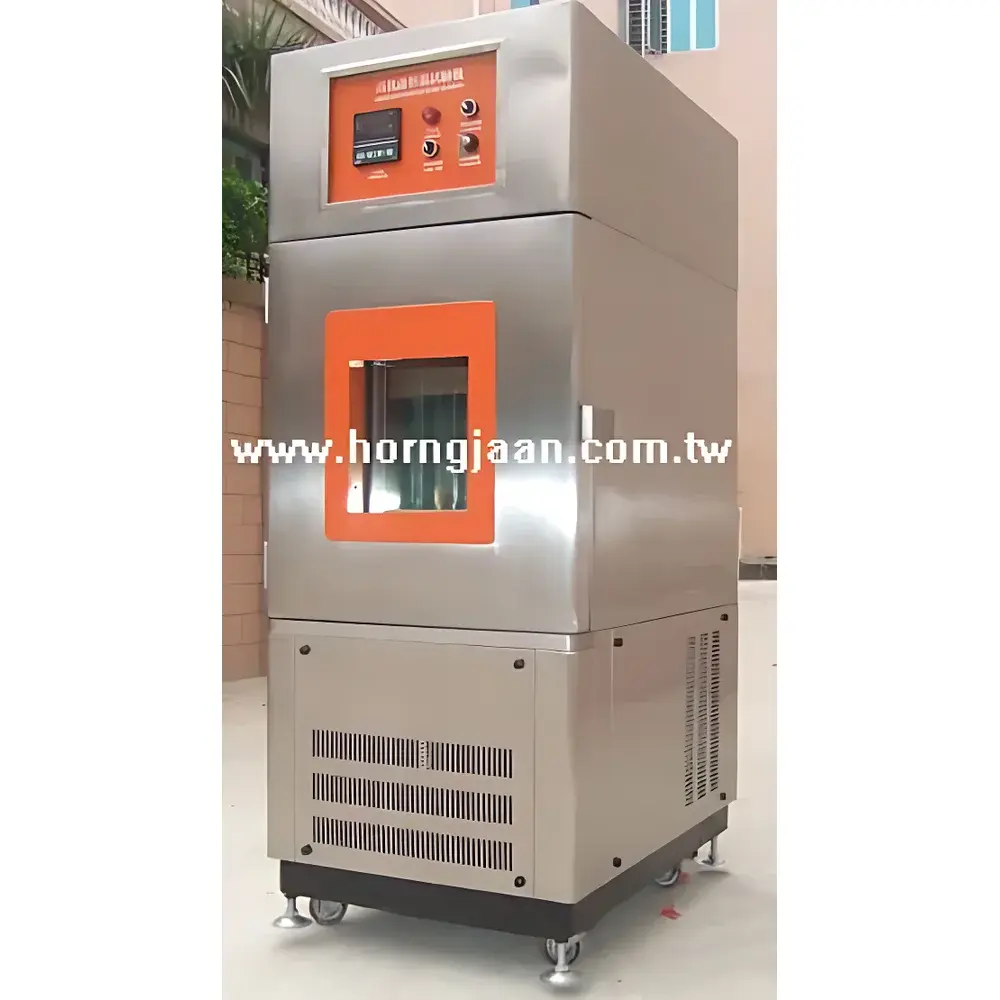
LabCompanion HC-80 High-Low Temperature Alternating Test Chamber
| Brand | LabCompanion |
|---|---|
| Origin | Guangdong, China |
| Manufacturer Type | Direct Manufacturer |
| Country of Origin | China |
| Model | HC-80 |
| Temperature Range | –0 °C to +100 °C (optional up to +150 °C) |
| Temperature Uniformity | ≤2 °C |
| Temperature Fluctuation | ±0.5 °C (high-temp), ±1 °C (low-temp) |
| Heating Rate | ≥2–3 °C/min |
| Cooling Rate | ≤1 °C/min |
| Internal Dimensions (W×H×D) | 400×500×400 mm |
| Power Supply | AC 220 V ±10% / 50 Hz or AC 380 V ±10% / 50 Hz |
| Ambient Operating Conditions | 15–35 °C, ≤85% RH |
| Insulation | High-density ultra-fine thermal insulation cotton |
| Air Circulation | Stainless steel impeller, single-cycle forced convection with low-noise centrifugal blower |
| Safety Protections | Leakage current cutoff, compressor high-pressure/overheat/overcurrent protection, fuse overload protection, fan overheat protection, audible alarm |
Overview
The LabCompanion HC-80 High-Low Temperature Alternating Test Chamber is an engineered environmental simulation system designed for rigorous thermal stress evaluation of materials, electronic components, automotive parts, and industrial assemblies under controlled non-cyclic temperature conditions. Based on forced-air convection thermodynamics, the chamber maintains precise thermal profiles across its stainless-steel interior chamber using a closed-loop PID-controlled heating and refrigeration system. Its architecture supports both steady-state exposure and stepwise temperature transitions—critical for validating product reliability per IEC 60068-2-1 (cold test), IEC 60068-2-2 (dry heat), and MIL-STD-810G Method 501.5/502.5 protocols. Unlike cyclic chambers, the HC-80 prioritizes thermal stability and repeatability over rapid transition sequencing, making it suitable for long-duration qualification testing where thermal equilibrium and uniformity are paramount.
Key Features
- High-precision digital temperature controller with auto-tuning PID algorithm, enabling stable setpoint maintenance and intuitive multi-parameter programming (e.g., dwell time, ramp rate limits, sensor offset compensation)
- Dual-mode power compatibility (220 V / 380 V, 50 Hz) with wide input tolerance (±10%) for global laboratory integration and industrial facility deployment
- Robust thermal insulation using ultra-fine mineral fiber cotton (≥80 mm thickness), minimizing external heat exchange and reducing energy consumption during extended operation
- Sealed double-glazed observation window with integrated transparent electric-heating film to prevent condensation and ensure unobstructed visual monitoring at sub-zero temperatures
- Standard 50 mm diameter cable port with silicone gasket for real-time signal routing without compromising chamber integrity
- Full-spectrum safety architecture: independent thermal fuses, compressor discharge pressure monitoring, motor winding temperature sensors, ground-fault circuit interruption (GFCI), and programmable audible alarm escalation
- Corrosion-resistant 304 stainless steel interior chamber and electrophoretically coated cold-rolled steel exterior—designed for ISO 14644-1 Class 8 cleanroom-adjacent environments
Sample Compatibility & Compliance
The HC-80 accommodates samples up to 400 × 500 × 400 mm (W×H×D) in internal volume, supporting standard test specimens defined in ASTM D3418 (thermal transitions of polymers), ISO 11357 (DSC calibration), and GB/T 2423.1–2022 (environmental testing—cold). Its stainless steel sample racks feature adjustable height positions and load capacity up to 30 kg per shelf. The chamber meets structural and operational requirements for GLP-compliant laboratories when configured with optional audit trail logging (via RS485/Modbus RTU interface). While not certified to UL 61010-1 or CE as a standalone unit, its subsystems—including compressors (Embraco or Danfoss equivalents), controllers (Yokogawa or Omron-based), and safety relays—comply with RoHS 2011/65/EU and IEC 61000-6-3 EMC emission standards. Documentation includes factory calibration certificates traceable to NIM (National Institute of Metrology, China) standards.
Software & Data Management
The HC-80 operates via embedded firmware with local control only; no proprietary PC software is bundled. However, its standard RS485 serial interface supports Modbus RTU protocol for integration into third-party SCADA or LIMS platforms (e.g., Ignition, LabVIEW, or Siemens Desigo CC). Optional data logging modules enable timestamped temperature recording at user-defined intervals (1 s to 60 min resolution), with CSV export capability for post-test statistical analysis (e.g., Cpk, ΔT distribution, stability duration). When deployed in regulated environments, the system supports 21 CFR Part 11 compliance through external validation of access controls, electronic signatures, and audit trail generation—provided by the host system, not the chamber itself.
Applications
- Pre-shipment thermal screening of PCBAs and semiconductor packages per JESD22-A104E
- Material coefficient of thermal expansion (CTE) assessment via dimensional metrology under stabilized isothermal holds
- Accelerated aging studies of elastomers, adhesives, and encapsulants per ASTM D573
- Validation of battery thermal management systems under static thermal load conditions
- Stability testing of pharmaceutical packaging per ICH Q1A(R2) guidelines (non-humidity variant)
- Calibration verification of infrared thermometers and contact probes using blackbody reference surfaces placed inside the chamber
FAQ
Does the HC-80 support humidity control?
No—the HC-80 is a dry-temperature-only chamber. For combined temperature/humidity testing, consider the LabCompanion TH-80 series.
Is the temperature range of –0 °C to +100 °C fixed, or can it be extended?
The standard configuration covers –0 °C to +100 °C. An optional high-temperature upgrade extends the upper limit to +150 °C using upgraded heater elements and enhanced insulation—but this requires factory recalibration and voids the base warranty on cooling performance.
What is the maximum sample mass the chamber can thermally stabilize?
Thermal stabilization capacity depends on thermal mass and emissivity. With a 30 kg total load evenly distributed, full-volume stabilization within ±1 °C of setpoint typically requires ≥45 minutes at extremes (–0 °C or +100 °C).
Can the HC-80 be integrated into an automated test cell with PLC coordination?
Yes—via its native Modbus RTU interface, the chamber accepts start/stop commands, setpoint updates, and status polling. Digital I/O terminals (optional) provide discrete signals for door interlock, alarm status, and cycle completion.



