
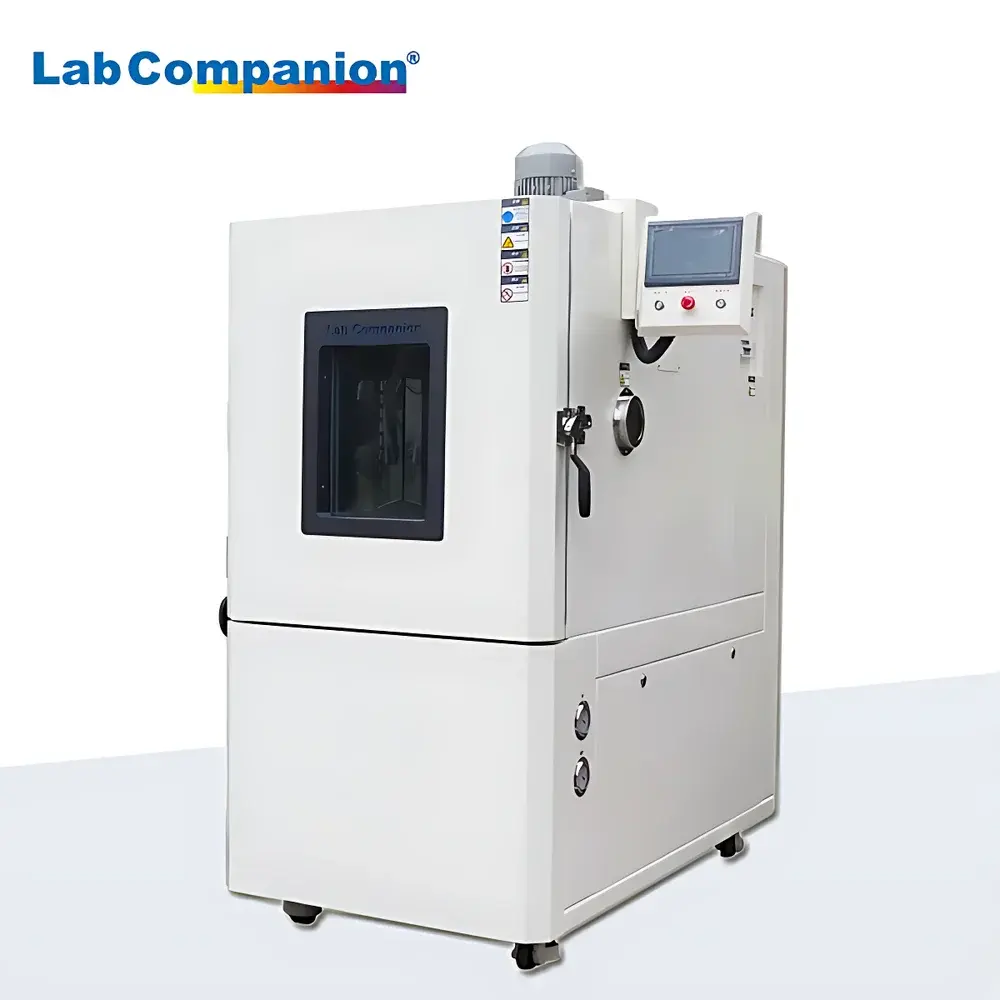
LabCompanion TC-180 High-Low Temperature Thermal Cycling Chamber
| Brand | LabCompanion |
|---|---|
| Origin | Guangdong, China |
| Manufacturer Type | Direct Manufacturer |
| Model | TC-180-12 |
| Temperature Range | −70 °C to +150 °C |
| Temperature Uniformity | ±0.5 °C |
| Temperature Deviation | ±2.0 °C |
| Heating Rate Options | 5–25 °C/min (linear or non-linear) |
| Cooling Rate Options | 5–25 °C/min (linear or non-linear) |
| Internal Dimensions (W×H×D) | 600 × 600 × 500 mm |
| Compliance | GB/T 5170.2–2008 (Temperature Testing Methods for Environmental Testing Equipment) |
Overview
The LabCompanion TC-180 High-Low Temperature Thermal Cycling Chamber is an engineered environmental test system designed for precise, repeatable thermal stress evaluation of electronic components, automotive modules, aerospace hardware, and polymer-based materials. It operates on a dual-refrigeration architecture—combining high-efficiency mechanical compression cooling with optional liquid nitrogen (LN₂) injection—to achieve rapid, programmable temperature transitions across a wide operational envelope of −70 °C to +150 °C. Unlike static temperature chambers, the TC-180 supports dynamic thermal cycling protocols with fully configurable ramp rates (5–25 °C/min standard; up to 30 °C/min with LN₂ assist), enabling accelerated life testing (ALT), thermal shock simulation, and qualification per MIL-STD-810H, IEC 60068-2-14, and JEDEC JESD22-A104. Its chamber core features stainless-steel construction, multi-layer insulated walls, and a balanced air circulation system to maintain uniform thermal distribution (±0.5 °C stability) and minimize gradient-induced measurement artifacts.
Key Features
- Programmable thermal cycling profiles with independent control of heating and cooling rates (5, 10, 15, 20, or 25 °C/min in linear or non-linear modes)
- Optional liquid nitrogen auxiliary cooling module for ultra-fast cooldowns up to 30 °C/min—critical for thermal shock validation per IEC 60068-2-14
- Stainless-steel interior (600 × 600 × 500 mm W×H×D) with electrostatically grounded surfaces and removable test access ports
- Dual-sensor temperature monitoring system with real-time deviation compensation, compliant with GB/T 5170.2–2008 verification methodology
- Integrated safety interlocks including over-temperature cutoff, refrigerant pressure monitoring, and LN₂ flow anomaly detection
- Modular controller interface supporting Ethernet/IP and RS-485 connectivity for integration into centralized lab automation networks
Sample Compatibility & Compliance
The TC-180 accommodates samples up to 30 kg with unrestricted airflow paths, making it suitable for PCB assemblies, battery packs, optical sensors, and molded plastic housings. Its thermal performance has been validated under no-load conditions at ambient +25 °C and chilled water supply at +25 °C—ensuring repeatability across laboratories. The chamber meets national metrological verification standards per GB/T 5170.2–2008 and supports traceable calibration via NIST-traceable reference sensors. For regulated industries, it provides audit-ready logging (timestamped, user-ID stamped) compatible with GLP and GMP documentation requirements. While not a humidity-capable model (TC-series designation indicates dry-cycle configuration), its thermal-only architecture eliminates condensation-related failure modes during low-temperature soak phases—enhancing reliability for moisture-sensitive electronics qualification.
Software & Data Management
The TC-180 is operated via LabCompanion’s TC-Studio v3.2 software suite, a Windows-based platform supporting ISO/IEC 17025-aligned test method definition, sequence scripting, and automated report generation (PDF/CSV). All thermal profiles—including dwell times, transition slopes, and hold tolerances—are stored with version control and digital signature capability. Data integrity is preserved through local encrypted storage (AES-256) and optional cloud synchronization with role-based access control. Audit trails record every parameter change, user login/logout event, and calibration action—fully compliant with FDA 21 CFR Part 11 requirements when deployed with electronic signature configuration. Remote monitoring is enabled via secure HTTPS API endpoints, allowing integration with MES or LIMS platforms for end-to-end test lifecycle traceability.
Applications
- Accelerated thermal aging of lithium-ion battery cells and BMS modules under cyclic low-/high-temperature exposure
- Thermal shock qualification of avionics enclosures per DO-160 Section 4.9
- Reliability screening of semiconductor packages (QFN, BGA) using JEDEC JESD22-A104-defined cycles
- Material coefficient-of-thermal-expansion (CTE) correlation studies for PCB substrate laminates
- Pre-conditioning of optical coatings and MEMS devices prior to laser damage threshold testing
- Validation of thermal management systems in electric vehicle power electronics
FAQ
What is the maximum thermal ramp rate achievable without liquid nitrogen assist?
Standard operation supports heating and cooling rates of 5–25 °C/min, selectable in discrete steps and configurable as linear or non-linear transitions.
Does the TC-180 support humidity control?
No—the TC-series models are dry-cycle thermal chambers only; humidity functionality is available in the TH-series (e.g., TH-180) and requires separate humidification and dehumidification subsystems.
How is temperature uniformity verified across the working volume?
Uniformity is measured per GB/T 5170.2–2008 using nine calibrated PT100 sensors arranged in a 3×3 vertical grid at mid-height; results are documented in the factory acceptance test (FAT) report.
Can the TC-180 be integrated into an automated test cell?
Yes—its EtherNet/IP and Modbus TCP interfaces allow seamless integration with PLC-based test sequencers and SCADA systems for unattended multi-chamber coordination.
Is calibration documentation provided with shipment?
Each unit ships with a NIST-traceable calibration certificate covering temperature sensors and controller input/output channels, valid for 12 months from date of manufacture.



