
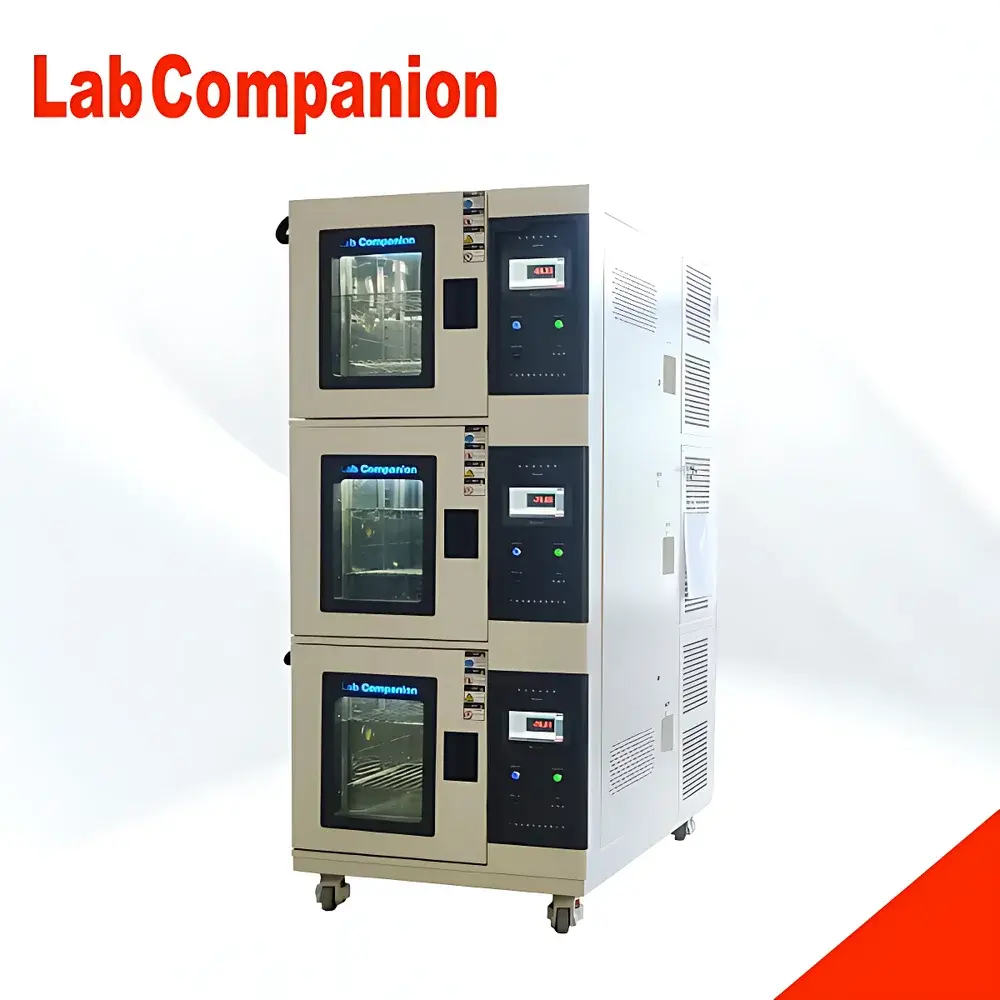
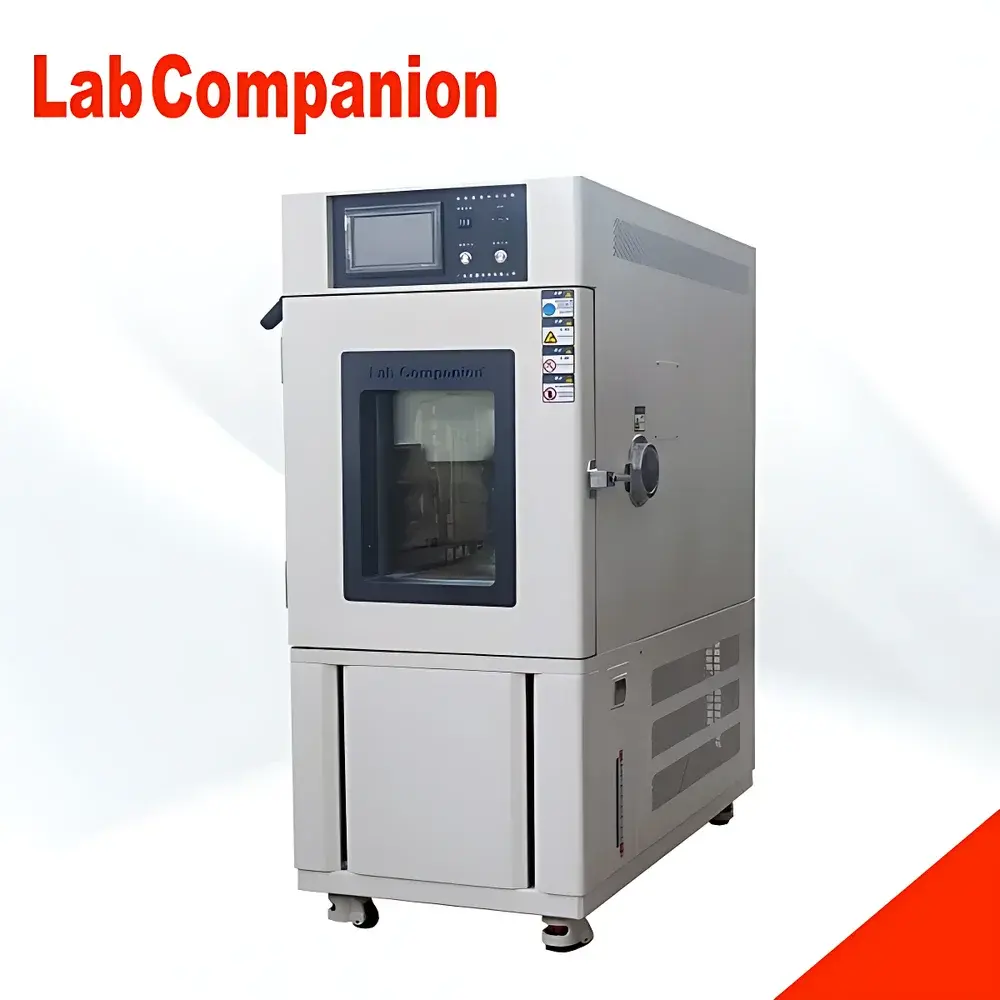
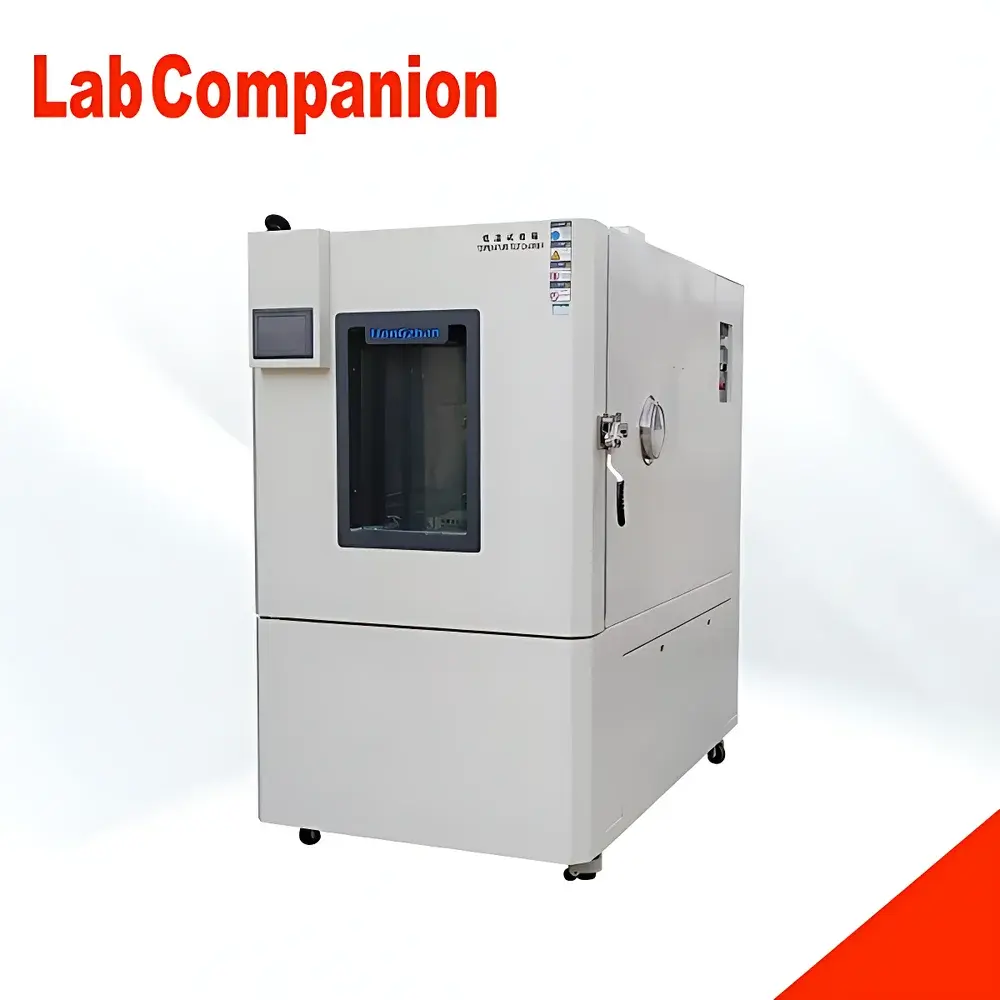
Hongzhan HLT/HA Series Programmable Temperature & Humidity Cycling Chamber
| Origin | Guangdong, China |
|---|---|
| Manufacturer Type | Authorized Distributor |
| Origin Category | Domestic (China) |
| Model | HLT/HA36 / HLT/HA80 / HLT/HA80A / HLT/HA220 / HLT/HA300 / HLT/HA1000 |
| Temperature Range | −20 °C to +125 °C / −40 °C to +125 °C / −70 °C to +125 °C |
| Humidity Range | 25–98 %RH |
| Internal Chamber Dimensions (W×D×H) | 400×300×300 mm to 1000×1000×1000 mm |
| Temperature Uniformity | ≤ ±2 °C |
| Temperature Stability | ≤ ±0.5 °C |
| Humidity Accuracy | ±3.0 %RH (>75 %RH), ±5.0 %RH (≤75 %RH) |
| Heating Rate (RT to +125 °C) | <40 min |
| Cooling Rate (RT to −40 °C) | <15 min |
| (RT to −70 °C) | <40–60 min |
| Refrigeration System | Dual-stage cascade (air-cooled or optional water-cooled) |
| Control Interface | Imported digital temperature/humidity controller |
| Compliance | GB/T 2423.1–4, GB 10586–89, GB 10592–89, IEC 60068-2 |
Overview
The Hongzhan HLT/HA Series Programmable Temperature & Humidity Cycling Chamber is an environmental simulation system engineered for precision-controlled exposure of materials and components to dynamic thermal and hygrothermal stress profiles. It operates on a dual-stage cascade refrigeration principle combined with PID-regulated electric heating and surface vaporization or pressure-jet humidification—enabling reproducible generation of defined temperature-humidity trajectories across wide operational ranges. Designed for laboratory-grade reliability and long-term stability, the chamber supports standardized environmental stress screening (ESS), accelerated aging, qualification testing, and conformance verification per international test protocols. Its architecture integrates thermal insulation with low-thermal-conductivity polyurethane foam (≥100 mm thickness), stainless steel inner chambers, and reinforced cold-rolled steel exteriors—ensuring minimal heat leakage, mechanical durability, and resistance to corrosion in high-humidity conditions.
Key Features
- Programmable multi-step cycling profiles: Up to 99 segments per program, supporting ramp-soak-hold sequences with independent control of temperature and humidity setpoints.
- Energy-optimized operation: Adaptive compressor modulation and intelligent defrost logic minimize power consumption without compromising cycle fidelity.
- Auto-detection of internal thermal load: Real-time monitoring of chamber thermal inertia enables automatic activation/deactivation of refrigeration—reducing unnecessary compressor cycling and extending system service life.
- Low-noise design: Acoustic enclosure and vibration-damped compressor mounting achieve sound pressure levels <65 dB(A) at 1 m—suitable for shared lab environments and ISO-classified cleanrooms.
- Modular accessibility: Front-opening or top-lifting door configurations (model-dependent); castor-mounted units (HLT/HA36–HA80) allow repositioning without disassembly.
- Dual-chamber option (HLT/HA80A): Two independent test zones enable simultaneous evaluation under divergent environmental conditions—ideal for comparative studies or reference/control sample pairing.
Sample Compatibility & Compliance
The chamber accommodates diverse specimen geometries—from PCB assemblies and sensor modules to pharmaceutical packaging, polymer films, and aerospace fasteners—within its stainless steel interior (AISI 304). All models comply with core environmental test standards including IEC 60068-2-1 (cold), IEC 60068-2-2 (dry heat), IEC 60068-2-30 (damp heat, cyclic), and GB/T 2423.1–4 (Chinese national equivalents). Optional calibration traceability to NIM (National Institute of Metrology, China) ensures metrological validity for GLP/GMP-regulated applications. Safety systems include independent over-temperature cutoff, phase-loss protection, ground-fault interruption, water-level monitoring (for water-cooled variants), and overload current limiting—all certified to IEC 61000-6-2 (EMC immunity) and IEC 61000-6-4 (EMC emissions).
Software & Data Management
Standard configuration includes a microprocessor-based controller with real-time data logging (1-second resolution) and USB export capability. Optional IPC500 touchscreen interface provides intuitive graphical programming, trend visualization, alarm history, and password-protected user levels. Data output conforms to CSV and Excel-compatible formats for integration into LIMS or statistical process control platforms. When configured with audit trail firmware, the system supports 21 CFR Part 11-compliant electronic records—including operator ID, timestamped parameter changes, deviation alerts, and immutable log archiving—meeting requirements for regulated pharmaceutical, medical device, and aerospace quality systems.
Applications
This chamber serves critical roles in product development and quality assurance across multiple sectors: evaluating solder joint integrity and capacitor drift in electronics under thermal cycling; validating seal performance of sterile barrier systems in medical packaging; assessing coating adhesion and dimensional stability of composite materials in automotive R&D; verifying sensor calibration drift in avionics under combined thermal-hygric stress; and conducting accelerated degradation studies on biologics excipients per ICH Q1A(R2). Its programmability and repeatability make it equally suitable for academic research in polymer science, corrosion engineering, and climate-responsive material behavior.
FAQ
What is the maximum allowable sample mass for thermal load compensation?
The system automatically adjusts cooling/heating power based on real-time thermal mass estimation; no manual input is required. However, total sample volume should not exceed 1/3 of chamber volume to maintain uniformity specifications.
Can the chamber operate continuously at −70 °C and 98 %RH?
No—simultaneous extreme low temperature and high humidity are thermodynamically incompatible due to condensation/frost formation. The controller enforces safe operating envelopes per ASHRAE psychrometric limits.
Is remote monitoring supported via Ethernet or Modbus?
Yes—optional RS485 Modbus RTU or Ethernet TCP/IP communication modules enable integration with building management systems (BMS) or centralized test farms.
What maintenance intervals are recommended for the cascade refrigeration system?
Compressor oil and filter replacement every 24 months; refrigerant charge verification annually; condenser coil cleaning quarterly (more frequently in dusty environments).
Does the chamber support custom test profiles compliant with MIL-STD-810G Method 502.6?
Yes—predefined templates for Method 502.6 (Temperature Shock) and Method 507.5 (High Altitude/Humidity) are available; full custom profile import via USB is also supported.



