
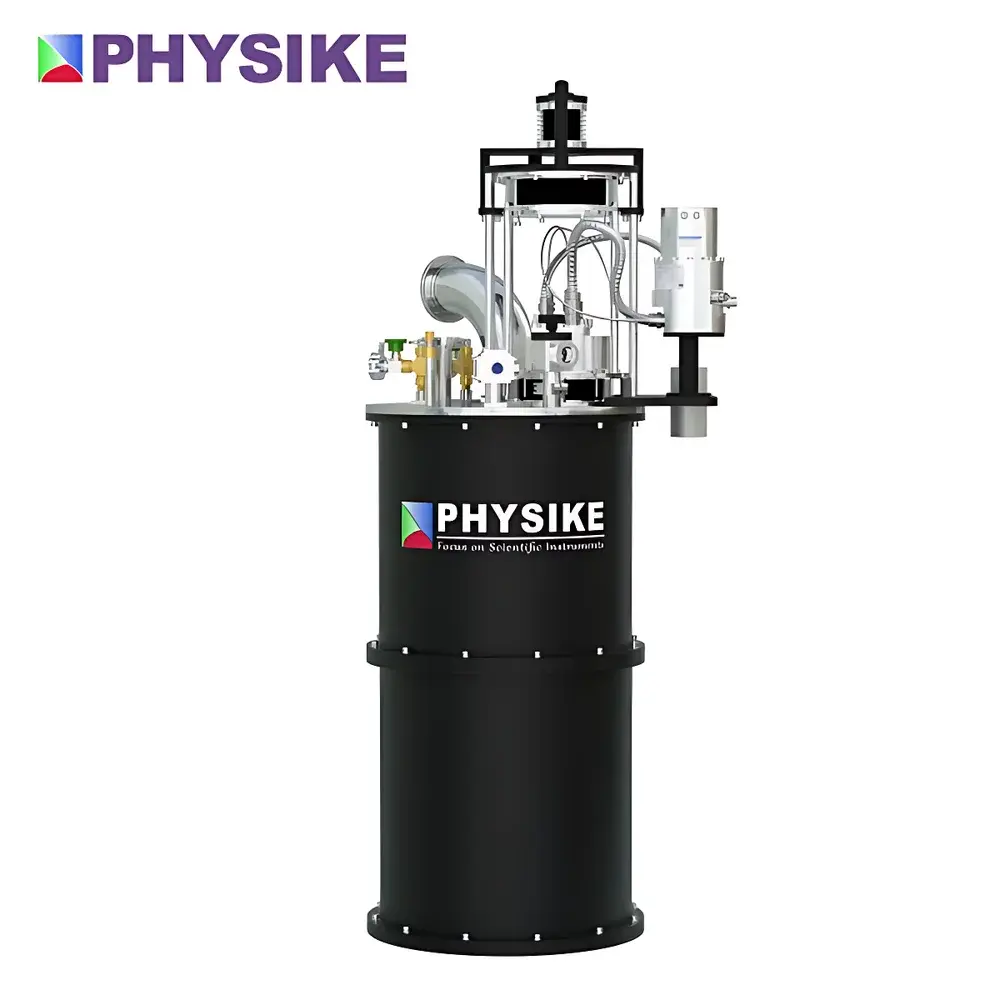
PHYSIKE Cryocloud-100 Integrated Continuous He-3 Cryocooler
| Brand | PHYSIKE |
|---|---|
| Origin | Beijing, China |
| Manufacturer Type | Direct Manufacturer |
| Model | Cryocloud-100 |
| Ultimate Temperature | < 350 mK |
| Cooling Source | 4 K Pulse Tube or Gifford-McMahon Refrigerator |
| Integrated 4 K Cold Head | Yes |
| Gas Recirculation System | External High-Speed Vacuum Pump Array + Purification & Condensation Loop |
| Liquid Nitrogen Cold Trap | Included |
| Thermal Switch | High-Performance Active Type |
| Optional Configurations | Top-Loading with Load-Lock Insert, Integrated Superconducting Magnet |
Overview
The PHYSIKE Cryocloud-100 is an integrated continuous-cycle helium-3 (He-3) cryocooler engineered for stable, long-duration operation at ultra-low temperatures below 350 mK. Unlike single-shot He-3 refrigerators, the Cryocloud-100 employs a closed-loop gas recirculation architecture: He-3 vapor is continuously pumped from the main condensation pot, purified and cooled via multi-stage precooling stages (including a liquid nitrogen cold trap), condensed, and re-injected—enabling uninterrupted thermal stability over days or weeks. Its fully integrated design embeds the 4 K pulse tube or Gifford-McMahon cold head directly within the cryostat body, eliminating external cold-head coupling losses and simplifying system footprint. This architecture delivers high cooling power (> 100 µW at 300 mK, typical) while maintaining mechanical rigidity and thermal homogeneity—critical for quantum-limited measurements requiring sub-mK temperature stability and minimal thermal drift.
Key Features
- Integrated 4 K cold stage co-located with He-3 pot, minimizing thermal resistance and vibration transmission
- Continuous He-3 circulation enabled by external high-speed vacuum pumping station and gas purification loop
- Dual-stage precooling: 4 K stage + LN₂ cold trap (77 K) ensures efficient He-3 condensation and low vapor pressure during operation
- High-efficiency active thermal switch reduces cooldown time from 300 K to base temperature by up to 40% versus passive designs
- Top-loading configuration available with load-lock insert and force-assisted sample transfer—enables in-situ sample exchange without warming the He-3 stage
- Optional integrated superconducting magnet (up to 9 T vertical field) with persistent mode operation and field homogeneity < 10 ppm over 10 mm DSV
- Modular flange interface compliant with ISO-KF 100 and CF-150 standards for seamless integration with UHV chambers and STM/AFM platforms
Sample Compatibility & Compliance
The Cryocloud-100 supports diverse experimental configurations including scanning probe microscopy (STM, AFM), angle-resolved photoemission spectroscopy (ARPES), transition-edge sensors (TES), SQUID magnetometers, and high-resolution transport setups. Its UHV-compatible stainless-steel construction (electropolished interior, bakeable to 150 °C) meets ASTM E595 outgassing requirements for space-qualified instrumentation. All electrical feedthroughs are hermetically sealed ceramic-metal (Kovar) types rated for ≤1 × 10⁻⁹ mbar·L/s He leak rate. The system conforms to IEC 61000-6-2 (immunity) and IEC 61000-6-4 (emission) for laboratory electromagnetic compatibility. Full traceability of material certifications (EN 10204 3.1) and ASME BPVC Section VIII Div. 1 pressure boundary documentation are provided for regulatory audit readiness.
Software & Data Management
Cryocloud-100 operation is managed via PHYSIKE’s CryoControl v4.2 platform—a deterministic real-time control suite running on a dedicated Linux RT kernel. It provides synchronized monitoring of > 64 analog/digital channels (temperature, pressure, flow, magnetic field, compressor status) with 16-bit resolution and 100 Hz sampling. All setpoints, PID parameters, and alarm thresholds are configurable with password-protected user roles. Audit trails—including operator ID, timestamp, parameter change, and value delta—are stored locally and exportable in CSV/SQLite formats compliant with FDA 21 CFR Part 11 requirements. Remote access is supported via TLS 1.3-secured WebSocket API, enabling integration into LabVIEW, Python (PyVISA), or MATLAB environments for automated experiment sequencing.
Applications
- Ultra-high-resolution ARPES experiments requiring sustained < 400 mK sample temperature and < 50 µK/hr thermal drift
- Quantum transport measurements in 2D electron gases under high magnetic fields (e.g., quantum Hall effect, fractional states)
- Low-energy X-ray and neutron scattering studies where background phonon population must remain below kBT ≈ 30 µeV
- De Haas–van Alphen oscillation mapping across multiple Fermi surface sheets
- Cryogenic detector characterization (TES, MKIDs, superconducting nanowires) under controlled thermal loading
- High-pressure diamond anvil cell (DAC) studies with integrated resistive or piezoelectric pressure sensors
- Coherent quantum control experiments in superconducting qubit testbeds requiring micro-vibration isolation and millikelvin stability
FAQ
What is the base temperature achievable with the Cryocloud-100 under standard operating conditions?
Typical base temperature is 290–330 mK, depending on thermal load, pump speed, and LN₂ trap efficiency. With optimized vacuum and minimal parasitic heat load, sub-280 mK has been verified in third-party metrology labs.
Does the system support remote diagnostics and predictive maintenance?
Yes—CryoControl v4.2 includes embedded health monitoring algorithms that track compressor valve wear, He-3 purity decay trends, and thermal switch actuation fatigue. Alerts trigger automatically when deviation thresholds exceed ISO 2372 vibration class A limits.
Can the Cryocloud-100 be retrofitted with a custom sample stage or wiring harness?
All flange interfaces follow ISO-KF/CF standards; PHYSIKE provides mechanical drawings (STEP/IGES), thermal budget calculators, and collaborative engineering support for customer-specific cold-finger, wiring loom, or RF-filtered feedthrough integration.
Is GLP/GMP-compliant documentation available for regulated research environments?
Yes—full IQ/OQ documentation packages, calibration certificates traceable to NIST standards, and 21 CFR Part 11-compliant electronic record templates are available upon request.



