
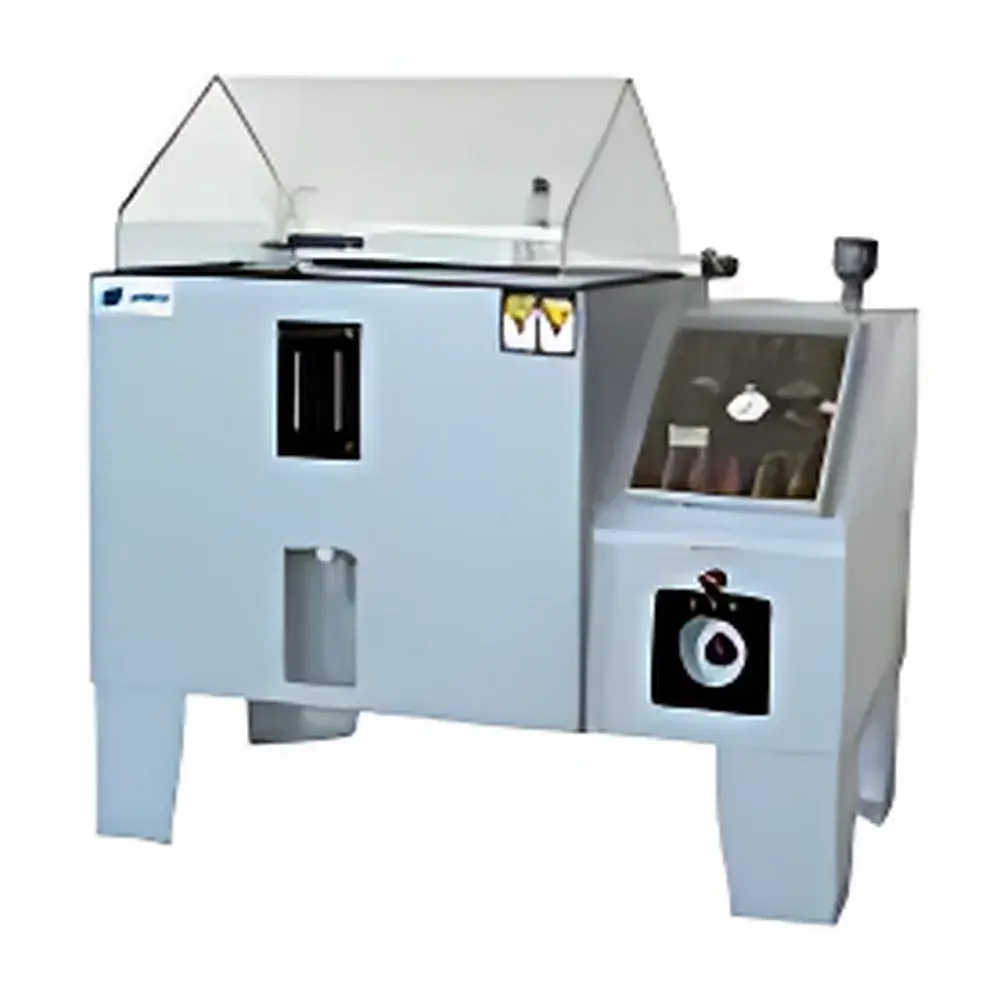
LabCompanion SH-60 Salt Spray Test Chamber
| Brand | LabCompanion |
|---|---|
| Origin | Guangdong, China |
| Manufacturer Type | Direct Manufacturer |
| Model | SH-60 |
| Temperature Range | R.T. +10 °C to 55 °C |
| Test Temp | 35 °C ±1 °C (NSS), 50 °C ±1 °C (CASS) |
| Temp. Uniformity | ±2 °C |
| Temp. Stability | ±0.5 °C |
| Salt Spray Deposition Rate | 1–2 mL / 80 cm²·h |
| Spray Mode | Continuous or Cyclic |
| Timer Range | 0–9999 h/min/sec |
| Chamber Material | 8 mm PVC board with reinforced banding |
| Saturated Air Tank | SUS#304 stainless steel |
| Heating Element | Stainless steel tubular heater |
| Control System | PID + PWM + SSR, digital display, ±0.3 °C accuracy |
| Safety Protections | Overcurrent breaker, chamber overtemperature protection, saturated air tank overtemperature protection, low-water-level cutoff |
| Power Supply | 220 V/50 Hz or 380 V/50 Hz |
| Internal Volume | 100 L |
| Dimensions (W×D×H) | 600×450×400 mm (chamber) |
| Standard Accessories | Sample racks, calibrated collection funnel, glass nozzle, spray tower assembly, operation manual |
Overview
The LabCompanion SH-60 Salt Spray Test Chamber is an ASTM B117-22 and ISO 9227-compliant environmental test system engineered for accelerated corrosion evaluation of coated, plated, anodized, and passivated metallic surfaces. It operates on the principle of continuous or cyclic nebulization of a standardized sodium chloride (NaCl) or copper-accelerated acetic acid salt solution (CASS) within a thermally controlled chamber, simulating aggressive marine or industrial atmospheric conditions. The chamber maintains precise test temperature stability (±0.5 °C) and uniformity (±2 °C) across its 100 L internal volume, ensuring reproducible exposure conditions required for comparative corrosion resistance assessment. Designed for laboratory and quality control environments, the SH-60 delivers metrologically traceable performance aligned with international standard test protocols—including ASTM B117, JIS Z2371, ISO 9227, and CNS 11377—supporting regulatory submissions, supplier qualification, and material development workflows under GLP and GMP-aligned practices.
Key Features
- High-integrity chamber construction using 8 mm thick PVC board with structural band reinforcement, eliminating warping and ensuring long-term dimensional stability under sustained saline exposure.
- Dual-safety interlock system combining EGO thermal cutout and PT100 sensor feedback for chamber temperature monitoring, providing fail-safe protection for both personnel and instrumentation.
- Advanced fog generation mechanism based on Bernoulli’s principle, enabling consistent aerosol dispersion and natural gravitational deposition—achieving spray uniformity within ±0.3–0.9 mL/80 cm²·h as verified by ASTM-standard collection funnels.
- Intelligent fault-detection interface with discrete LED indicators for real-time diagnostics of heater failure, low water level, saturation tank overheating, and controller anomalies.
- Front-access modular drainage architecture supporting independent discharge from solution reservoirs, minimizing cross-contamination and simplifying maintenance in multi-test scenarios.
- Integrated anti-fog system for the transparent acrylic observation lid, enabling immediate post-test visual inspection without condensation interference.
- Flexible water supply mode: fully automatic fill via solenoid valve or manual override—ensuring uninterrupted testing even during municipal water supply interruption.
Sample Compatibility & Compliance
The SH-60 accommodates standard test specimens up to 150 mm × 150 mm × 50 mm per rack, with adjustable sample holder angles (15°–30°) meeting ASTM B117 orientation requirements. Its chamber geometry ensures unobstructed spray distribution and minimal airflow turbulence, critical for achieving uniform salt deposition per ISO 9227 Annex A. All wetted components—including the saturated air tank (SUS#304), spray nozzles (borosilicate glass), and solution delivery lines—are chemically inert to acidic chloride media. The system supports full auditability: temperature setpoints, runtime, and operational status are logged digitally, enabling compliance with FDA 21 CFR Part 11 data integrity requirements when paired with validated software extensions. Routine calibration verification against NIST-traceable thermistors and volumetric collection standards satisfies ISO/IEC 17025 laboratory accreditation criteria.
Software & Data Management
While the base SH-60 features a stand-alone digital PID controller with manual parameter entry, optional PC-based data acquisition modules enable time-stamped logging of chamber temperature, saturation tank temperature, and cumulative runtime at user-defined intervals (1–60 s resolution). Exportable CSV files support statistical process control (SPC) analysis in Minitab or JMP. Audit trail functionality records all operator-initiated changes—including setpoint adjustments, timer resets, and mode switches—with timestamp, user ID, and reason-for-change fields. Firmware updates are performed via USB port, preserving configuration integrity across revisions. For regulated environments, optional 21 CFR Part 11-compliant software packages provide electronic signatures, role-based access control, and immutable record archiving.
Applications
- Quality assurance of electroplated zinc, nickel, chromium, and tin coatings on automotive fasteners and chassis components.
- Validation of corrosion-inhibiting oil films on machined steel parts prior to packaging and storage.
- Comparative screening of organic coating systems (epoxy, polyurethane, powder coat) for offshore wind turbine housings.
- Accelerated aging studies of aluminum alloys subjected to anodizing + sealing processes per MIL-A-8625.
- Supplier qualification testing per OEM-specific specifications (e.g., Ford WSK-M2G224-A2, GMW14872).
- Research into synergistic effects of humidity, temperature, and chloride concentration on localized pitting initiation in stainless steels.
FAQ
What international standards does the SH-60 comply with?
The SH-60 is configured and validated to meet ASTM B117-22, ISO 9227:2022, JIS Z2371, and CNS 11377 requirements for apparatus specification, calibration, and operational procedure.
Can the SH-60 perform cyclic corrosion testing (CCT)?
Yes—the controller supports programmable cycling between salt spray, dry-off, and high-humidity phases when equipped with optional humidity control and drying modules.
Is the chamber material resistant to hydrochloric acid used in modified CASS tests?
The 8 mm PVC chamber and SUS#304 saturated air tank maintain structural integrity under standard CASS (pH 3.1–3.3) conditions; extended exposure to lower-pH variants requires optional PTFE-coated internal components.
How is temperature uniformity verified during IQ/OQ protocols?
Uniformity is confirmed using nine calibrated PT100 probes placed at defined locations per ISO 16702:2017, with maximum deviation recorded across three consecutive 24-hour stabilization cycles.
Does the system include documentation for regulatory audits?
Standard delivery includes Factory Acceptance Test (FAT) report, material certificates for SUS#304 and PVC, and calibration certificates for embedded sensors—fully traceable to national metrology institutes.
Related Products



