
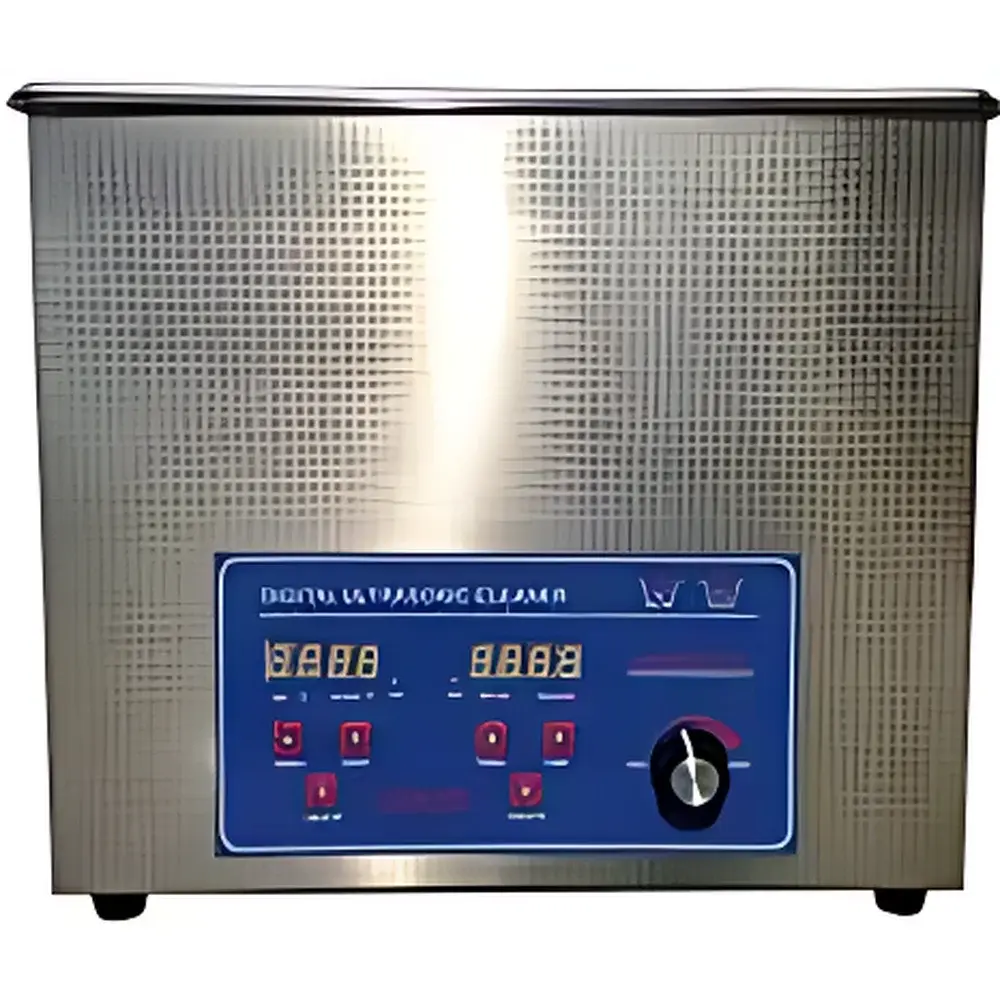
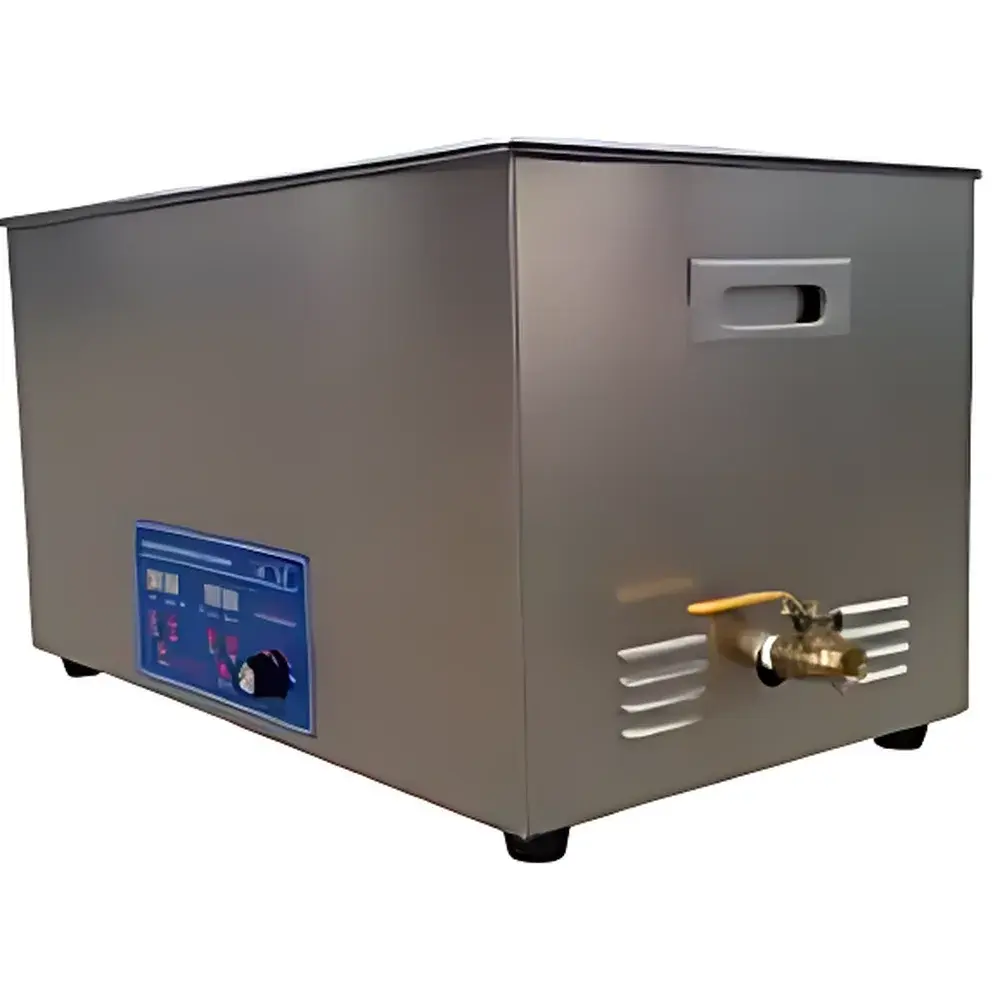
Hanuo HN-6AL Adjustable-Power Ultrasonic Cleaner
| Brand | Hanuo |
|---|---|
| Origin | Shanghai, China |
| Model | HN-6AL |
| Capacity | 6 L |
| Ultrasonic Frequency | 40 kHz |
| Ultrasonic Power Output | 120 W (adjustable 40–100%) |
| Heating Power | 100 W |
| Temperature Range | 20–80 °C |
| Timer Range | 0–30 min |
| Tank Material | SUS304 Stainless Steel |
| Lid | Sound-Dampening Cover |
| Drain | Manual Valve |
| Construction | Full SUS304 stainless steel tank, housing, and lid |
Overview
The Hanuo HN-6AL Adjustable-Power Ultrasonic Cleaner is an entry-level benchtop ultrasonic cleaning system engineered for precision cleaning of delicate and complex components in laboratory, clinical, and light industrial environments. It operates on the principle of acoustic cavitation: high-frequency sound waves (40 kHz) generate microscopic vacuum bubbles in the cleaning liquid that rapidly collapse, producing localized shockwaves and microstreaming effects capable of dislodging particulate contaminants, organic residues, oils, and biofilms from surfaces—even within blind holes, crevices, and microstructures. Designed for reproducibility and operational safety, the unit integrates a digitally controlled timer, adjustable heating with thermostatic stability, and continuously variable ultrasonic power output—enabling users to optimize energy delivery for diverse sample types without risk of surface erosion or component damage.
Key Features
- Adjustable ultrasonic power output (40–100% of 120 W nominal), allowing fine-tuned intensity control for sensitive substrates such as optical lenses, dental instruments, or microelectronic assemblies.
- Digital LCD interface with independent controls for time (0–30 min), temperature (20–80 °C), and power level—ensuring repeatable parameter setup across user-defined cleaning protocols.
- SUS304 stainless steel tank, outer housing, and hinged sound-dampening lid provide corrosion resistance, structural integrity, and reduced ambient noise during operation.
- Integrated heating module (100 W) with PID-based temperature regulation maintains ±2 °C stability across the full operating range, supporting aqueous and solvent-based cleaning chemistries requiring thermal activation.
- Manual drain valve enables safe, controlled fluid disposal—critical for handling hazardous solvents or bio-contaminated solutions in regulated settings.
- IPX4-rated electrical enclosure and reinforced insulation meet basic laboratory safety standards for splash resistance and long-term reliability under routine use conditions.
Sample Compatibility & Compliance
The HN-6AL accommodates a broad spectrum of sample geometries and material classes—including printed circuit boards (PCBs), dental handpieces, surgical forceps, watch components, precision optics, and jewelry—without requiring fixtures or agitation. Its 6 L capacity (300 × 150 × 150 mm internal dimensions) supports batch processing of medium-sized parts while maintaining uniform cavitation field distribution. The unit complies with IEC 61000-6-3 (EMC emissions) and IEC 61000-6-2 (immunity), and its construction adheres to ISO 13485-aligned manufacturing practices for medical device support equipment. While not certified for sterile processing per ISO 17664 or AAMI ST79, it serves as a validated pre-cleaning step in multi-stage decontamination workflows compliant with ASTM F3127 (standard guide for ultrasonic cleaning validation) and USP (cleaning and sterilization of laboratory glassware).
Software & Data Management
The HN-6AL operates via embedded firmware with no external software dependency—ideal for GLP/GMP environments where system validation simplicity is prioritized. All operational parameters are retained in non-volatile memory after power cycling. Though it lacks network connectivity or audit trail functionality, its discrete digital controls enable manual logging of cleaning cycles (time, temperature, power setting) consistent with FDA 21 CFR Part 11 Annex 11 principles when integrated into documented SOPs. For laboratories requiring traceability, integration with external data loggers (via optional analog voltage outputs, available upon request) supports time-stamped environmental monitoring and protocol adherence verification.
Applications
- Research & Development Laboratories: Removal of photoresist residues from silicon wafers, degassing of sol-gel precursors, and dispersion of nanomaterial suspensions prior to characterization.
- Clinical & Dental Facilities: Pre-sterilization cleaning of orthodontic instruments, endodontic files, and impression trays; compatible with enzymatic and low-foaming disinfectant formulations.
- Electronics Manufacturing: Debris removal from solder paste stencils, inkjet printheads, and MEMS sensors without mechanical abrasion.
- Quality Control Labs: Cleaning of reference standards, calibration weights, and metrology fixtures to eliminate adsorbed hydrocarbons affecting measurement accuracy.
- Academic Teaching Labs: Demonstrating cavitation physics, surface tension effects, and solvent compatibility testing across undergraduate chemistry and materials science curricula.
FAQ
What cleaning solutions are compatible with the HN-6AL?
Aqueous detergents, ethanol, isopropanol, acetone, and other low-surface-tension solvents may be used—provided they are non-corrosive to stainless steel and do not exceed 80 °C vapor pressure limits. Avoid halogenated solvents unless equipped with explosion-proof modifications.
Can the unit be used for passivation or descaling?
No. The HN-6AL is designed solely for physical contaminant removal via cavitation. Acidic or chelating solutions for metal passivation or scale dissolution require dedicated chemical-resistant systems with corrosion-rated tanks and ventilation.
Is the 40 kHz frequency suitable for cleaning microfluidic devices?
Yes—40 kHz provides an optimal balance of cavitation intensity and penetration depth for features >50 µm. For sub-20 µm channels, higher frequencies (80–130 kHz) are recommended to reduce inertial cavitation damage.
Does the unit include validation documentation?
Factory calibration certificates for timer accuracy (±1 sec) and temperature sensor linearity (±1.5 °C at 50 °C) are provided. IQ/OQ protocols and performance qualification templates are available upon request for GxP-regulated installations.
How often should the transducer performance be verified?
We recommend quarterly verification using ASTM E1558 aluminum foil erosion test or calibrated hydrophone mapping—especially after extended use with abrasive particulates or high-power operation (>80% duty cycle).
Related Products



