
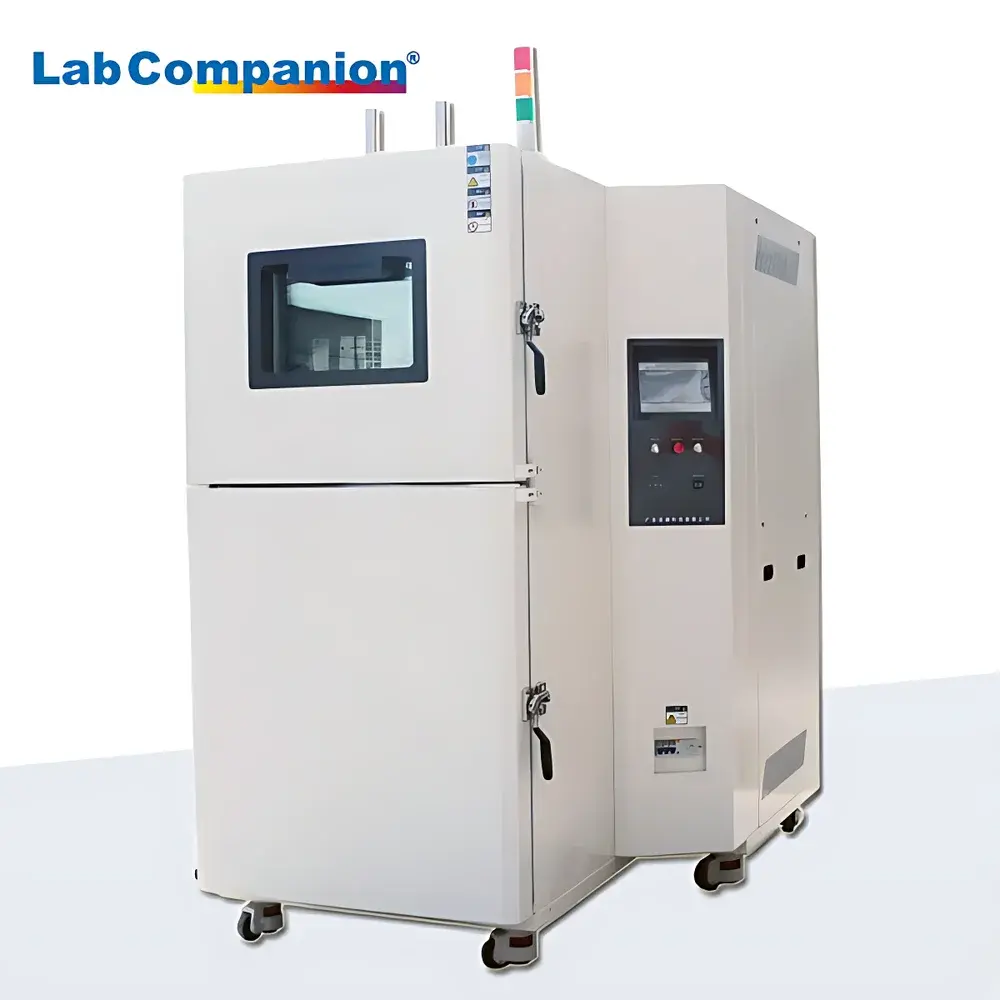
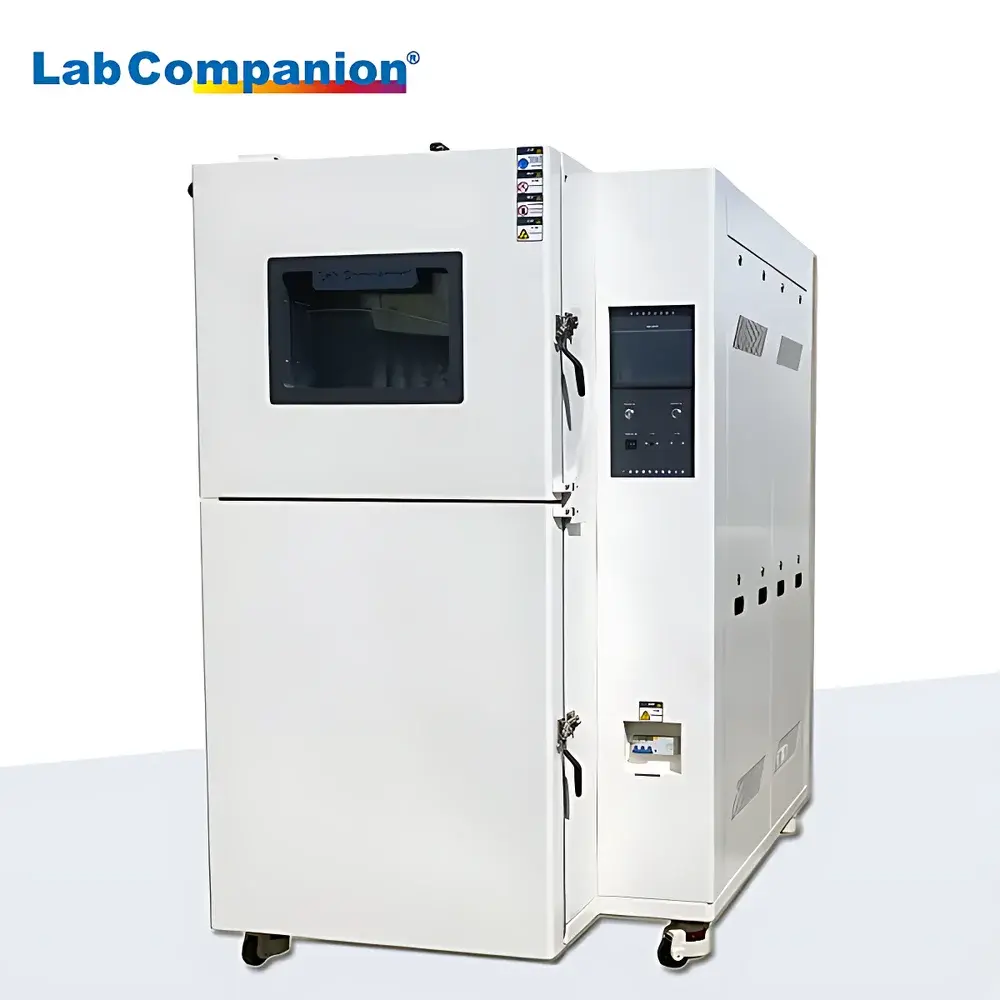
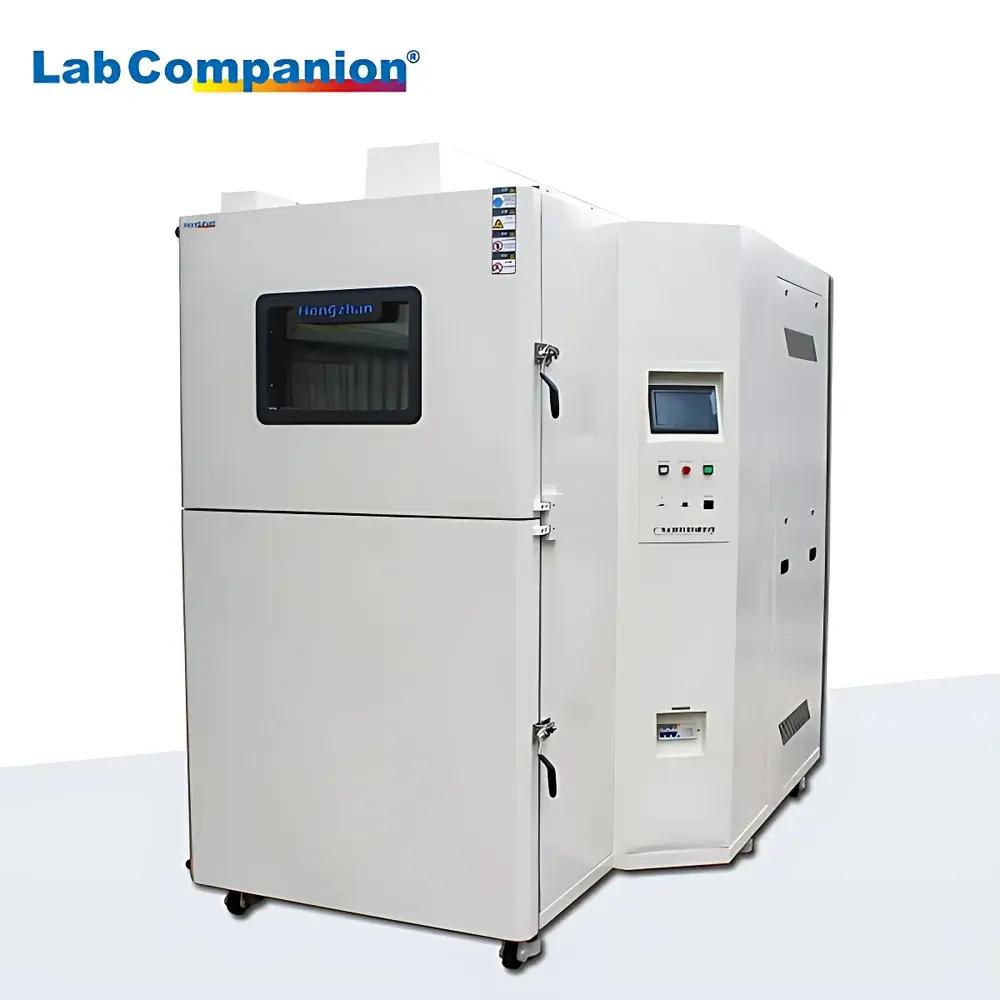
LabCompanion CTU-180W Thermal Shock Test Chamber
| Brand | LabCompanion |
|---|---|
| Model | CTU-180W |
| Origin | Guangdong, China |
| Manufacturer Type | Direct Manufacturer |
| High-Temperature Range | +60 °C to +200 °C |
| Low-Temperature Range | 0 °C to −70 °C |
| Thermal Shock Range | −55 °C to +150 °C |
| Temperature Stability | ±2 °C |
| Heating Rate | R.T. → +200 °C in ~40 min |
| Cooling Rate | R.T. → −70 °C in ~60 min |
| Transfer Time | ≤5 s |
| Temperature Recovery Time | ≤5 min |
| Internal Dimensions (W×H×D) | 600×660×450 mm |
| External Dimensions (W×H×D) | 2920×1100×2150 mm |
| Construction | Cold-rolled steel outer shell with epoxy powder coating |
| Refrigeration | Air-cooled or water-cooled (W suffix indicates water-cooled configuration) |
| Compressor | Imported hermetic scroll compressor |
| Temperature Sensor | Armored Pt100 RTD |
| Controller | Siemens PLC + 7-inch color TFT touchscreen (LabCompanion Platinum V1.0 embedded firmware) |
| Data Interface | USB port (CSV log export, non-hot-pluggable), RJ45 Ethernet (for optional Platinum V1.0 PC monitoring software, supports up to 5 concurrent clients per chamber, 32 chambers per server) |
| Power Supply | AC 380 V, 50 Hz, 3-phase + PE |
| Total Installed Capacity | 36 kVA |
| Compliance | GB/T 2423.1, GB/T 2423.2, GJB 150.3–150.5 |
Overview
The LabCompanion CTU-180W Thermal Shock Test Chamber is an engineered environmental simulation system designed for rapid, repeatable evaluation of material and component reliability under extreme thermal cycling conditions. Based on the two-chamber static air thermal shock principle—featuring physically separated high-temperature and low-temperature zones—the CTU-180W utilizes a horizontal specimen transfer mechanism (elevator-style basket) to shuttle test samples between zones within ≤5 seconds. This architecture enables precise, high-fidelity simulation of real-world thermal stress events such as solder joint fatigue, coating delamination, seal integrity failure, and intermetallic growth in electronic assemblies, aerospace composites, and automotive power modules. Unlike single-chamber ramp-based systems, the dual-zone design ensures stable, non-overlapping temperature exposure at both extremes—+200 °C and −70 °C—without thermal inertia-induced deviation, making it suitable for qualification testing per MIL-STD-810H Method 503.5 and IEC 60068-2-14.
Key Features
- Dual independent temperature zones: High-temp chamber (+60 °C to +200 °C) and low-temp chamber (0 °C to −70 °C), each equipped with dedicated refrigeration and heating circuits for simultaneous stability
- Horizontal transfer basket with pneumatic actuation and position feedback sensors, achieving ≤5 s transfer time and ≤5 min temperature recovery post-transfer (per GB/T 5170.2 & GB/T 5170.3)
- High-reliability refrigeration system using imported hermetic scroll compressors and environmentally compliant R404A/R23 cascade refrigerant blend (non-ozone-depleting, low-GWP formulation)
- Siemens S7-1200 PLC controller integrated with LabCompanion’s proprietary Platinum V1.0 firmware, delivering deterministic real-time control, alarm logging, and cycle sequencing with programmable dwell times, step counts, and direction logic (up/down/cycle)
- 7-inch industrial-grade TFT touchscreen HMI with multi-language UI (English default), password-protected parameter editing, and built-in trend visualization for chamber setpoints and sensor readings
- Robust thermal isolation: 150 mm thick non-hazardous fiberglass insulation (ASTM C547-compliant), 1.2 mm #304 mirror-finish stainless steel interior, and electrostatically coated cold-rolled steel exterior (RAL 9016 ivory white)
Sample Compatibility & Compliance
The CTU-180W accommodates specimens up to 600 × 660 × 450 mm (W×H×D) internal volume, supporting standard test fixtures including PCB carriers, component trays, and encapsulated modules. Its temperature uniformity (±2 °C across working volume) and stability (≤±0.5 °C fluctuation, per GB/T 5170.2–1996) meet requirements for GLP-compliant validation protocols. The system is fully traceable to national metrological standards via calibrated Pt100 sensors (NIST-traceable calibration certificate optional). It satisfies mandatory test criteria defined in GJB 150.3 (high temperature), GJB 150.4 (low temperature), and GJB 150.5 (temperature shock), as well as international equivalents ISO 16750-4, AEC-Q200, and JEDEC JESD22-A104. Optional IQ/OQ documentation packages are available for FDA 21 CFR Part 11–aligned validation workflows.
Software & Data Management
Data acquisition and archival are handled through LabCompanion’s embedded Platinum V1.0 platform. All operational parameters—including chamber setpoints, actual temperatures (high/low/basket), cycle count, elapsed time, and alarm history—are logged continuously to internal flash memory and exported via USB 2.0 interface in comma-separated value (.csv) format. The CSV structure includes timestamp (ISO 8601), zone identifiers, and raw sensor values—enabling direct import into MATLAB, Python pandas, or statistical process control (SPC) platforms. For networked environments, the RJ45 Ethernet port supports TCP/IP communication with LabCompanion’s Platinum V1.0 PC monitoring software, enabling remote supervision, centralized alarm notification (email/SNMP), audit trail generation (user login, parameter changes, start/stop events), and multi-chamber synchronization. The software complies with ALCOA+ data integrity principles and supports electronic signatures for regulated industries.
Applications
- Qualification of avionics hardware subjected to rapid altitude-induced thermal transients
- Accelerated life testing of lead-free solder joints in automotive ECUs per IPC-9701
- Evaluation of thermal expansion coefficient mismatch in MEMS packaging and ceramic substrates
- Validation of conformal coating adhesion on flex-rigid PCBs under cyclic condensation-free thermal stress
- Reliability screening of battery cell housings and thermal interface materials (TIMs) for EV applications
- Material science research on phase transformation kinetics in shape-memory alloys and polymer blends
FAQ
What is the difference between CTU, CTL, and CTS model series?
The CTU series features a water-cooled condenser (‘W’ suffix), optimized for continuous operation in ambient temperatures >30 °C or confined spaces with limited airflow. CTL models use air cooling with extended low-temp capability (−75 °C), while CTS variants support ultra-low shock ranges down to −65 °C using triple-stage cascade refrigeration.
Can the CTU-180W be validated for ISO/IEC 17025 accredited laboratories?
Yes—LabCompanion provides optional Factory Acceptance Test (FAT) reports, sensor calibration certificates (traceable to CNAS-accredited labs), and IQ/OQ protocol templates aligned with ISO/IEC 17025:2017 clause 6.4.1 for measurement equipment verification.
Is remote firmware update supported over Ethernet?
Firmware updates require physical USB media loaded with signed .bin files; remote update functionality is disabled by design to ensure regulatory compliance and prevent unauthorized modification in GxP environments.
What maintenance intervals are recommended for the refrigeration system?
Compressor oil analysis and filter-drier replacement every 24 months; annual inspection of refrigerant charge and heat exchanger cleanliness per ASHRAE Guideline 3-2021; quarterly verification of door gasket compression and basket alignment.
Does the system support custom thermal profiles beyond standard shock cycles?
Yes—the Platinum V1.0 controller allows user-defined multi-segment profiles with variable dwell times, ramp rates (within mechanical limits), and conditional branching (e.g., “if basket temp ≠ target, extend dwell”); profiles are stored in non-volatile memory with version timestamping.



