
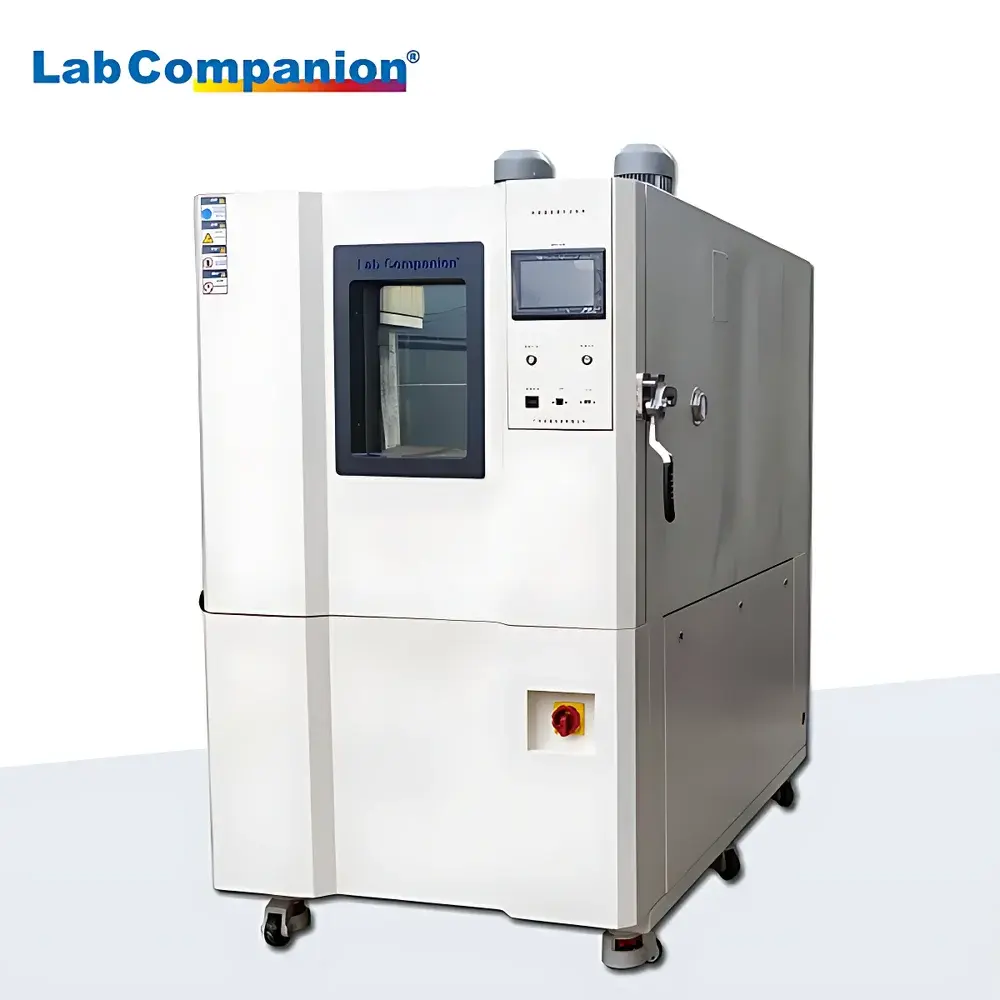
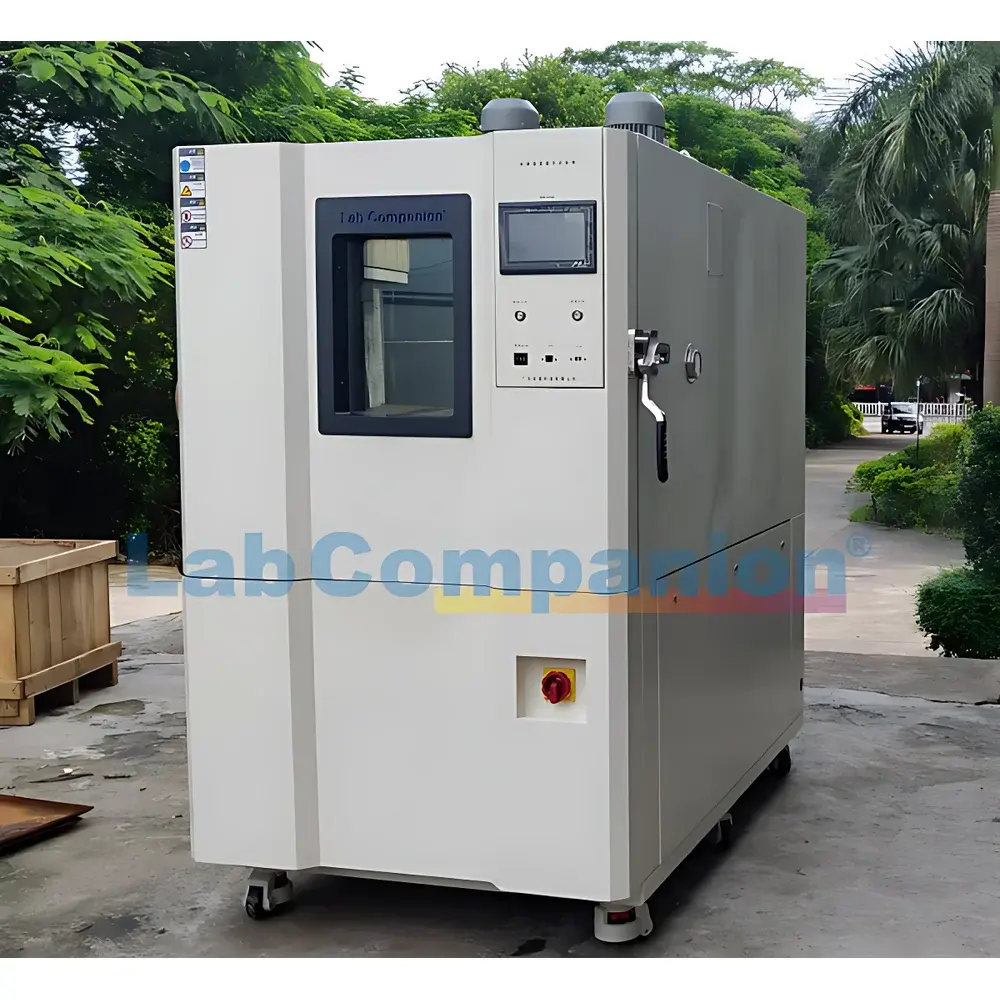
LabCompanion TH-408-5 High-Low Temperature Cycling Chamber
| Brand | LabCompanion |
|---|---|
| Origin | Guangdong, China |
| Manufacturer Type | Direct Manufacturer |
| Model | TH-408-5 |
| Temperature Range | −70 °C to +150 °C |
| Temperature Fluctuation | ±0.5 °C |
| Temperature Deviation | ±2.0 °C |
| Temperature Uniformity | ≤2.0 °C |
| Heating Rate | 1–25 °C/min (linear or non-linear) |
| Cooling Rate | 1–25 °C/min (linear or non-linear) |
| Working Chamber Dimensions | 800 × 850 × 600 mm (W × H × D) |
Overview
The LabCompanion TH-408-5 High-Low Temperature Cycling Chamber is an engineered environmental simulation system designed for precise, repeatable thermal stress testing across industrial R&D, quality assurance, and reliability validation workflows. Based on forced-air convection with dual-stage refrigeration and PID-controlled electric heating, the chamber delivers programmable temperature cycling profiles within a certified operating range of −70 °C to +150 °C. Its architecture supports both linear and non-linear ramping modes—enabling compliance with test standards such as IEC 60068-2-14 (change of temperature), MIL-STD-810H Method 503.6 (temperature shock), and JEDEC JESD22-A104 (temperature cycling). The chamber is constructed to meet ISO 9001:2015 quality management requirements and integrates mechanical and control systems validated under ISO/IEC 17025-aligned calibration practices.
Key Features
- Robust dual-compartment refrigeration system with cascade low-temperature stage and high-efficiency compressor, enabling stable operation at −70 °C without liquid nitrogen dependency.
- PID-based digital temperature controller with 0.1 °C resolution, real-time deviation compensation, and auto-tuning functionality for consistent setpoint adherence.
- Double-wall insulated chamber structure with polyurethane foam (≥100 mm thickness) and stainless steel inner liner (SUS304) for minimized thermal leakage and long-term corrosion resistance.
- Programmable multi-segment cycling capability: up to 99 cycles with 99 segments per cycle, supporting dwell time, ramp rate, and soak duration definition per segment.
- Integrated safety interlocks including over-temperature cut-off, compressor high-pressure protection, phase failure detection, and door-open alarm with automatic power cutoff.
- Front-access observation window with double-layer tempered glass and anti-fog heater for uninterrupted visual monitoring during extreme thermal conditions.
Sample Compatibility & Compliance
The TH-408-5 accommodates samples up to 800 × 850 × 600 mm (W × H × D) in internal volume, with load capacity rated for uniform thermal distribution under full-load conditions (validated per IEC 60068-3-5). It supports standard test specimens used in electronics packaging (e.g., PCBAs, IC packages), automotive ECUs, aerospace avionics modules, and battery cells. Chamber performance complies with ASTM E145 Class B specifications for laboratory ovens and chambers, and meets baseline requirements for GLP-compliant thermal validation protocols. Optional traceable calibration certificates (NIST-traceable sensors) and IQ/OQ documentation packages are available for regulated environments subject to FDA 21 CFR Part 11 or ISO 13485 audit readiness.
Software & Data Management
The chamber operates via LabCompanion’s proprietary TC-Link™ control software (Windows-compatible), offering local and remote configuration, real-time graphing, data logging at user-defined intervals (down to 1-second resolution), and export in CSV or Excel format. Audit trail functionality records all parameter changes, operator logins, and alarm events with timestamps—supporting 21 CFR Part 11 electronic record integrity requirements when paired with user authentication and digital signature modules. Optional Ethernet/Wi-Fi connectivity enables integration into centralized facility monitoring systems (BMS) or MES platforms via Modbus TCP or OPC UA protocols.
Applications
- Thermal cycling qualification of semiconductor devices per JEDEC JESD22-A104 and A110.
- Environmental stress screening (ESS) of printed circuit board assemblies prior to burn-in or final shipment.
- Material coefficient of thermal expansion (CTE) characterization through controlled dimensional change analysis.
- Validation of adhesive bond integrity, conformal coating performance, and solder joint reliability under repeated thermal excursions.
- Accelerated life testing of lithium-ion battery modules under variable charge/discharge thermal boundary conditions.
- Pre-conditioning of optical components and sensor housings for aerospace-grade thermal vacuum compatibility assessments.
FAQ
What is the maximum allowable sample mass for uniform temperature distribution?
The chamber maintains ≤2.0 °C uniformity with up to 50 kg of thermally inert mass placed centrally; heavier or high-thermal-mass loads require empirical verification using calibrated PT100 probes.
Can the TH-408-5 be integrated into an automated test sequence with external equipment?
Yes—digital I/O ports and RS485/Modbus support allow synchronization with power supplies, data acquisition units, or robotic handlers for unattended multi-step reliability tests.
Is third-party calibration and certification available for regulatory submissions?
LabCompanion provides optional UKAS-accredited calibration reports and IQ/OQ validation kits compliant with ISO/IEC 17025 and GxP expectations.
Does the system support rapid transition between extreme temperatures without overshoot?
The adaptive control algorithm minimizes overshoot during transitions; typical stabilization time after a −70 °C to +150 °C step is <12 minutes with <±1.0 °C transient deviation.
What maintenance intervals are recommended for sustained performance?
Compressor oil and refrigerant levels should be verified annually; air filters require cleaning every 3 months; full system performance verification is advised biannually per ISO 17025 guidelines.



