
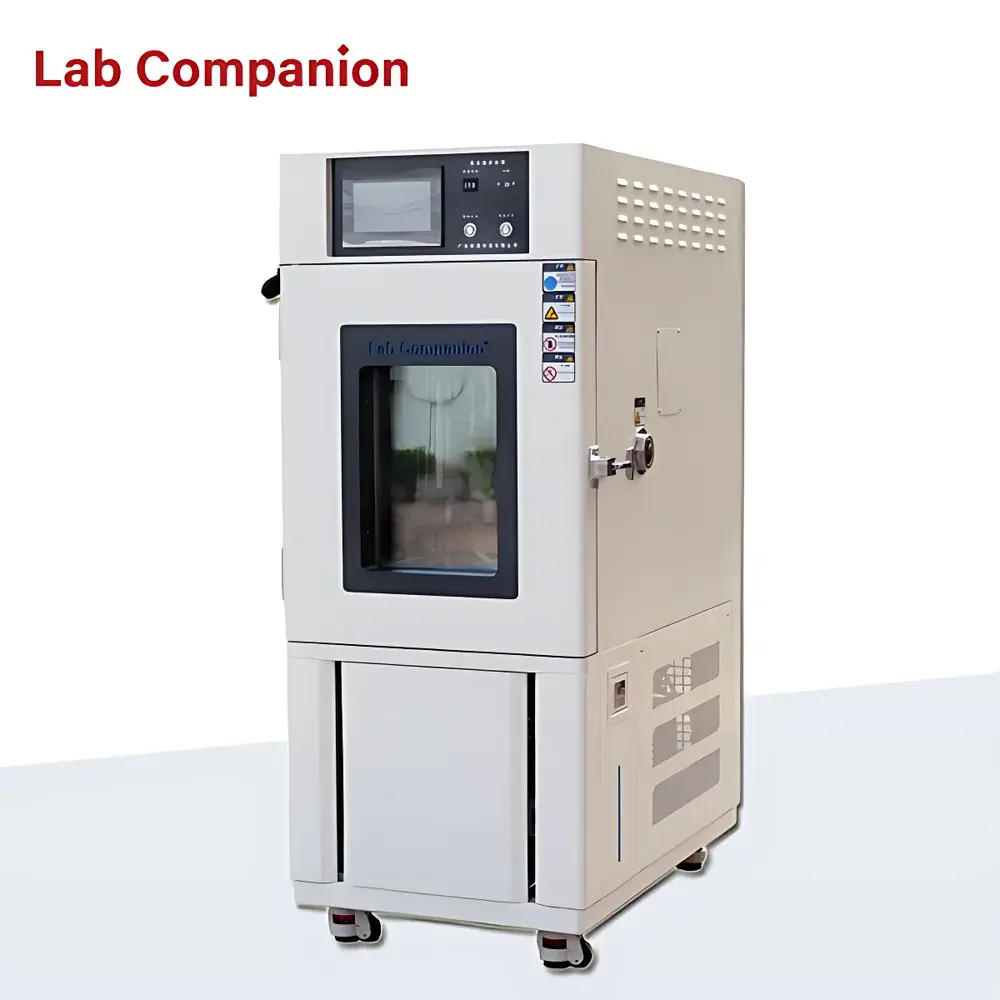
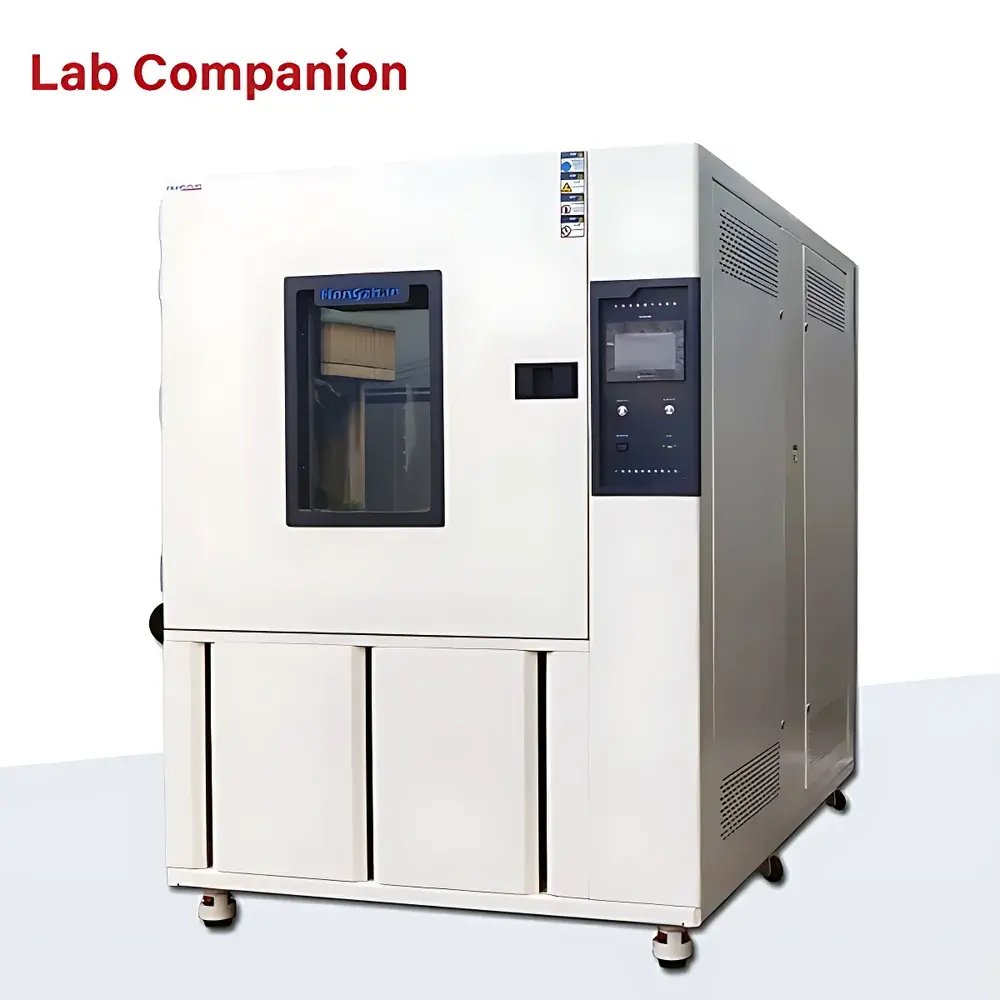
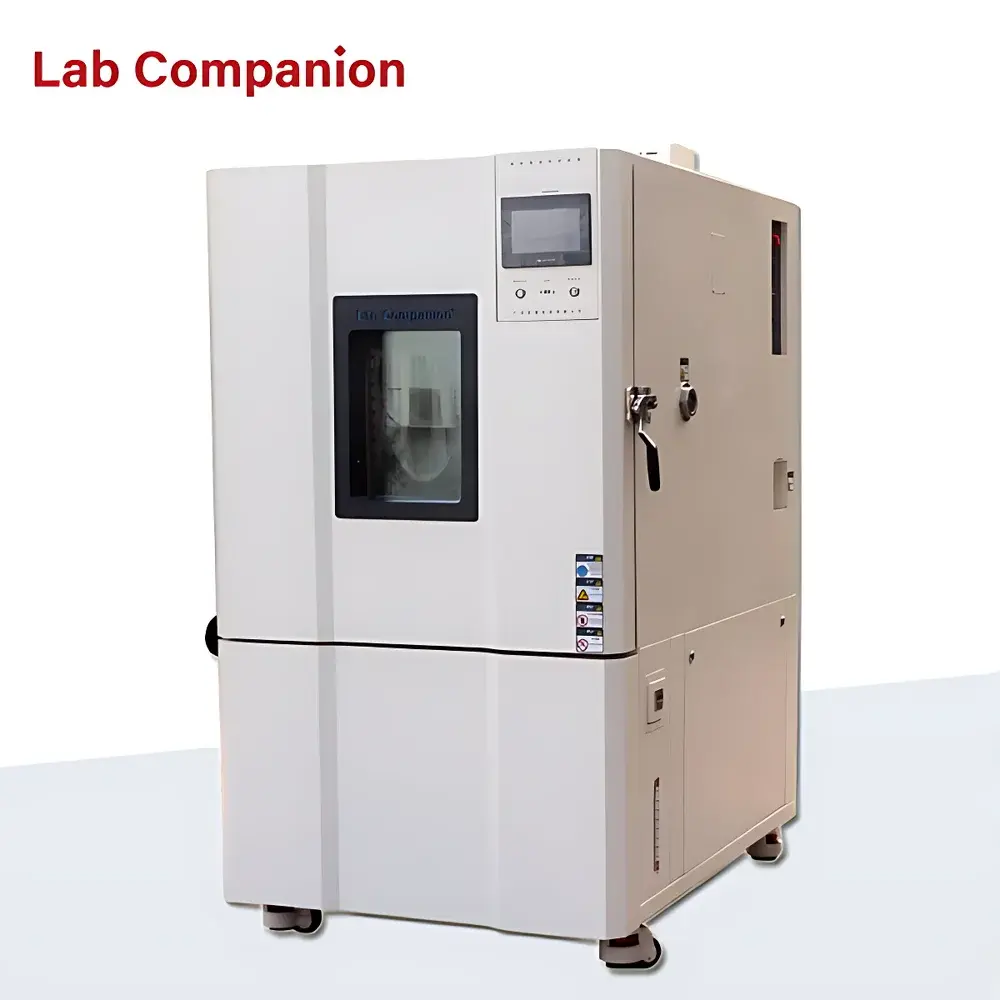
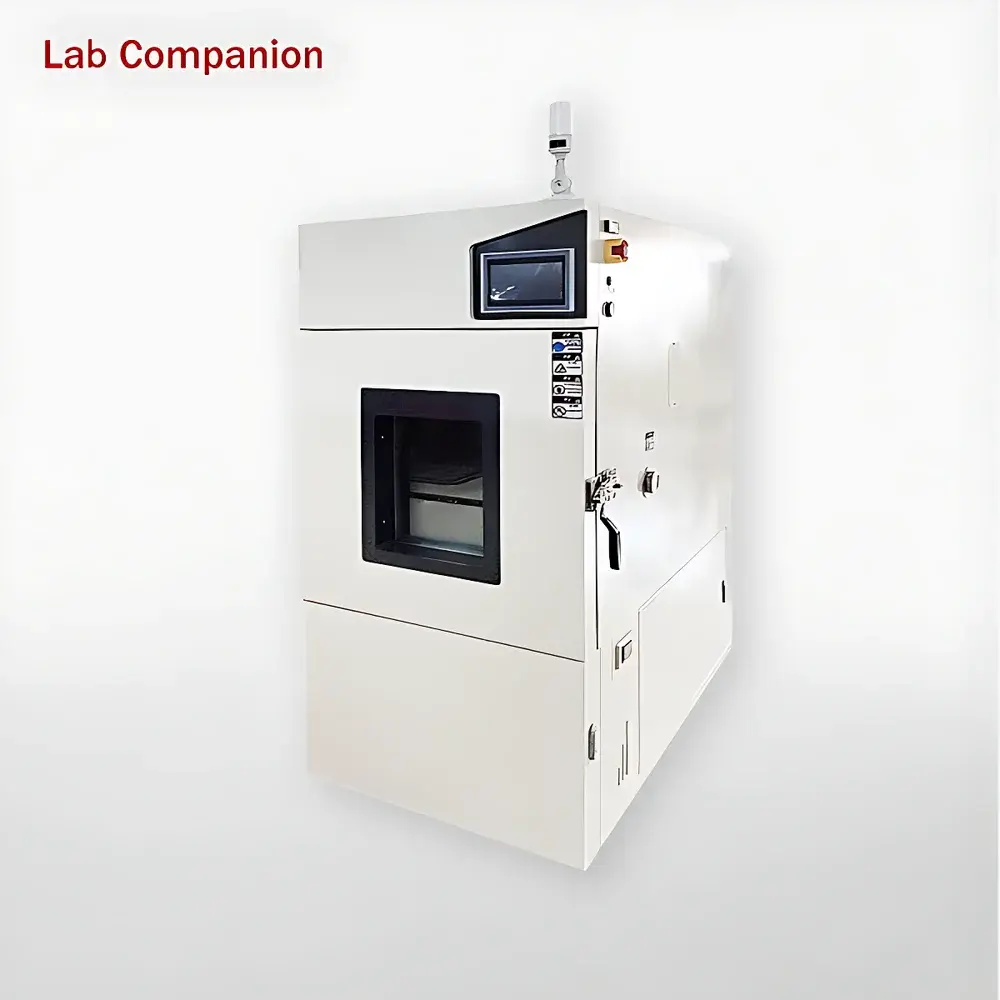
LabCompanion T-Series High-Low Temperature Environmental Test Chambers
| Brand | LabCompanion |
|---|---|
| Model | T-150 / T-225 / T-408 / T-800 / T-1000 |
| Temperature Range | -70 °C to +150 °C |
| Temperature Fluctuation | ±1 °C |
| Temperature Uniformity | ≤ ±1.5 °C (standard models), ≤ ±2 °C (T-800/T-1000) |
| Temperature Accuracy | ±0.1 °C to ±0.3 °C |
| Heating Rate (20 °C → +150 °C, no-load, nonlinear) | ~3.0 °C/min (T-150–T-408), ~2.5 °C/min (T-800/T-1000) |
| Cooling Rate (20 °C → -70 °C, no-load, nonlinear) | ~1.2 °C/min (T-150–T-408), ~1.0 °C/min (T-800/T-1000) |
| Internal Volume | 150 L, 225 L, 408 L, 800 L, 1000 L (customizable) |
| Refrigerant | R404A (ozone-friendly, non-CFC) |
| Control System | 7-inch color touchscreen interface with AI-enhanced thermal field compensation algorithm |
| Programmability | Up to 100 user-defined test profiles |
| Data Traceability | Network-enabled data logging, exportable CSV/Excel reports, audit-ready for GLP/GMP environments |
| Compliance | Fully aligned with GB/T 2423.1, GB/T 2423.2, IEC 60068-2-1, IEC 60068-2-2, ISO 16750-4, and GJB 150A-2009 |
Overview
The LabCompanion T-Series High-Low Temperature Environmental Test Chambers are engineered for precision reliability testing of semiconductor devices, electronic components, and advanced materials under rigorously controlled thermal conditions. These chambers employ a dual-stage cascade refrigeration system—featuring high-efficiency compressors and environmentally compliant R404A refrigerant—to achieve stable operation across the full range of -70 °C to +150 °C. The core measurement principle is thermally driven environmental stress screening (ESS), where temperature-induced mechanical and electrical responses—including solder joint fatigue, die attach delamination, and parametric drift in active devices—are quantified under repeatable, traceable conditions. Designed specifically for semiconductor qualification per JEDEC JESD22-A104 (Temperature Cycling) and A119 (Highly Accelerated Temperature and Humidity Stress Test), the T-Series supports both standard-rate and accelerated thermal cycling protocols. Its AI-optimized air distribution architecture ensures uniform thermal exposure across the entire working chamber, minimizing spatial gradients that could compromise device-level failure analysis.
Key Features
- Dual-Stage Cascade Refrigeration: Enables deep-cold capability down to -70 °C while maintaining long-term stability and low maintenance intervals; compressor protection includes overpressure, overcurrent, and overheating safeguards.
- Precision Thermal Control: Dual-PID control loop integrated with real-time AI thermal field compensation delivers ±0.1 °C to ±0.3 °C temperature accuracy and ≤ ±1.5 °C uniformity in standard configurations (≤ ±2 °C for T-800/T-1000).
- Modular Volume Architecture: Five standardized internal volumes (150 L to 1000 L) optimized for distinct use cases—from wafer-level IC packages and photonic modules (T-150/T-225) to full battery packs and automotive ECUs (T-800/T-1000); all models support custom porting, wiring feedthroughs, and load-bearing upgrades.
- Intelligent Touch Interface: 7-inch industrial-grade color touchscreen with intuitive navigation, multi-language support (EN/DE/FR/JP/CN), and embedded firmware update capability.
- Energy-Efficient Design: Optimized refrigerant circuitry and low-thermal-conductivity insulation reduce power consumption by up to 35% versus legacy single-stage systems—certified compliant with ISO 50001 energy management principles.
- Robust Construction: Interior chamber fabricated from electropolished SUS304 stainless steel (Ra ≤ 0.02 µm surface roughness); outer shell finished with corrosion-resistant powder-coated cold-rolled steel.
Sample Compatibility & Compliance
The T-Series accommodates a broad spectrum of semiconductor and microelectronic specimens—including bare dies, packaged ICs (QFN, BGA, CSP), MEMS sensors, optoelectronic transceivers, and PCBAs—without compromising thermal fidelity. All models include standard 100 mm observation windows with anti-fog heating, multiple 25 mm diameter cable ports with silicone gaskets, and optional inert gas purge capability (N₂ or dry air). From a regulatory standpoint, the chambers meet essential requirements for environmental testing under ISO/IEC 17025-accredited laboratories and are pre-validated for compliance with ASTM E1545, IEC 60749-27 (temperature cycling), MIL-STD-810H Method 502.7, and US Department of Defense standards including GJB 150A-2009. Full documentation packages—including IQ/OQ protocols, calibration certificates traceable to NIST standards, and 21 CFR Part 11-compliant electronic signature readiness—are available upon request.
Software & Data Management
LabCompanion’s proprietary T-Link™ control software provides seamless remote monitoring, profile editing, and real-time parameter visualization via Ethernet or Wi-Fi connectivity. Each chamber logs timestamped temperature readings at configurable intervals (1 s to 60 min), storing up to 30 days of continuous data internally. Export functions support CSV, Excel, and PDF formats—with metadata fields for operator ID, test ID, chamber serial number, and calibration status. Audit trails record all user actions (e.g., program edits, setpoint changes, door openings) with immutable timestamps, satisfying GLP and GMP data integrity mandates. Optional integration with LIMS platforms (e.g., Thermo Fisher SampleManager, LabVantage) enables automated result ingestion and cross-system workflow orchestration.
Applications
- Semiconductor Qualification: Pre-screening of wafers and packaged devices per JEDEC JESD22-A104 and A119; identification of latent defects induced by CTE mismatch during thermal cycling.
- Automotive Electronics: Validation of ADAS sensors, infotainment ECUs, and battery management systems against ISO 16750-4 thermal shock and endurance requirements.
- Photonics & 5G Components: Stability assessment of laser diodes, RF amplifiers, and optical transceivers under rapid thermal transitions typical of outdoor deployment scenarios.
- Research & Development: Material coefficient-of-thermal-expansion (CTE) characterization, interfacial adhesion studies, and accelerated life modeling for next-generation packaging substrates.
- Third-Party Certification Labs: Accredited testing services supporting UL, CE, CCC, and KC mark submissions with full traceability and report generation capabilities.
FAQ
What temperature uniformity can be expected across the working volume?
For T-150 through T-408 models, temperature uniformity is guaranteed at ≤ ±1.5 °C (measured per IEC 60068-3-5); for T-800 and T-1000, it is ≤ ±2.0 °C due to increased cavity dimensions and thermal mass.
Is remote monitoring and control supported out of the box?
Yes—each unit ships with built-in Ethernet/Wi-Fi hardware and T-Link™ software enabling secure web-based access, alarm notifications via email/SMS, and real-time data streaming.
Can the chamber be validated for GxP-regulated environments?
Absolutely. IQ/OQ documentation templates, calibration records traceable to national metrology institutes, and 21 CFR Part 11-compliant electronic signature modules are available as optional add-ons.
What customization options exist for specialized semiconductor testing?
Available enhancements include ESD-safe interior finishes, ultra-low particulate airflow filters (ISO Class 5 compatible), nitrogen purge manifolds, and integration-ready interfaces for probe stations and parametric analyzers.
How does the system ensure long-term calibration stability?
All units undergo factory calibration using dual-reference PT100 sensors verified against certified standards; annual recalibration is recommended, with drift typically < ±0.05 °C/year under normal operating conditions.



