
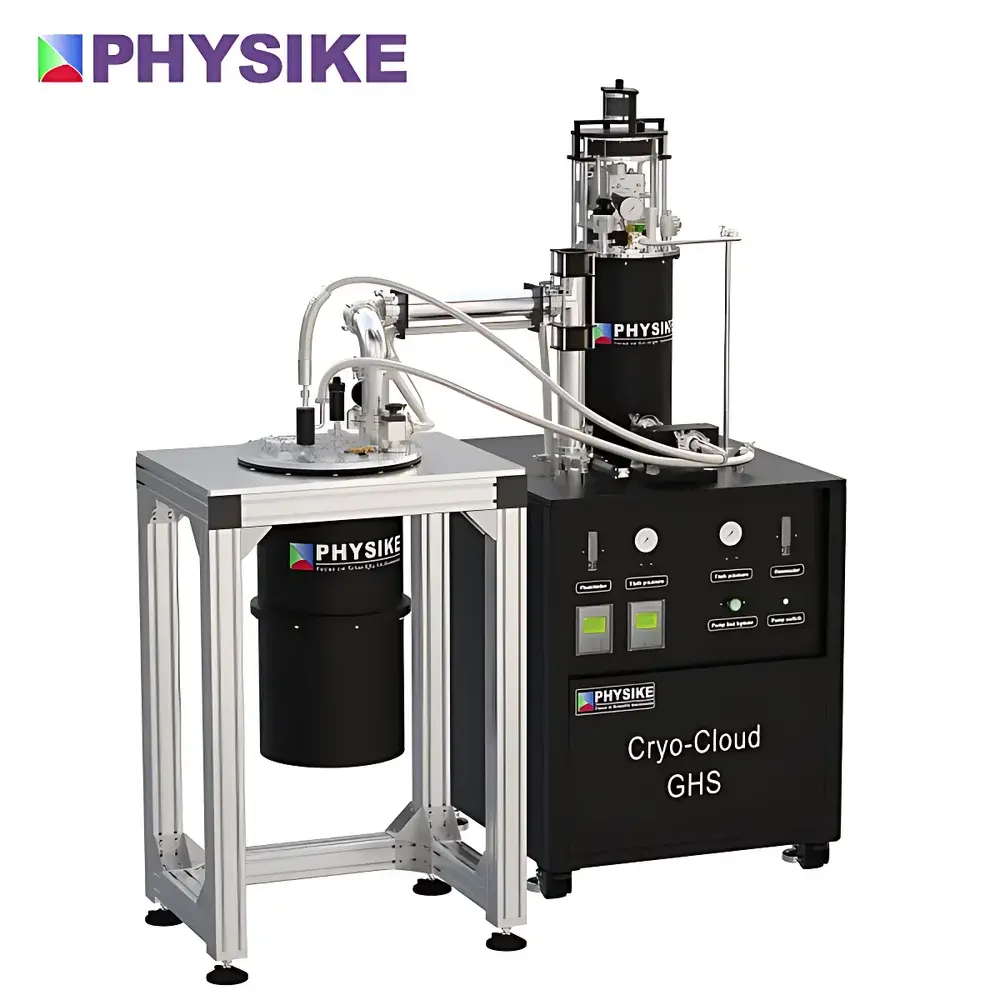
PHYSIKE Cryocloud-200 Split-System Continuous He-3 Cryostat
| Brand | PHYSIKE |
|---|---|
| Origin | Beijing, China |
| Manufacturer Type | Direct Manufacturer |
| Model | Cryocloud-200 |
| Base Temperature | < 350 mK |
| Cooling Architecture | Split-system (external Qcryo® helium-recycling cryocooler) |
| Vibration Isolation | Active mechanical decoupling between compressor/coldhead and He-3 insert |
| Vacuum Compatibility | UHV-compatible (bakeable to 150 °C) |
| Optional Integration | Superconducting magnet (up to 9 T, persistent mode) |
Overview
The PHYSIKE Cryocloud-200 is a high-stability, split-system continuous He-3 cryostat engineered for ultra-low-temperature physics experiments requiring sustained operation below 350 mK with minimal mechanical perturbation. Unlike conventional monolithic He-3 refrigerators, the Cryocloud-200 employs a physically decoupled architecture: its 4 K precooling stage is supplied by an external Qcryo® helium-recycling cryocooler, while the He-3 cooling loop—including gas handling, multi-stage condensation, and recirculation—is housed separately in a vibration-isolated insert. This design eliminates direct transmission of compressor and coldhead vibrations to the experimental sample stage—a critical requirement for scanning probe microscopy (SPM), nano-optical spectroscopy, and quantum-limited metrology. The system operates on the principle of continuous He-3 phase-change refrigeration: He-3 gas is pumped from the pot to induce evaporative cooling, then purified, compressed, pre-cooled through multiple stages (including 4 K, 1.5 K, and sub-K intercepts), liquefied, and re-injected—enabling stable base temperatures 72 hours without manual intervention.
Key Features
- Split-system configuration with full mechanical isolation between Qcryo® coldhead/compressor and He-3 insert—reducing broadband vibration amplitude by >90% compared to integrated dry He-3 systems
- UHV-compatible stainless-steel vacuum vessel, bakeable to 150 °C, certified for pressures ≤1×10⁻¹⁰ mbar after bakeout
- Integrated gas management subsystem: Roots-backed turbomolecular pumping station with real-time pressure monitoring, catalytic recombination, and cryotrapping for He-3 purity maintenance (>99.999% purity over 1000 h)
- Modular thermal anchoring: Sample stage thermally linked to He-3 pot via high-conductivity Cu braids; optional low-thermal-conductance wiring for quantum-limited measurements
- Standard 120 mm clear bore diameter accommodating custom sample holders, SPM scanners, or optical access windows (AR-coated CaF₂ or sapphire)
- Optional superconducting magnet integration (persistent-mode, up to 9 T) with independent thermal shielding and field homogeneity ≤5×10⁻⁵ over 5 mm Ø
Sample Compatibility & Compliance
The Cryocloud-200 supports diverse experimental platforms including scanning tunneling microscopes (STM), atomic force microscopes (AFM), angle-resolved photoemission spectrometers (ARPES), transition-edge sensors (TES), and quantum capacitance devices. Its UHV-compliant construction meets ASTM E595 outgassing specifications (<1.0% TML, <0.1% CVCM) and adheres to ISO 10110-7 surface quality standards for internal optical components. All electrical feedthroughs comply with IEC 60068-2-64 (vibration testing) and MIL-STD-202G (hermeticity). The system is fully compatible with GLP/GMP-aligned lab environments: digital log files record all operational parameters (temperature, pressure, flow rate, magnet current) with timestamped audit trails compliant with FDA 21 CFR Part 11 requirements when paired with validated data acquisition software.
Software & Data Management
Control is managed via PHYSIKE’s CryoControl v4.2 platform—a Linux-based real-time system running on a dedicated industrial PC. The GUI provides synchronized monitoring of 32+ analog/digital channels (pot temperature, 4 K stage, shield temperatures, He-3 vapor pressure, pump speeds, magnet status). Automated sequences include ramp-and-hold cooldown, pressure-regulated He-3 injection, and fault-responsive shutdown (e.g., vacuum breach >1×10⁻⁶ mbar triggers immediate valve closure and warm-up protocol). Raw data are stored in HDF5 format with embedded metadata (sample ID, operator, calibration certificates); export options include CSV, MATLAB .mat, and NI DIAdem compatibility. Remote access supports SSH-secured CLI and TLS-encrypted web dashboard (HTTPS) for off-site monitoring.
Applications
- Ultra-low-temperature scanning tunneling microscopy (STM) and spectroscopy (STS) on correlated electron systems
- Nano-ARPES with sub-10 meV energy resolution at < 400 mK
- Quantum transport measurements in 2D materials under simultaneous high magnetic field and sub-500 mK conditions
- Cryogenic optical cavity stabilization for quantum memory and single-photon source characterization
- De Haas–van Alphen and Shubnikov–de Haas oscillations in topological semimetals
- Calorimetric studies of quantum phase transitions using thin-film NIS (normal-insulator-superconductor) thermometers
FAQ
What is the typical cooldown time from 300 K to base temperature?
Approximately 18–22 hours, depending on initial vacuum level and thermal load; accelerated cooldown options (e.g., forced He-4 precooling) reduce this to ≤14 h.
Can the Cryocloud-200 be retrofitted into existing UHV chambers?
Yes—flange configurations (CF150, CF200, or custom KF/NW) and mounting interfaces are configurable per customer chamber drawings.
Is helium recovery supported?
The integrated gas handling system enables >92% He-3 recovery efficiency over a 1000-hour operational cycle; recovery requires connection to a dedicated He-3 purification skid (optional accessory).
What vacuum pumping speed is required to achieve optimal cooling power at 500 mK?
A minimum effective pumping speed of 1200 L/s (He) at the He-3 pot is recommended; use of dual-stage Roots + turbo pumps achieves ≥3× higher cooling power at 500 mK versus single-pump configurations.
Does the system support automated temperature sweeps with feedback control?
Yes—PID parameters are tunable per thermal zone; sweep rates from 0.1 mK/min to 5 K/min are programmable with ±5 mK stability over 24 h.



