
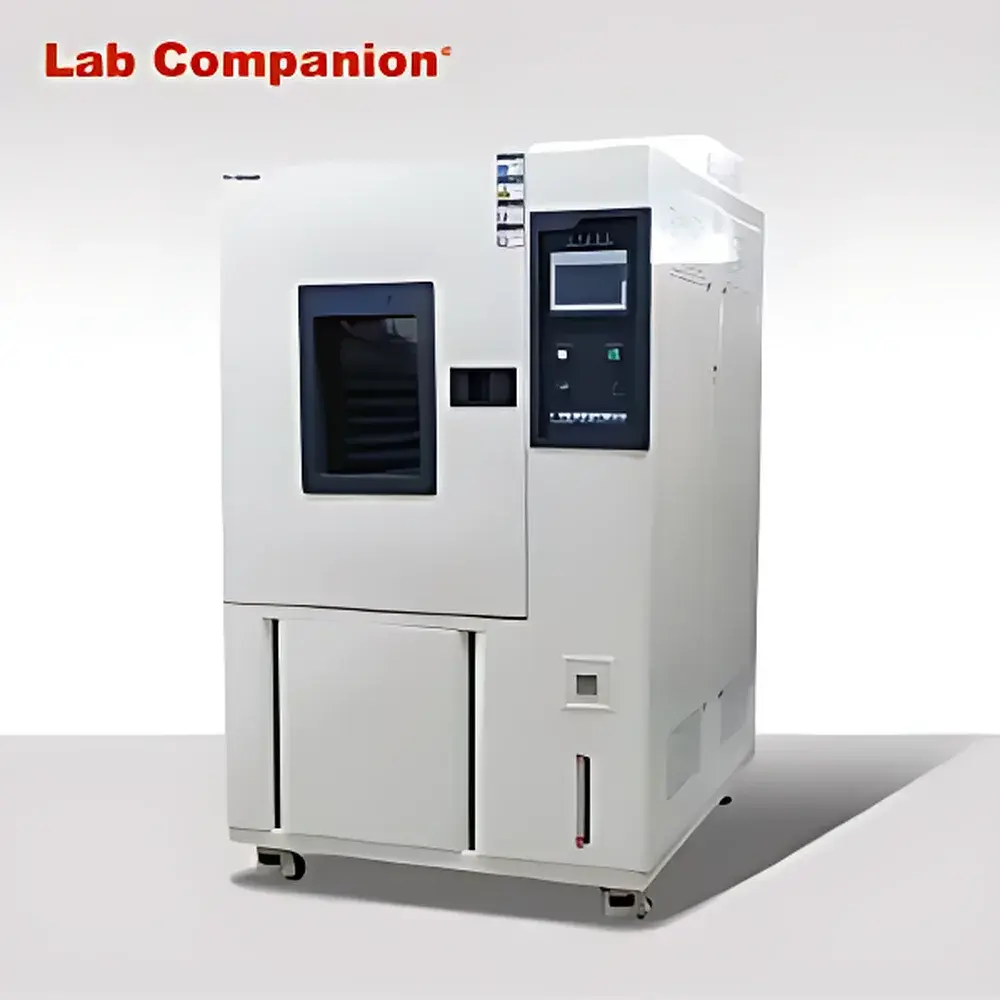
LabCompanion T/C Series Rapid Temperature Cycling Chamber
| Brand | LabCompanion |
|---|---|
| Origin | Guangdong, China |
| Manufacturer Type | Direct Manufacturer |
| Model | T/C Series |
| Price Range | USD 7,000 – 14,000 (FOB) |
| Temperature Range | −70 °C to +150 °C |
| Refrigeration Method | Compressor-based cooling |
| Explosion-Proof Option | Standard (Non-Explosion-Proof) |
| Temperature Fluctuation | ±0.5 °C |
| Temperature Uniformity | ±2.0 °C |
| Temperature Deviation | ±2.0 °C |
| Heating Rate | 5.0 °C/min (typical, non-linear, no-load) |
| Cooling Rate | 5.0 °C/min (typical, non-linear, no-load) |
| Internal Chamber Dimensions | 800 × 850 × 600 mm (W × H × D) |
Overview
The LabCompanion T/C Series Rapid Temperature Cycling Chamber is an engineered environmental test system designed for accelerated thermal stress evaluation of electronic components, automotive modules, aerospace materials, and industrial polymers under controlled, repeatable, and traceable conditions. It operates on the principle of dynamic thermal equilibrium—leveraging precision PID-controlled heating and refrigeration subsystems to achieve rapid, programmable transitions between extreme temperature setpoints. Unlike static thermal soak chambers, the T/C Series supports defined ramp-and-soak profiles with high temporal fidelity, enabling compliance-driven testing per IEC 60068-2-14 (Change of Temperature), MIL-STD-810H Method 503.6 (Temperature Shock), and JEDEC JESD22-A104 (Temperature Cycling). Its architecture integrates a dual-stage cascade refrigeration system using environmentally compliant R504A/R23A refrigerants, coupled with high-efficiency nickel-chromium heating elements and PT100 Class A platinum resistance sensors for metrological-grade temperature feedback.
Key Features
- Robust chamber construction: Interior chamber fabricated from mirror-finish SUS 304 stainless steel; exterior enclosure available in either brushed-finish SUS 201 stainless or powder-coated cold-rolled steel.
- High-fidelity thermal control: Digital PID + SSR coordinated control system with 0.1 °C resolution and ±0.1 °C display accuracy; real-time auto-tuning compensates for thermal load variations during cycling.
- Rapid thermal transition capability: Achieves 5.0 °C/min average ramp rates across the full −70 °C to +150 °C range under no-load conditions—validated per ASTM E1545 calibration methodology.
- Dual independent humidity management (optional): Integrated steam-generation humidification system with automatic water-level compensation, dry-wet bulb or digital relative humidity sensing, and P.I.D.-regulated moisture delivery.
- Comprehensive safety architecture: Dual-stage overtemperature protection, compressor high-pressure/overheat/overcurrent cutouts, fan motor thermal overload relay, phase failure detection, dry-heater burnout prevention, and leak-current monitoring.
- Thermal insulation: 100 mm thick rigid polyurethane foam (density ≥40 kg/m³, thermal conductivity ≤0.022 W/m·K) with seamless foaming process to minimize thermal bridging.
Sample Compatibility & Compliance
The T/C Series accommodates standard-sized PCB assemblies, battery packs (up to 20 kg), optical sensor housings, and encapsulated semiconductor packages within its 408 L internal volume (800 × 850 × 600 mm). All models comply with CE marking requirements (2014/30/EU EMC Directive and 2014/35/EU LVD Directive) and meet mechanical safety standards per ISO 13857. The controller firmware supports audit-ready data logging aligned with GLP and GMP principles—including time-stamped event records, operator ID tagging (via optional RFID reader integration), and configurable alarm history retention. Optional 21 CFR Part 11-compliant software packages provide electronic signature support, user role-based access control, and immutable audit trails for regulated industries.
Software & Data Management
Standard communication interfaces include RS-232 and RS-485 ports with Modbus RTU protocol support; USB interface is available as a factory-configurable option. The included LabCompanion TestSuite™ software enables remote profile programming, real-time parameter visualization, and automated report generation (PDF/CSV). Data logs are timestamped to UTC with microsecond resolution and support configurable sampling intervals (1 s to 60 min). For enterprise integration, OPC UA server functionality is available via firmware upgrade—enabling seamless connectivity with MES, SCADA, and LIMS platforms. All firmware updates are digitally signed and verified at boot to ensure integrity.
Applications
- Qualification testing of automotive ECUs per ISO 16750-4 (Electrical loads) and AEC-Q200 stress screening protocols.
- Reliability assessment of lithium-ion battery cells undergoing accelerated aging via temperature cycling (e.g., 500–1000 cycles between −20 °C and +60 °C).
- Validation of conformal coating adhesion and solder joint integrity in avionics hardware per DO-160 Section 4.11.
- Material compatibility studies for medical device housings exposed to sterilization-relevant thermal excursions (e.g., ethylene oxide pre-conditioning).
- Process validation of adhesive curing cycles where thermal ramp rate directly influences cross-link density and bond strength.
FAQ
What is the standard calibration interval recommended for this chamber?
Annual calibration against NIST-traceable reference standards is recommended; field verification using calibrated PT100 probes is advised before each qualification test series.
Can the T/C Series be integrated into an existing facility’s Building Management System (BMS)?
Yes—via optional BACnet MS/TP or Modbus TCP gateway module, supporting status monitoring, setpoint override, and alarm forwarding.
Is water-cooled condenser configuration available for high-ambient installations?
Yes—water-cooled condenser kits with ASME-certified heat exchangers are offered for ambient temperatures exceeding 35 °C or continuous operation above 85% duty cycle.
Does the chamber support thermal shock testing per MIL-STD-810H Method 503.6?
Yes—when equipped with dual-compartment configuration (optional) or validated single-zone rapid transition profiles meeting the specified dwell time and transfer time criteria.
What documentation is provided for IQ/OQ/PQ validation support?
Factory-supplied validation templates (IQ/OQ checklists, PQ protocol examples), equipment specification sheets, calibration certificates, and material declarations (RoHS/REACH) are included with each shipment.



