
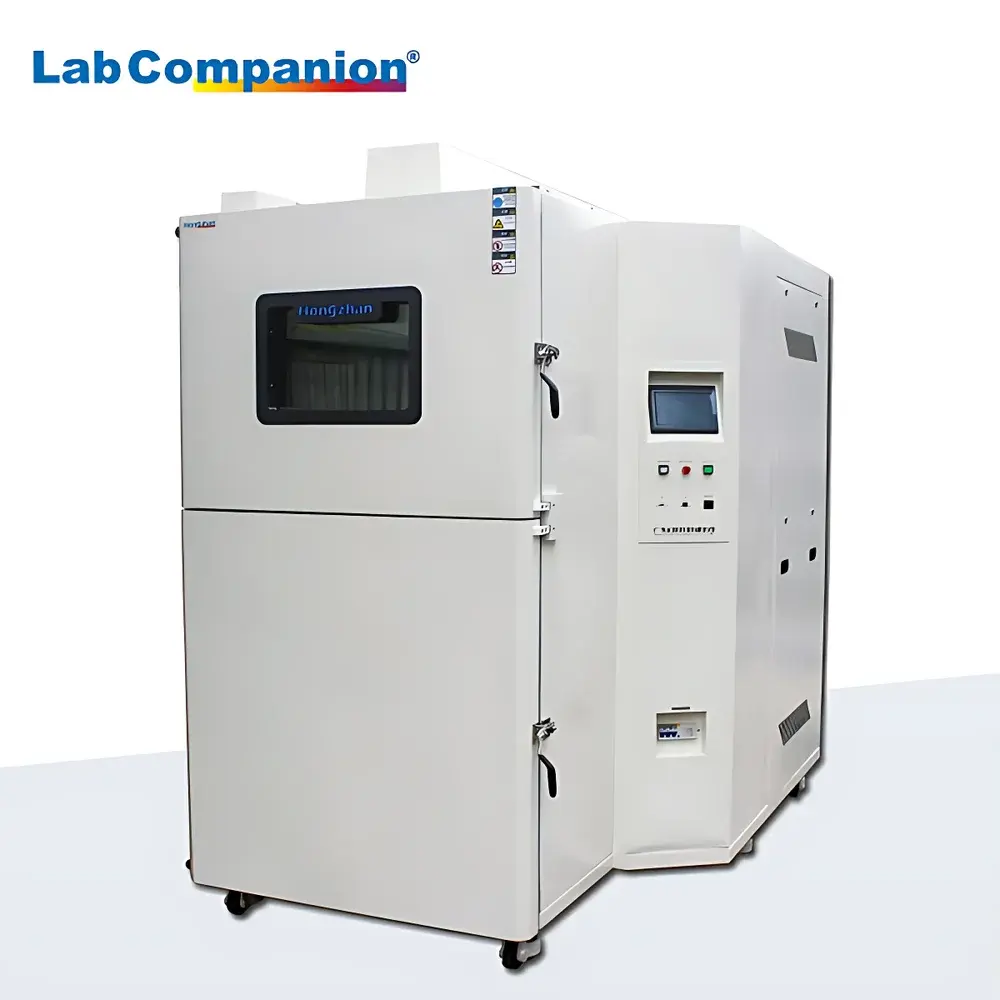
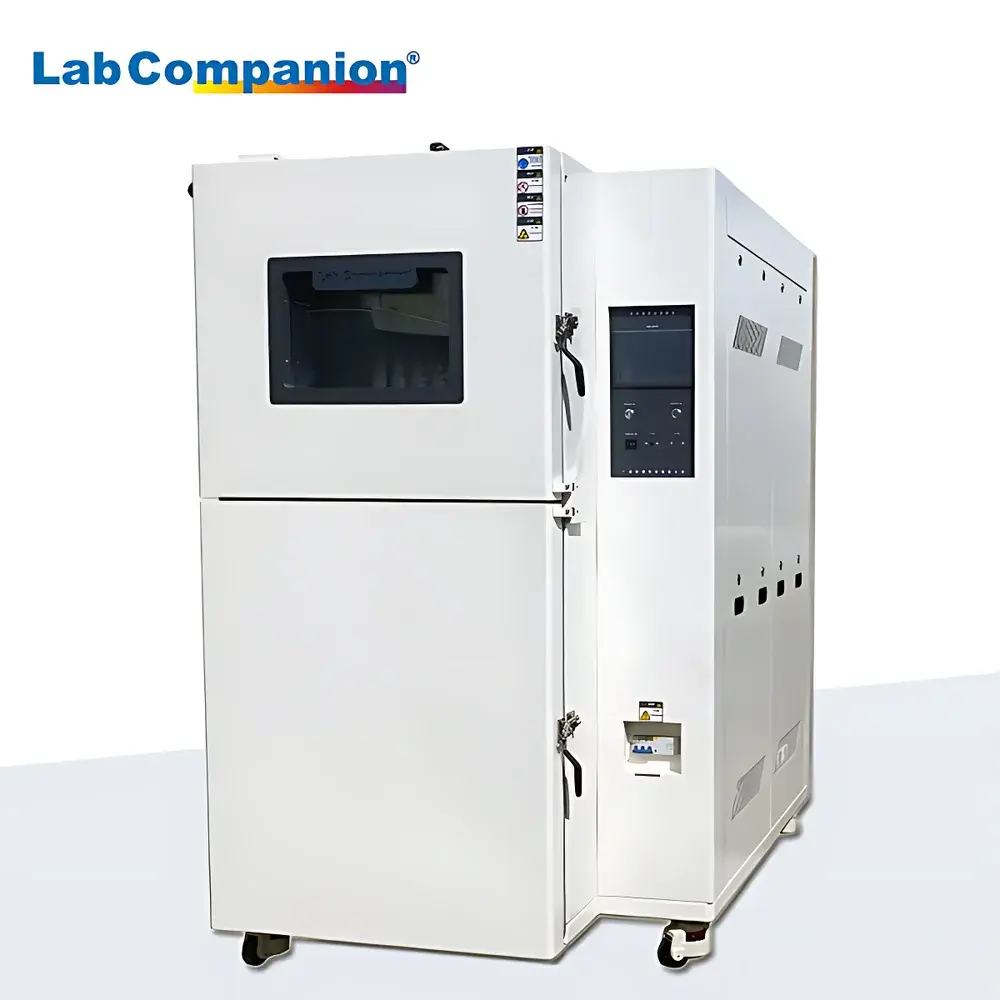
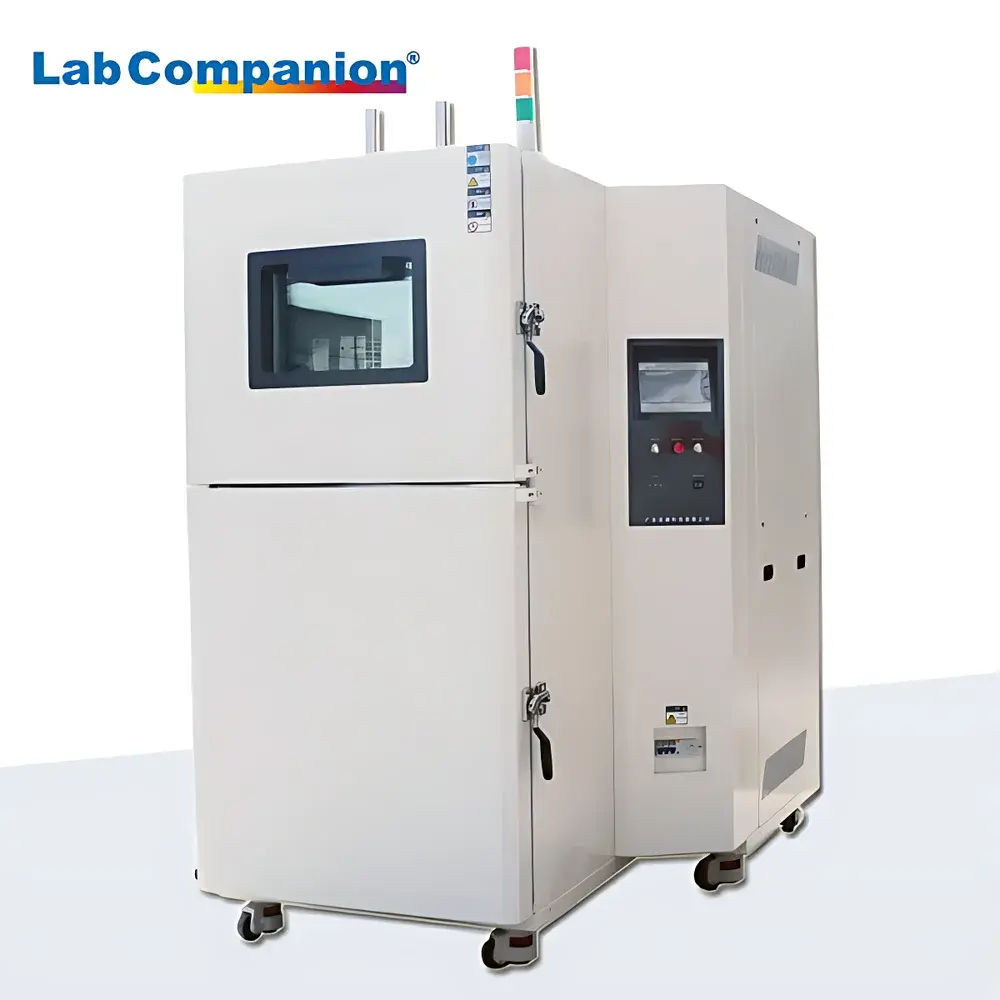
LabCompanion CTS-50W Thermal Shock Test Chamber
| Brand | LabCompanion |
|---|---|
| Origin | Guangdong, China |
| Manufacturer Type | Direct Manufacturer |
| Model | CTS-50W |
| Price | ¥100,000 |
| High-Temperature Range | +60 °C to +200 °C |
| Low-Temperature Range | 0 °C to −70 °C |
| Thermal Shock Range | −65 °C to +150 °C |
| Temperature Stability | ±2 °C |
| Ramp-Up Rate | RT to +200 °C in ~40 min |
| Ramp-Down Rate | RT to −70 °C in ~60 min |
| Transfer Time | ≤5 s |
| Temperature Recovery Time | ≤5 min |
| Internal Dimensions (W×H×D) | 300×460×350 mm |
| External Dimensions (W×H×D) | 2250×1200×1950 mm |
| Construction | Exterior – Powder-coated cold-rolled steel |
| Compliance Standards | GJB 150.3–150.5, GB/T 2423.1–2423.2 |
Overview
The LabCompanion CTS-50W Thermal Shock Test Chamber is an engineered environmental stress screening (ESS) system designed for rapid, repeatable evaluation of material and component reliability under extreme temperature transitions. It operates on the two-chamber static air thermal shock principle: separate high-temperature and low-temperature zones maintain stable setpoints, while a horizontally translating test basket rapidly transfers samples between them—enabling controlled exposure to abrupt thermal gradients without mechanical stress from forced convection or direct contact cooling/heating. This architecture ensures high reproducibility in accelerated life testing, failure mode identification, and qualification validation for electronics, aerospace components, automotive modules, and advanced packaging materials.
Key Features
- Independent dual-zone thermal control: High-temp chamber (+60 °C to +200 °C) and low-temp chamber (0 °C to −70 °C), each equipped with dedicated refrigeration and heating circuits for simultaneous stability.
- High-speed transfer mechanism: Basket movement completed within ≤5 seconds, minimizing dwell time in transition zones and preserving thermal integrity of the shock profile.
- Precision temperature recovery: ≤5 minutes to re-stabilize chamber setpoints post-transfer, critical for multi-cycle test protocols requiring tight dwell-time repeatability.
- Robust thermal insulation: Non-hazardous, low-conductivity fiberglass layer (≥100 mm thickness) minimizes heat leakage and improves energy efficiency across extended test durations.
- Industrial-grade control architecture: Siemens S7-series PLC core paired with a 7-inch resistive touchscreen running LabCompanion’s proprietary PlatinumV1.0 firmware—certified for deterministic real-time response and deterministic I/O handling per IEC 61131-3.
- Comprehensive data traceability: Onboard USB interface logs timestamped CSV files containing target/actual temperatures, cycle counts, elapsed times, and alarm events—structured for GLP/GMP-aligned audit trails when used with validated LabCompanion PC software.
Sample Compatibility & Compliance
The CTS-50W accommodates test specimens up to 300 mm (W) × 460 mm (H) × 350 mm (D), with a maximum payload of 15 kg per cycle. Its internal 304 stainless steel chamber resists corrosion from condensate, flux residues, and outgassed volatiles common in PCB and semiconductor packaging validation. The system complies with military and industrial thermal shock standards including GJB 150.3 (high temperature), GJB 150.4 (low temperature), GJB 150.5 (temperature shock), and GB/T 2423.1–2423.2 (IEC 60068-2-1/2 equivalents). All temperature uniformity, stability, and recovery performance metrics are verified per GB/T 5170.2–2017 (equivalent to IEC 60068-3-5) using calibrated Pt100 sensors traceable to NIM (National Institute of Metrology, China).
Software & Data Management
Data acquisition and remote supervision are supported via the optional PlatinumV1.0 PC-based monitoring suite. This software enables centralized management of up to 32 chambers across a LAN, with role-based user access, electronic signature support, and configurable alarm notifications (email/SNMP). Logged CSV datasets include full metadata (operator ID, test plan revision, chamber serial number) and are compatible with third-party statistical process control (SPC) platforms. For regulated environments, the system supports 21 CFR Part 11-compliant audit trail generation when deployed with validated electronic signatures and time-stamped event logging—fully documented in LabCompanion’s IQ/OQ/PQ protocol package.
Applications
- Qualification testing of avionics housings and flight-critical sensors per DO-160 Section 4.5 (Temperature Shock).
- Failure analysis of solder joint integrity in lead-free BGA assemblies subjected to JEDEC J-STD-020D-defined thermal cycling profiles.
- Validation of conformal coating adhesion and delamination resistance in automotive ECUs exposed to −40 °C to +125 °C transitions.
- Accelerated aging of polymer-based medical device enclosures per ISO 10993-12 requirements for thermal stress-induced microcracking.
- Reliability screening of lithium-ion battery modules prior to vibration and humidity exposure in combined environmental stress screening (CESS) sequences.
FAQ
What is the difference between air-cooled and water-cooled configurations?
Air-cooled (suffix “A”) units use ambient air heat rejection and require ≥1 m clearance on all sides for ventilation. Water-cooled (suffix “W”) models employ a closed-loop chiller interface (3–5 bar inlet pressure, ≤35 °C supply temperature) and are recommended for installations where ambient temperatures exceed 30 °C or space constraints limit airflow.
Can the CTS-50W be integrated into a factory MES or LIMS platform?
Yes—via its standard RJ45 Ethernet port and Modbus TCP/IP protocol stack, the chamber supports bidirectional communication with MES/LIMS systems for automated job dispatch, parameter upload, and result ingestion. LabCompanion provides OPC UA gateway compatibility documentation upon request.
Is temperature calibration traceable to international standards?
All factory calibrations are performed using Fluke 1524 reference thermometers calibrated annually against NIM primary standards. A full calibration certificate (including uncertainty budget per ISO/IEC 17025) is supplied with each unit.
What safety interlocks are implemented?
The system includes door-position switches, overtemperature cutouts (dual independent channels), compressor high-pressure shutdown, and emergency power-off (EPO) circuitry compliant with IEC 60204-1. All interlocks trigger audible/visual alarms and halt thermal cycling without data loss.
Does the controller support custom test profiles with variable dwell times and ramp rates?
Yes—the PlatinumV1.0 firmware allows creation of multi-step profiles with up to 99 segments, programmable dwell durations (1 s to 999 h), and conditional branching based on real-time sensor feedback (e.g., “hold until T ≤ −65 °C ±0.5 °C for 10 min”).



