
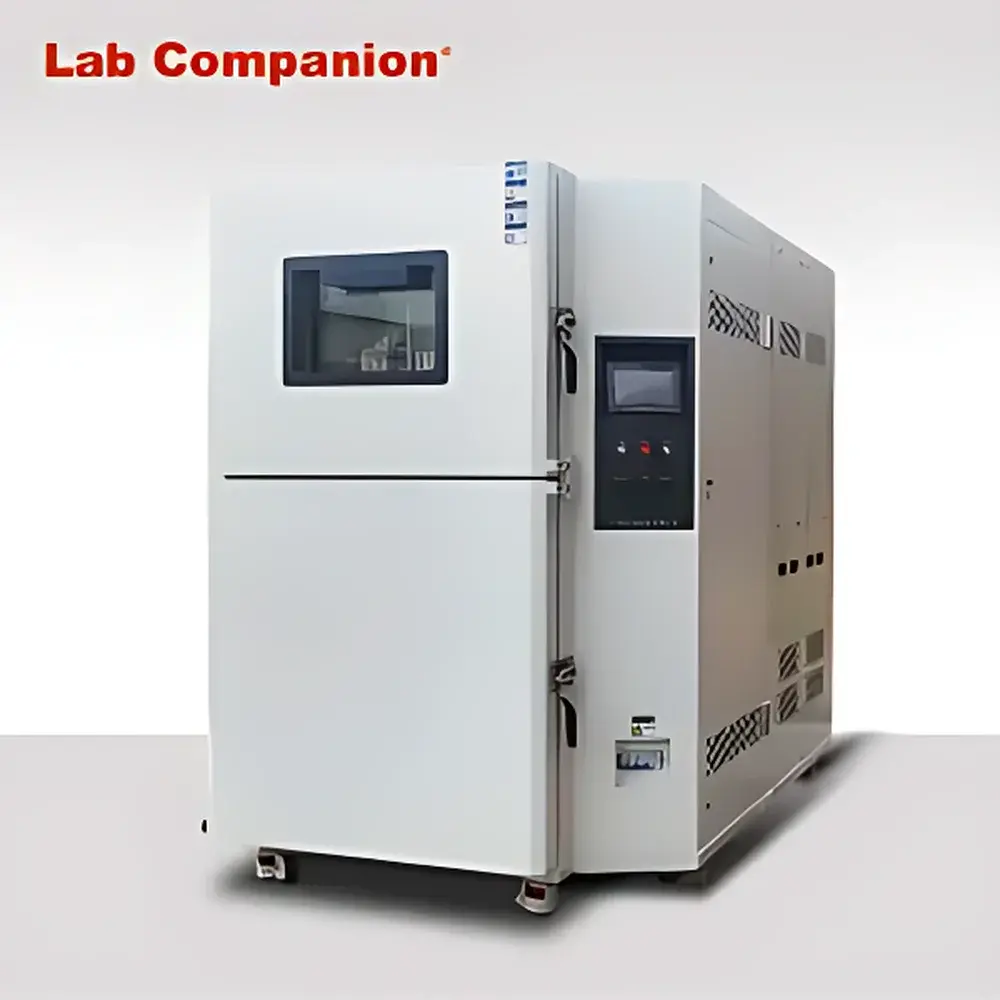
LabCompanion TSL Series Basket-Transfer Thermal Shock Test Chamber
| Brand | LabCompanion |
|---|---|
| Origin | Guangdong, China |
| Manufacturer Type | Direct Manufacturer |
| Product Origin | Domestic (China) |
| Model | TSL |
| Temperature Range | -65 °C to +150 °C |
| Heating Rate | +60 °C to +200 °C ≤ 20 min |
| Cooling Rate | +20 °C to -75 °C ≤ 60 min |
Overview
The LabCompanion TSL Series Basket-Transfer Thermal Shock Test Chamber is an engineered environmental stress screening system designed for rapid, repeatable thermal cycling between extreme temperature extremes. Utilizing a three-chamber architecture—comprising independent high-temperature, low-temperature, and test chambers—the system employs a vertically actuated basket mechanism to physically transfer test specimens between thermal zones. This mechanical transfer method eliminates convective cross-contamination and ensures precise, step-change thermal exposure without residual ambient influence. The chamber conforms to the fundamental operational principle defined in IEC 60068-2-14 (Test N: Change of temperature) and supports standardized thermal shock profiles per MIL-STD-810H Method 503.5, JESD22-A104E, and GB/T 2423.22. It is intended for qualification testing of electronic assemblies, automotive components, aerospace hardware, and polymer-based enclosures where material integrity under abrupt thermal transients must be rigorously evaluated.
Key Features
- Three-zone segregated chamber design with independent refrigeration and heating systems for simultaneous maintenance of extreme thermal setpoints
- Motor-driven stainless-steel transfer basket with programmable dwell time control (0–999 min per zone) and position-synchronized door interlocks
- High-efficiency cascade refrigeration system using environmentally compliant R404A/R23 mixed refrigerant, enabling stable operation at -65 °C
- Electrically heated ceramic resistance elements with PID-controlled power modulation, achieving uniform +150 °C distribution across the hot zone
- Double-wall vacuum-insulated construction with polyurethane foam core (≥150 mm thickness) minimizing thermal leakage and energy consumption
- Integrated safety architecture including over-temperature cut-off, refrigerant pressure monitoring, door-open inhibition, and emergency stop circuitry compliant with IEC 61000-6-2/6-4 EMC standards
Sample Compatibility & Compliance
The TSL chamber accommodates standard test loads up to 20 kg (aluminum equivalent mass), with configurable basket dimensions supporting IPC-9701-compliant board-level assemblies, surface-mount packages (QFN, BGA), and molded plastic housings. Internal chamber volume (standard configuration) allows placement of multiple DUTs under identical thermal history conditions. All thermal profiles are traceable to NIST-traceable RTD sensors (Class A, ±0.15 °C accuracy) mounted at geometric center and corners. The system supports audit-ready documentation per ISO/IEC 17025 requirements and integrates with GLP/GMP workflows via optional calibration certificate packages (including as-found/as-left data). Compliance includes adherence to ASTM D5279 (plastics—thermal shock resistance), USP (thermally induced degradation assessment), and JEDEC J-STD-020 (moisture/reflow sensitivity classification).
Software & Data Management
Control and data acquisition are managed through LabCompanion’s proprietary WinTSC v4.2 software suite, running on an embedded industrial PC with Windows IoT Enterprise OS. The interface provides real-time multi-channel temperature plotting (up to 12 channels), profile sequencing with conditional branching (e.g., “if chamber deviation > ±2 °C, pause and alert”), and automatic generation of PDF test reports compliant with FDA 21 CFR Part 11 requirements—including electronic signatures, audit trails, and immutable data archiving. Export formats include CSV, XML, and encrypted SQLite databases. Remote monitoring is supported via HTTPS-enabled web server (TLS 1.2+) with role-based access control (RBAC) and session timeout enforcement.
Applications
- Qualification of solder joint reliability in PCBAs subjected to repeated thermal expansion mismatch
- Evaluation of coating adhesion and delamination thresholds in automotive lighting modules
- Stress screening of MEMS sensors prior to burn-in and final acceptance testing
- Validation of seal integrity in hermetically packaged medical devices under accelerated aging protocols
- Material phase transition analysis in thermoplastic elastomers and shape-memory alloys
- Failure mode identification in power semiconductor modules exposed to junction temperature cycling
FAQ
What is the minimum dwell time achievable between temperature zones?
The basket transfer mechanism enables a mechanical switch time of ≤ 5 seconds; however, minimum dwell is user-defined and typically set ≥ 10 minutes to ensure thermal equilibrium per IEC 60068-2-14 Clause 6.2.
Can the system operate under vacuum or inert gas purge?
Standard configuration operates at ambient atmospheric pressure; optional nitrogen purge ports and O-ring sealed viewports are available for controlled-atmosphere variants (model suffix “-N2”).
Is third-party calibration support available?
Yes—LabCompanion provides ISO/IEC 17025-accredited calibration services with certified uncertainty budgets, including sensor mapping, thermal uniformity verification, and rate-of-change validation.
How is temperature uniformity verified across the test chamber?
Uniformity is validated per IEC 60068-3-5 using 9-point sensor mapping (center + 8 corners) at three representative setpoints (-55 °C, 25 °C, +125 °C); typical performance is ±1.5 °C at steady state.
Does the system meet CE or UKCA marking requirements?
Yes—the TSL series carries full CE marking under the EU Machinery Directive 2006/42/EC and Electromagnetic Compatibility Directive 2014/30/EU; UKCA documentation is provided upon request.



