
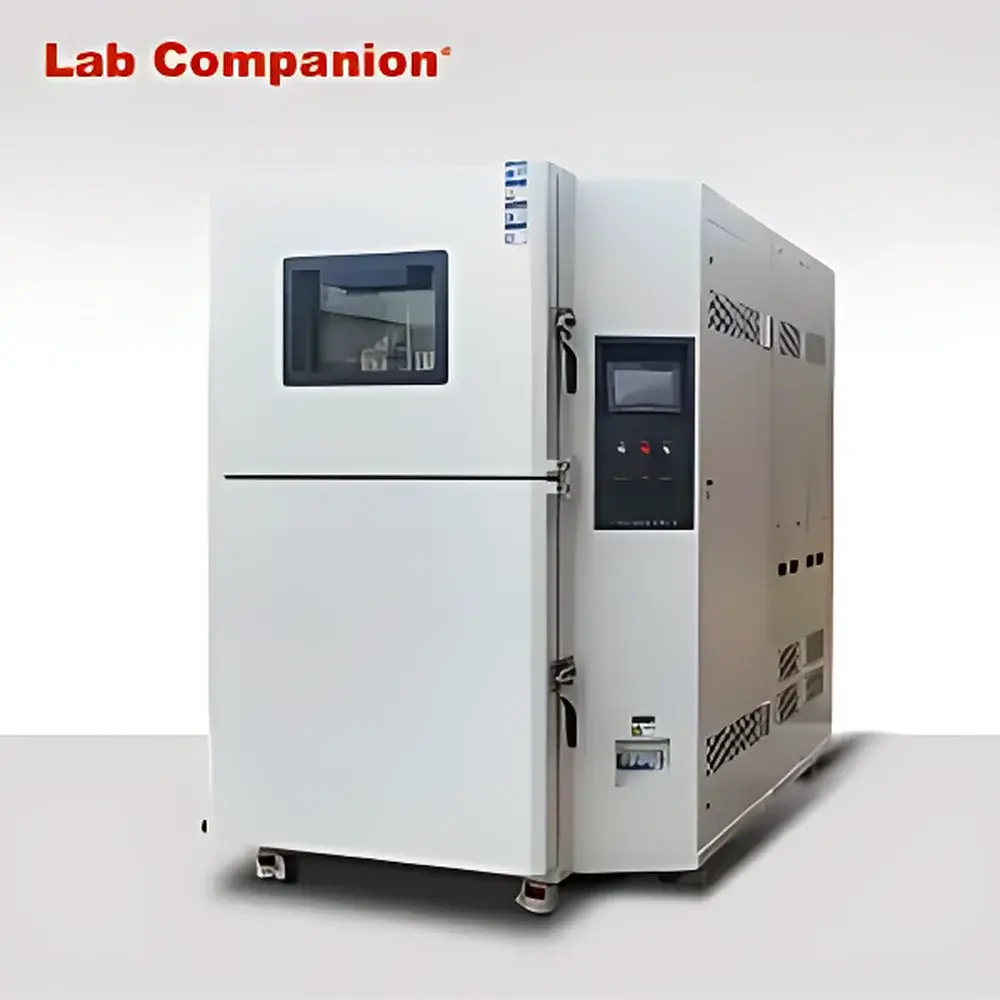
LabCompanion TS2-225 Basket-Type Thermal Shock Test Chamber
| Brand | LabCompanion |
|---|---|
| Model | TS2-225 |
| Origin | Guangdong, China |
| Manufacturer Type | Direct Manufacturer |
| High-Temperature Range | +150 °C |
| Low-Temperature Range | −65 °C |
| Thermal Shock Range | −65 °C to +150 °C |
| Heating Rate | ≤50 °C/min (from RT 10–30 °C to +200 °C) |
| Cooling Rate | ≤40 °C/min (from RT 10–30 °C to −70 °C) |
Overview
The LabCompanion TS2-225 Basket-Type Thermal Shock Test Chamber is an engineered solution for accelerated reliability assessment of electronic components, automotive modules, aerospace assemblies, and advanced packaging materials under rapid, repetitive thermal transitions. Based on the basket-transfer principle—where a horizontally moving specimen carrier shuttles between independently controlled high-temperature and low-temperature chambers—the system enables precise, high-reproducibility thermal shock cycling without subjecting samples to convective air turbulence or thermal lag associated with single-chamber ramping methods. This architecture conforms to core test methodologies defined in MIL-STD-883 Method 1010.8, JESD22-A104 (Temperature Cycling), and IEC 60068-2-14 (Change of Temperature), supporting qualification-level stress screening in R&D labs and production QA environments.
Key Features
- Basket-driven dual-chamber design with pneumatic door actuation ensures sub-5-minute temperature recovery time between extremes (−65 °C ↔ +150 °C), minimizing dwell-time variability and enhancing cycle fidelity.
- Independent high-temperature chamber (operable up to +200 °C) and low-temperature chamber (down to −75 °C) with PID-controlled forced-air circulation and multi-stage refrigeration (cascade system with R404A/R23 refrigerants).
- Stainless-steel internal chamber (750 × 500 × 600 mm W×H×D) with non-reflective finish, corrosion-resistant insulation, and integrated over-temperature/over-pressure safety interlocks compliant with IEC 61000-6-2 EMC requirements.
- Programmable controller with 100-segment profile storage, real-time data logging (±0.5 °C accuracy), and RS485/Ethernet interface supporting Modbus TCP for integration into centralized MES or SCADA systems.
- Load capacity: 30 kg maximum on specimen basket; designed for standard JEDEC trays, PCB panels (up to 400 × 300 mm), and encapsulated IC packages per IPC-J-STD-020 moisture sensitivity level (MSL) protocols.
Sample Compatibility & Compliance
The TS2-225 accommodates a broad range of physically stable specimens—including bare die, molded plastic ICs, soldered PCBAs, MEMS sensors, and polymer-coated optical housings—without requiring custom fixtures. Its thermal uniformity (±2 °C across working volume per IEC 60068-3-5) and rapid transition capability make it suitable for evaluating interfacial delamination, solder joint fatigue, coefficient-of-thermal-expansion (CTE) mismatch failure, and glass transition-related embrittlement. The chamber meets structural and operational prerequisites for ISO/IEC 17025-accredited laboratories and supports audit-ready documentation for GLP, GMP, and AEC-Q200-compliant automotive validation workflows.
Software & Data Management
Equipped with LabCompanion’s TC-Manager v3.2 software suite, the TS2-225 provides full-cycle traceability: user-defined test profiles (including dwell time, transfer speed, and soak duration), automated pass/fail flagging against user-set deviation thresholds, and timestamped CSV/PDF report generation. All calibration events, operator logins, parameter changes, and alarm histories are recorded with tamper-proof digital signatures—ensuring compliance with FDA 21 CFR Part 11 requirements for electronic records and signatures. Optional cloud synchronization enables remote monitoring and cross-site comparative analysis across global engineering centers.
Applications
- Qualification testing of lead-free solder joints per IPC-9701 and IPC-A-610 standards.
- Preconditioning of humidity-sensitive devices prior to reflow soldering (MSL Level 3–6).
- Failure mode identification in power modules subjected to transient thermal loads in EV inverters.
- Material compatibility verification for conformal coatings, underfill epoxies, and wafer-level packaging adhesives.
- Accelerated life testing of LED packages, battery management systems (BMS), and ADAS radar housings under cyclic thermal stress.
FAQ
What is the difference between basket-type and single-chamber thermal shock testers?
Basket-type systems physically move samples between isolated hot/cold zones, achieving faster transition rates and tighter temperature stability than air-shock or liquid-immersion alternatives—critical for detecting latent defects in microelectronics.
Can the TS2-225 perform tests per MIL-STD-202G Method 107?
Yes—the chamber’s programmable dwell times, ±0.5 °C control precision, and documented thermal uniformity meet the environmental conditioning requirements specified in Test Method 107H (Thermal Shock).
Is external water cooling required for continuous operation?
For sustained operation above 85% duty cycle at extreme setpoints (e.g., −65 °C / +150 °C), chilled water supply (10–15 °C inlet, 3 bar pressure) is recommended to maintain compressor efficiency and thermal stability.
How is calibration traceability maintained?
Each unit ships with NIST-traceable calibration certificates for chamber sensors (Pt100 Class A), validated annually using accredited third-party providers per ISO/IEC 17025 Clause 6.5.
Does the system support automated test sequencing with external handlers?
Yes—via discrete I/O signals and Modbus TCP commands, the TS2-225 integrates with robotic loading arms and AOI stations for unattended, high-throughput reliability screening lines.



