
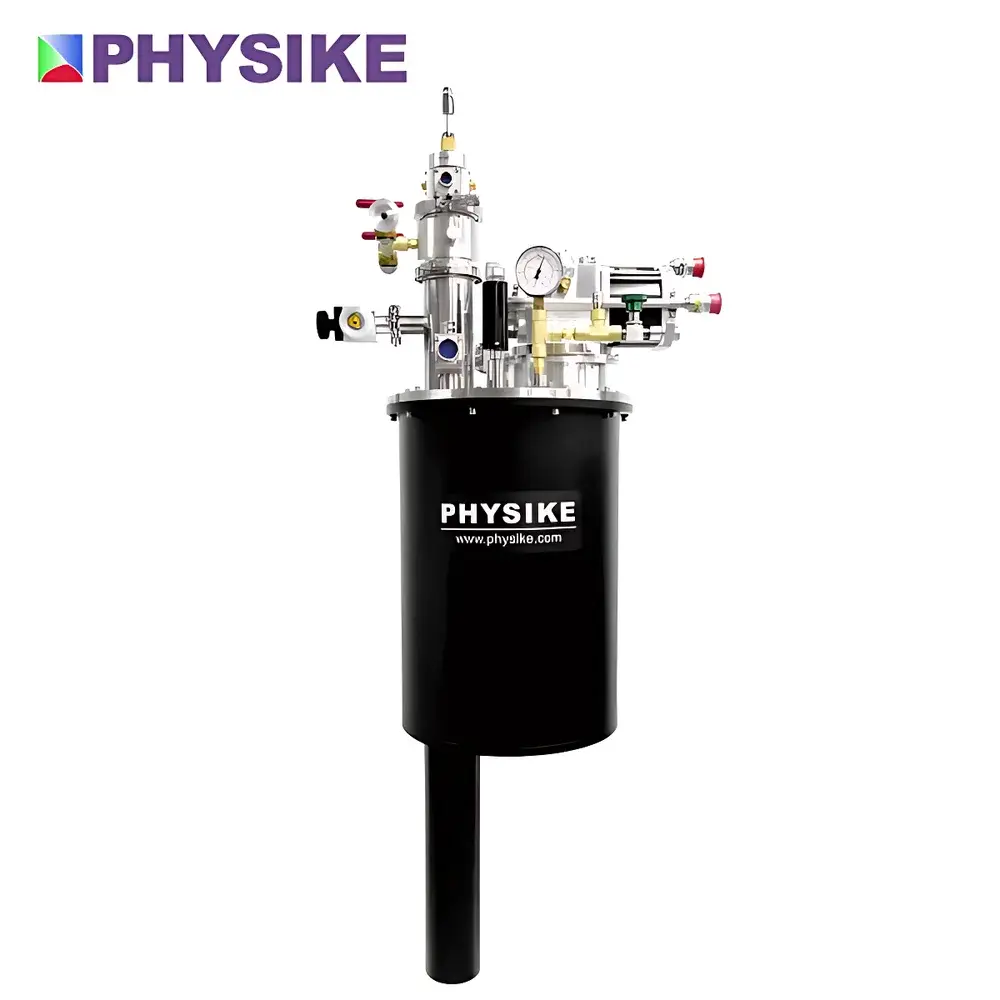
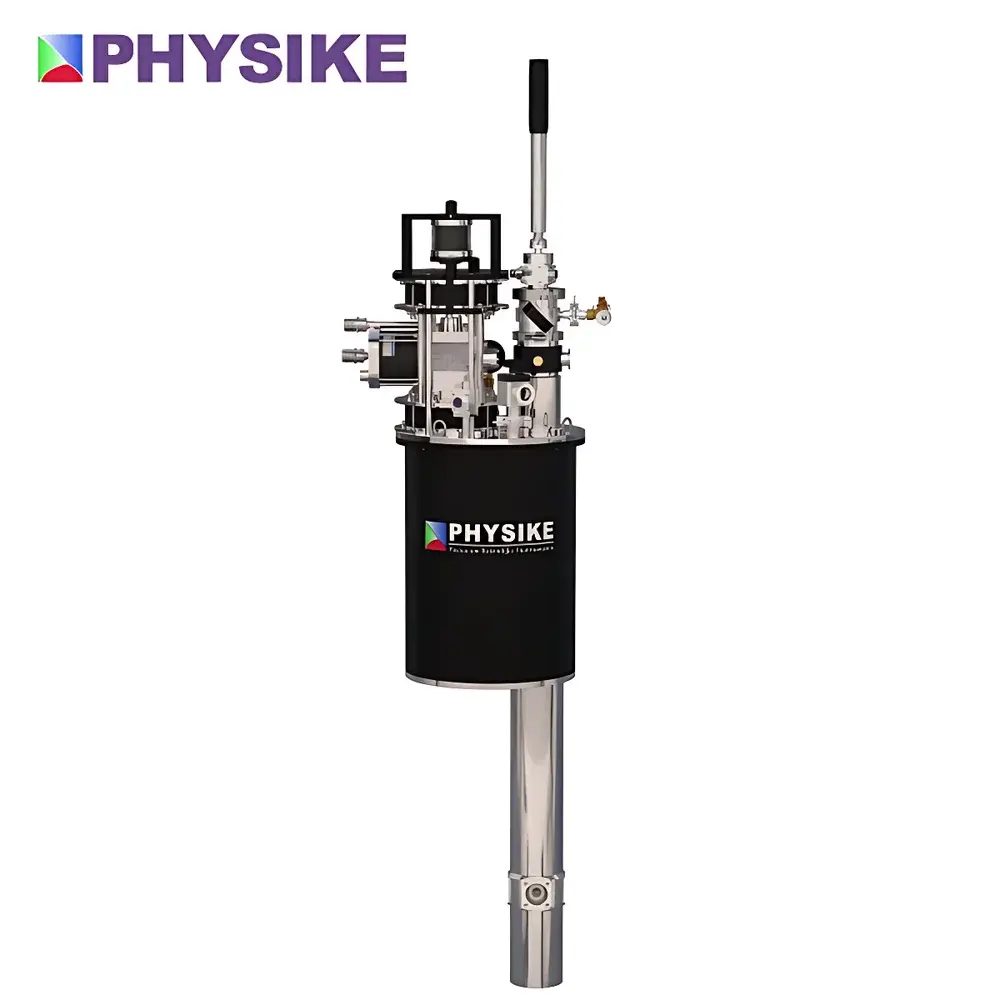
Physiké Acryo-TL-4K Top-Loading Cryocooler
| Brand | Physiké |
|---|---|
| Origin | Beijing, China |
| Manufacturer Type | Direct Manufacturer |
| Model | Acryo-TL-4K |
| Cooling Method | Gifford-McMahon or Pulse Tube Refrigeration |
| Base Temperature | ≤4.2 K (standard), optional 1.5 K single-shot mode |
| Sample Loading | Top-loading via removable sample probe |
| Sample Tube ID | Standard 55 mm (customizable) |
| Vibration Mitigation | Cryocooler head suspension + sand-damped base |
| Optical Access | Optional visible/IR/THz/X-ray/neutron windows |
| Magnetic Compatibility | Compact tail configuration for superconducting/electromagnets |
| Software Interface | RS-232/RS-485/Ethernet for remote control and logging |
| Compliance | Designed to meet GLP/GMP-relevant operational traceability requirements |
Overview
The Physiké Acryo-TL-4K is a top-loading, closed-cycle cryogenic refrigeration system engineered for high-reproducibility low-temperature experimentation at base temperatures down to 4.2 K (with optional 1.5 K single-shot capability). Unlike conventional insert-style cryostats, its top-loading architecture enables rapid, in-situ sample exchange without interrupting compressor operation—critical for high-throughput characterization of thermally sensitive or geometrically complex specimens. The system operates on either Gifford-McMahon (GM) or pulse tube (PT) cryocooler technology, both integrated with active vibration isolation via suspended cold-head mounting and a dedicated sand-damped mechanical base. Its thermal design prioritizes uniform cooling across low-thermal-conductivity materials—including powders, liquid samples, diamond anvil cells (DACs), and encapsulated high-pressure packages—by optimizing helium exchange gas flow dynamics within the sample tube and minimizing conductive heat leaks through optimized thermal anchoring.
Key Features
- Top-loading sample access with quick-disconnect probe interface—enables full sample replacement in under 90 seconds while maintaining base temperature stability
- Modular cold stage architecture supporting interchangeable inserts: standard 55 mm ID sample tube (expandable to 80 mm), vacuum-compatible probe variants, and high-temperature options up to 800 K
- Dual-stage vibration suppression: passive isolation via suspended cold head + secondary damping using calibrated sand-filled enclosure base
- Optical and neutron access ports: factory-integrated sapphire, CaF₂, or polyethylene windows for visible, IR, THz, X-ray, and cold neutron transmission
- Magnet-compatible tail geometry: low-profile rear section designed for seamless integration with superconducting magnets (up to 16 T) and split-pair electromagnets
- AC susceptibility measurement readiness: pre-wired probe option with integrated pick-up coils and low-noise twisted-pair leads
- Rotatable sample stage: motorized 360° rotation with encoder feedback for angular-dependent transport, magnetotransport, and optical alignment studies
Sample Compatibility & Compliance
The Acryo-TL-4K accommodates heterogeneous sample geometries—including irregular solids, slurry suspensions, DAC assemblies, fiber-optic-coupled devices, and microfabricated quantum circuits—without requiring cryogenic glue or thermal interface compounds. Its static helium exchange gas environment ensures minimal convective disturbance during measurements. All electrical feedthroughs comply with IEC 61000-4 electromagnetic immunity standards, and vacuum integrity meets ISO 2861 Class 5 specifications (≤1×10⁻⁷ mbar after bake-out). The system supports ASTM D5276-compliant thermal cycling protocols and is routinely deployed in ISO/IEC 17025-accredited laboratories conducting low-temperature electrical transport (IEEE Std 116), magnetic susceptibility (ASTM A977), and microwave surface impedance (IEC 60404-10) testing.
Software & Data Management
Physiké provides open-architecture LabVIEW-based control software with TCP/IP and Modbus RTU support, enabling integration into existing data acquisition ecosystems (Keysight, Lake Shore, Quantum Design platforms). Full audit trail logging—including setpoint history, compressor status, cold-head temperature gradients, and valve actuation timestamps—is stored in CSV/SQLite format with configurable retention policies. Optional FDA 21 CFR Part 11-compliant user authentication and electronic signature modules are available for regulated environments requiring GLP/GMP traceability.
Applications
The Acryo-TL-4K serves as a foundational platform for advanced condensed matter research and industrial R&D. It is routinely employed in quantum device characterization (transmon qubit coherence mapping, Josephson junction IV curves), high-pressure resistivity studies in diamond anvil cells (up to 100 GPa), low-temperature magnetometry (SQUID and AC susceptibility), terahertz time-domain spectroscopy (THz-TDS), neutron scattering sample environments, and ultra-low-noise microwave reflectometry of 2D electron gases. Its compatibility with in-situ pressure tuning, rotational degrees of freedom, and multi-probe DC/RF wiring makes it particularly suited for correlated electron systems, topological insulators, and spintronic heterostructures.
FAQ
Can the Acryo-TL-4K operate continuously at 1.5 K?
No—the 1.5 K capability is provided via a single-shot helium-3 sorption stage that requires periodic recondensation; continuous operation below 2.8 K requires integration with a dilution refrigerator.
Is the system compatible with existing superconducting magnet bore sizes?
Yes—compact tail configurations are available for 50 mm, 70 mm, and 100 mm warm bore diameters, with magnetic field homogeneity preserved up to ±0.05% over 10 mm DSV.
What vacuum level is maintained during operation?
The system achieves and sustains ≤2×10⁻⁷ mbar in the sample space after standard 12-hour bake-out at 120 °C, verified per ISO 2861 Annex B procedures.
Are custom electrical feedthroughs supported?
Yes—feedthrough options include 48-channel low-noise coaxial (SMA), superconducting NbTi twisted pairs, and hermetic ceramic-cored multiconductor bundles rated to 100 VDC and 1 MHz bandwidth.
Does Physiké provide application-specific validation reports?
Yes—upon request, factory-verified performance documentation includes thermal gradient maps, vibration spectral density plots (1–1000 Hz), and helium exchange gas flow calibration certificates traceable to NIST standards.



