
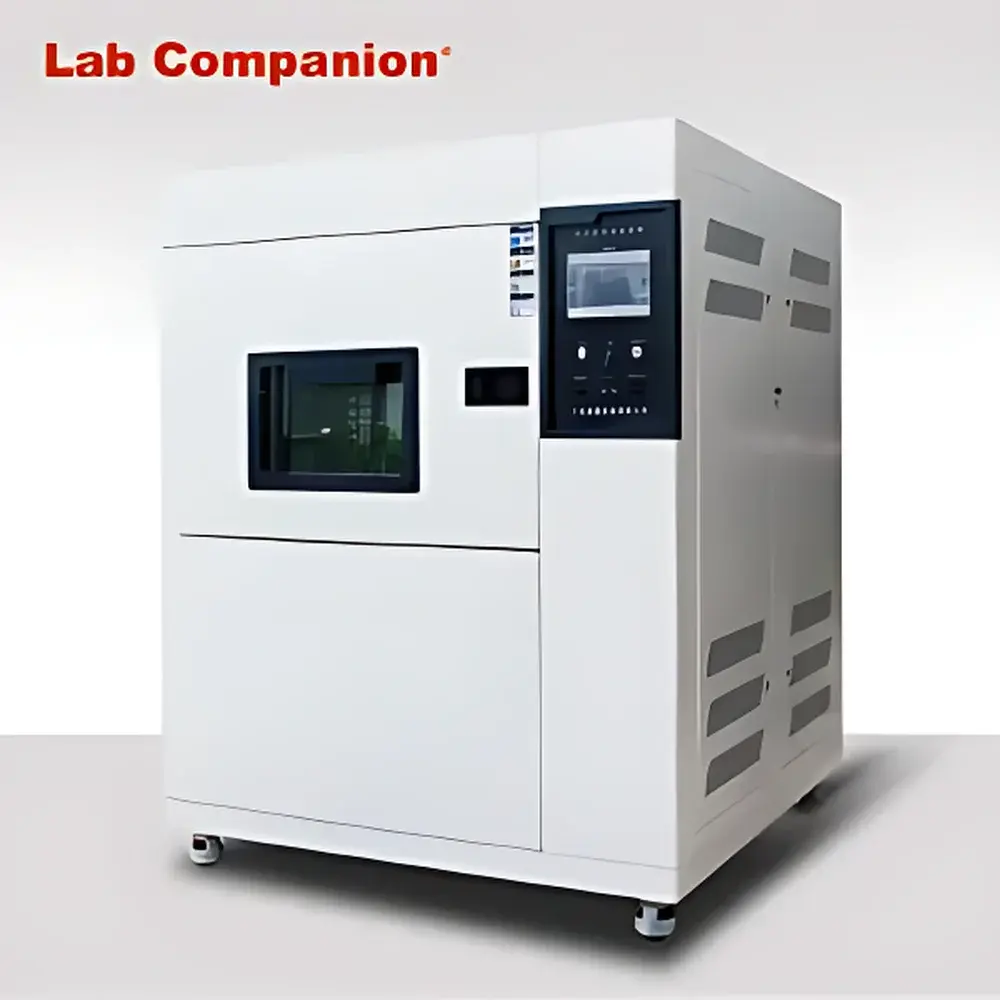
LabCompanion TS3 Three-Zone Thermal Shock Test Chamber
| Brand | LabCompanion |
|---|---|
| Origin | Guangdong, China |
| Manufacturer Type | Direct Manufacturer |
| Product Origin | Domestic (China) |
| Model | TS3 |
| Price Range | USD 7,000 – 14,000 |
| High-Temperature Range | +150 °C |
| Low-Temperature Range | −65 °C |
| Thermal Shock Range | −65 °C to +150 °C |
| Heating Rate | +60 °C → +200 °C ≤ 20 min |
| Cooling Rate | +20 °C → −75 °C ≤ 80 min |
Overview
The LabCompanion TS3 Three-Zone Thermal Shock Test Chamber is an engineered environmental stress screening (ESS) system designed for rapid, repeatable, and highly controlled thermal cycling between extreme temperature extremes. Unlike single- or dual-chamber designs, the TS3 employs a true three-zone architecture—comprising separate high-temperature, low-temperature, and test chamber zones—enabling near-instantaneous thermal transitions via mechanical transfer of test specimens. This configuration eliminates thermal mass interference and ensures minimal dwell time variability, critical for evaluating solder joint integrity, polymer dimensional stability, coating adhesion, and electronic component reliability under accelerated life testing protocols per MIL-STD-810H Method 503.5, IEC 60068-2-14, and JESD22-A104.
Key Features
- Three-zone independent thermal control architecture with dedicated heating and refrigeration circuits for each zone, enabling precise, decoupled temperature setpoint management
- Programmable thermal shock profiles supporting both fixed-temperature and multi-step ramp/soak sequences, compliant with ASTM E1545 and ISO 16750-4 test requirements
- Test chamber constructed from mirror-finished SUS304 stainless steel with optimized weld geometry to resist thermal fatigue and corrosion under repeated condensation/frost cycles
- High-density polyurethane foam insulation (≥150 mm thickness, closed-cell structure) minimizing heat leakage and ensuring thermal gradient stability across operational ranges
- Electro-mechanically actuated specimen transfer basket with servo-controlled positioning and position feedback verification for repeatable dwell timing accuracy ±0.5 s
- Energy-efficient refrigeration system utilizing variable-speed scroll compressors and proportional expansion valves, delivering 30% lower power consumption versus conventional heater-balanced control schemes
- Dual-stage cascade refrigeration circuit with R-507A (ozone-friendly, zero-ODP) refrigerant, certified to EN 378-1 and ASHRAE Standard 34 safety classifications
- Integrated overcurrent, overtemperature, and short-circuit protection for all motor drives, heaters, and compressor circuits—fully documented in the electrical safety compliance report
Sample Compatibility & Compliance
The TS3 accommodates standard test specimens up to 500 mm × 500 mm × 500 mm (W×D×H) with optional custom chamber dimensions available upon engineering review. Its sealed, gasketed access door utilizes high-temperature silicone rubber (rated to +250 °C / −70 °C), maintaining leak rates <1.0 × 10⁻⁵ mbar·L/s per ISO 10964. Optional feedthrough ports (Φ20–Φ50 mm, NPT or ISO-KF flanged), embedded PT100 sensor arrays, and calibrated internal reference thermocouples (Class A, DIN EN 60584-2) support in-situ monitoring per IEC 60746-3. The system meets electromagnetic compatibility requirements per CISPR 11 Group 2 Class B and is CE-marked for use within EU harmonized standards.
Software & Data Management
Equipped with LabCompanion’s TC-OS v4.2 embedded controller, the TS3 supports real-time PID parameter tuning, alarm event logging with timestamped cause codes, and audit-trail-enabled user access control (up to 16 role-based accounts). Data export options include CSV via USB 2.0 host port, Ethernet TCP/IP (Modbus TCP and native LabCompanion protocol), and optional 16-channel external data logger integration. All recorded thermal profiles—including chamber air temperature, specimen surface temperature (via optional IR sensor interface), and actuator status—are stored with SHA-256 checksum validation. The system complies with FDA 21 CFR Part 11 requirements when configured with digital signature authentication and electronic record retention policies.
Applications
- Qualification testing of aerospace avionics modules per DO-160G Section 4.5 (Temperature Shock)
- Failure mode analysis of automotive ECUs under transient thermal loading (SAE J2223, ISO 16750-4)
- Reliability assessment of lead-free PCB assemblies following JEDEC J-STD-020D moisture sensitivity level (MSL) preconditioning
- Material characterization of composite laminates, elastomers, and thermal interface materials (TIMs) under cyclic thermal strain
- Validation of hermetic seal integrity in MEMS packaging and medical device enclosures
- Accelerated aging studies for battery cell modules operating in hybrid vehicle thermal management systems
FAQ
What is the difference between two-zone and three-zone thermal shock testing?
A three-zone system isolates high-temperature, low-temperature, and test chambers physically and thermally, eliminating cross-contamination and enabling faster transition times with superior repeatability. Two-zone systems rely on airflow reversal and suffer from residual thermal inertia.
Can the TS3 perform standard temperature cycling or steady-state environmental tests?
Yes—the TS3 includes integrated high- and low-temperature chamber modes that operate independently as conventional thermal chambers, supporting IEC 60068-2-2 (heat) and IEC 60068-2-1 (cold) test execution without shock functionality.
Is remote monitoring and control supported?
Standard Ethernet connectivity enables web-based supervision via HTTPS-secured interface, including live trend graphs, alarm push notifications, and firmware update capability through authenticated admin access.
What calibration and traceability documentation is provided?
Each unit ships with a factory calibration certificate traceable to NIM (National Institute of Metrology, China) for all primary temperature sensors, verified at three points per zone (−65 °C, 25 °C, +150 °C) using Fluke 1524 reference thermometers.
Are custom test chamber dimensions or extended temperature ranges available?
Yes—engineering consultation is required for non-standard configurations; extended low-temperature options down to −80 °C and high-temperature variants up to +200 °C are available under TS3-X series derivatives.



