
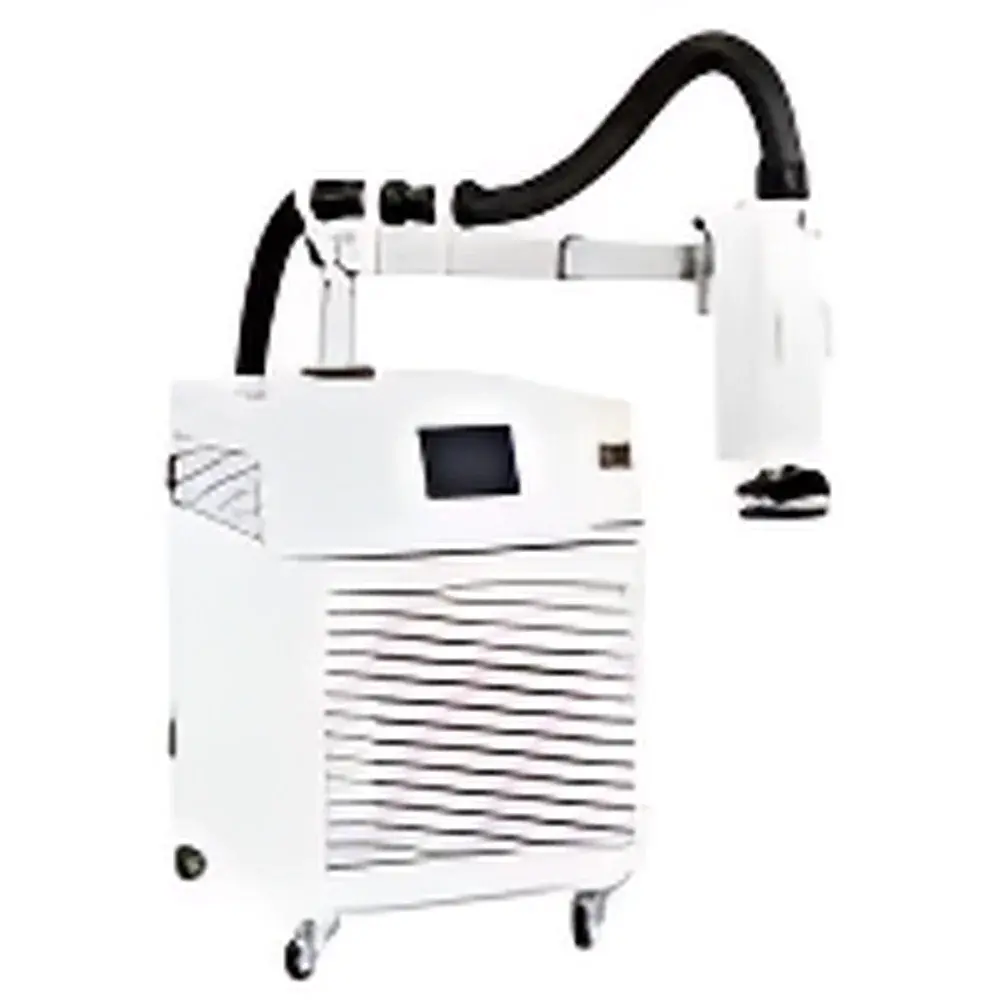
Froilabo Dragon Rapid Thermal Shock System
| Brand | Froilabo |
|---|---|
| Model | Dragon |
| Origin | Guangdong, China (Distributed by Hongzhan Technology Co., Ltd.) |
| Temperature Range | −80 °C to +250 °C |
| Ramp Rates | −55 °C ↔ +125 °C in 7 s / 14 s |
| Airflow | 2.2–8.4 L/s |
| Temperature Stability | ±0.1 °C |
| Control Interface | Touchscreen HMI |
| Program Storage | 45 profiles × 20 steps each |
| Compliance | JEDEC JESD22-A104, MIL-STD-883 Method 1010, MIL-STD-750 Method 1037 |
| Operating Modes | Manual, Auto, Editable Sequence Mode |
Overview
The Froilabo Dragon Rapid Thermal Shock System is an engineered thermal cycling platform designed for accelerated reliability assessment of electronic components, materials, and assemblies under extreme and rapidly alternating temperature conditions. Based on forced-convection air heating and cryogenic cooling principles, the system delivers precise, repeatable thermal transitions without direct contact—ensuring non-invasive, uniform exposure across test specimens. With over a century of heritage in precision temperature control since its founding in Lyon, France (1918), Froilabo applies rigorous thermodynamic design principles to achieve high-fidelity thermal transients. The Dragon system operates across a wide ambient-compensated range of −80 °C to +250 °C, supporting both low-temperature shock (e.g., cryogenic soak) and high-temperature dwell (e.g., solder reflow simulation), making it suitable for qualification testing in mission-critical environments including aerospace, defense, and automotive electronics.
Key Features
- High-speed thermal transition capability: achieves −55 °C ↔ +125 °C switching in ≤7 seconds (heating) and ≤14 seconds (cooling), meeting stringent cycle-time requirements of modern qualification standards.
- Stable, high-resolution temperature regulation with ±0.1 °C setpoint accuracy and <±0.3 °C uniformity across the test chamber volume.
- Adjustable airflow delivery (2.2–8.4 L/s) ensures consistent convective heat transfer coefficients—critical for reproducible thermal loading on heterogeneous samples such as BGA packages or multi-layer PCBs.
- Three operational modes: Manual mode for real-time parameter override; Auto mode for preloaded standardized sequences; Editable mode for custom multi-step thermal profiles with independent dwell time, ramp rate, and endpoint logic per step.
- Intuitive 7-inch capacitive touchscreen HMI with multilingual UI support (English, Chinese, French), password-protected user levels, and embedded event logging.
- Onboard memory stores up to 45 distinct thermal programs, each configurable with up to 20 discrete steps—including soak, ramp, hold, and conditional branching based on elapsed time or external trigger signals.
Sample Compatibility & Compliance
The Dragon system accommodates a broad class of test objects—from bare die and wafer-level devices to fully assembled modules, connectors, sensors, and small mechanical subassemblies (max. footprint: 300 × 300 mm; max. height: 150 mm). Its open-chamber architecture allows integration with external instrumentation (e.g., parametric analyzers, impedance analyzers, or optical inspection tools) via I/O ports and TTL/RS-485 interfaces. The system is validated for compliance with industry-standard thermal shock protocols including JEDEC JESD22-A104 (Temperature Cycling), MIL-STD-883 Method 1010.12 (Thermal Shock), and MIL-STD-750 Method 1037 (Temperature Cycling for Discrete Semiconductors). All calibration records, firmware revision logs, and operational audit trails are retained internally and exportable in CSV format—supporting GLP/GMP-aligned documentation workflows and FDA 21 CFR Part 11 readiness when paired with optional electronic signature modules.
Software & Data Management
The Dragon system includes Froilabo’s proprietary ThermalSync™ control software, compatible with Windows 10/11 and accessible via Ethernet or USB-C. Software features include remote monitoring, real-time graphing of chamber temperature vs. setpoint, deviation alerts with email/SNMP notification, and automated report generation (PDF/Excel) compliant with ISO/IEC 17025 traceability requirements. Raw temperature data is timestamped at 100 ms intervals and stored with metadata (operator ID, program name, cycle count, environmental ambient log). Optional cloud synchronization enables centralized fleet management for multi-site laboratories, while local database encryption (AES-256) ensures data integrity during transfer and archival.
Applications
- Qualification testing of semiconductor packages (QFN, QFP, CSP, WLP) per JEDEC AEC-Q200 and AEC-Q100 stress requirements.
- Failure analysis root-cause investigation of intermetallic growth, solder joint fatigue, and delamination in PCBAs subjected to field-relevant thermal histories.
- Material characterization of thermal expansion mismatch (CTE) in polymer composites, adhesives, and encapsulants used in harsh-environment electronics.
- Process validation of conformal coating curing, underfill dispensing, and rework thermal profiles in contract manufacturing settings.
- Accelerated life testing of automotive ECUs, battery management systems (BMS), and ADAS sensor housings under combined thermal-mechanical stress.
FAQ
What standards does the Dragon system support for thermal shock validation?
It natively supports JEDEC JESD22-A104, MIL-STD-883 Method 1010.12, MIL-STD-750 Method 1037, and IEC 60068-2-14. Custom profiles may be configured to align with internal OEM specifications or ISO 16750-4 automotive requirements.
Can the system interface with external data acquisition hardware?
Yes—via isolated digital I/O (8 in / 8 out), RS-485 Modbus RTU, and Ethernet TCP/IP, enabling synchronized triggering with oscilloscopes, source-measure units (SMUs), or thermal imaging cameras.
Is calibration traceable to national metrology institutes?
All factory calibrations are performed using NIST-traceable reference probes (Fluke 1523/1524) and documented per ISO/IEC 17025 Annex A. Calibration certificates include uncertainty budgets and are supplied with each unit.
How is temperature uniformity verified across the test zone?
Uniformity mapping is conducted per ASTM E2203 using a 9-point thermocouple array during commissioning. Typical spatial variation remains within ±0.5 °C at steady-state conditions across the usable volume.
Does the system meet electromagnetic compatibility (EMC) requirements for laboratory use?
Yes—the Dragon complies with EN 61326-1:2013 (Class B) for EMC emissions and immunity, and has been tested for radiated/conducted susceptibility per IEC 61000-4-x series standards. CE and UKCA marking are applied.



