
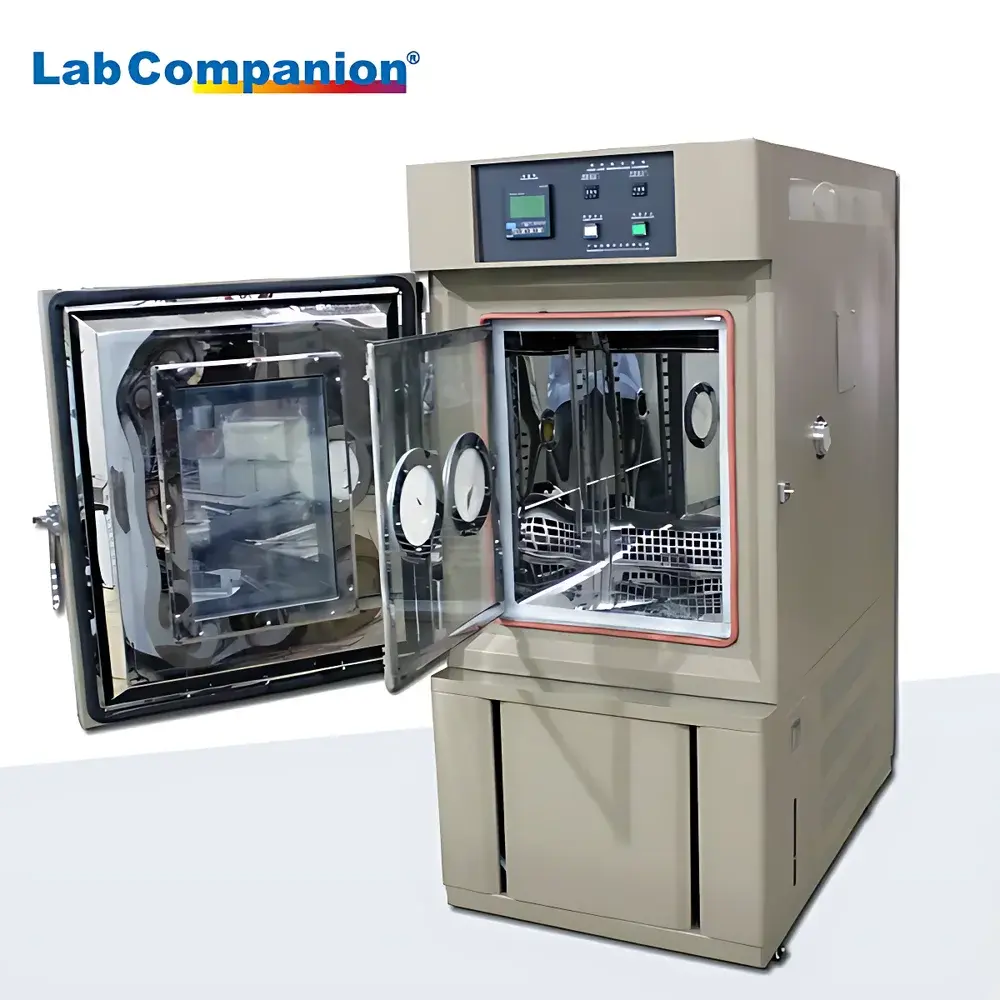
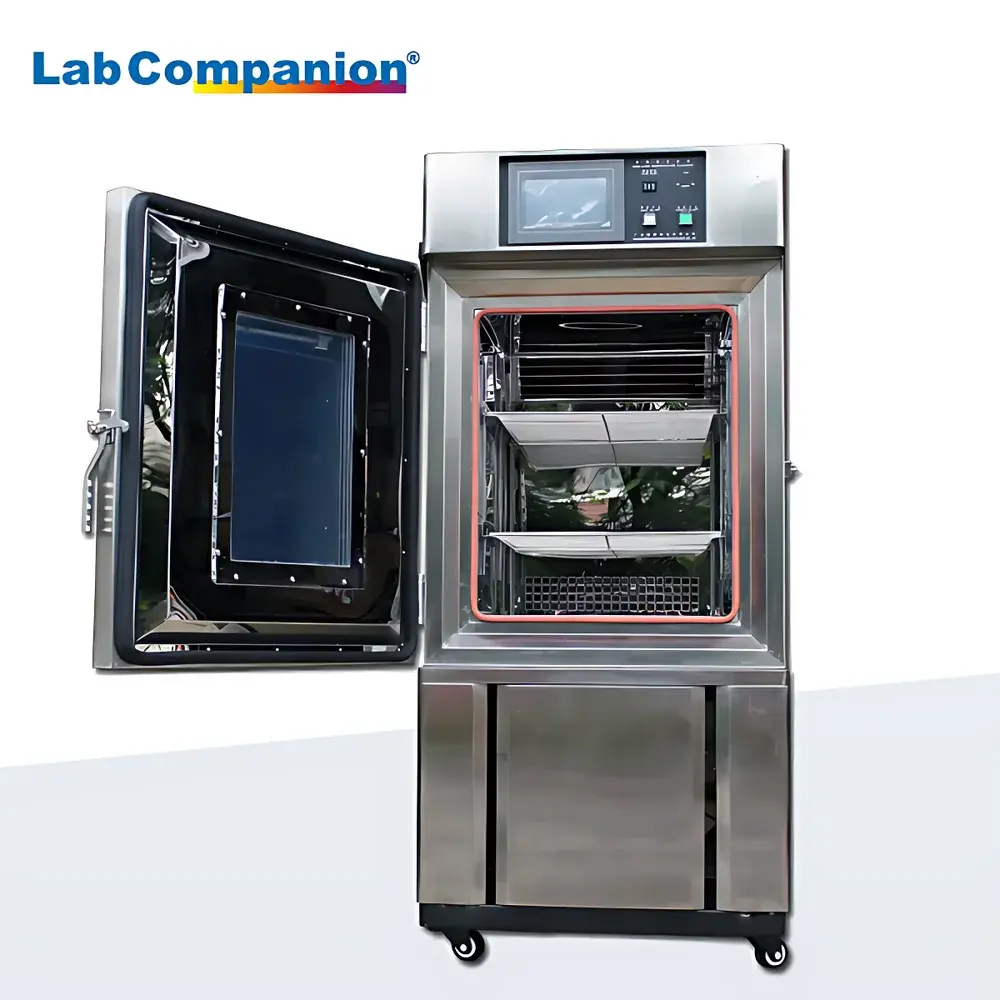
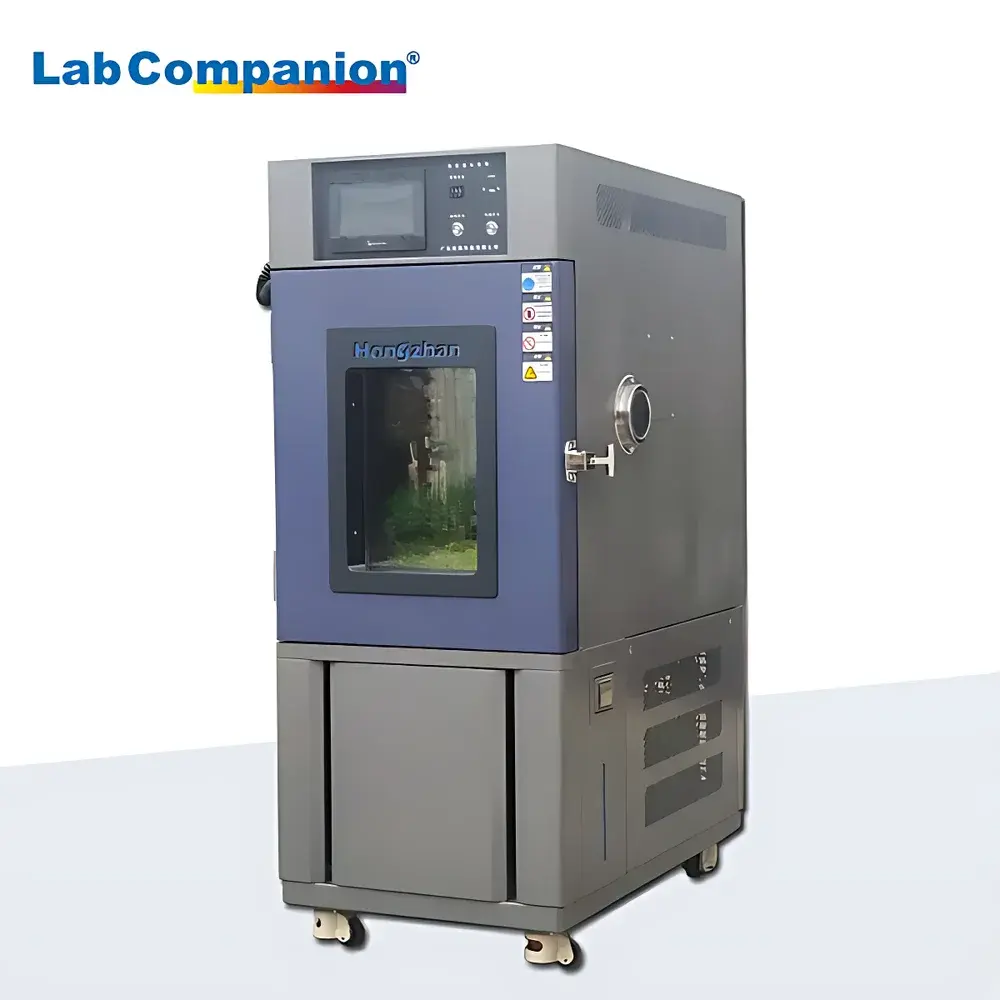
LabCompanion PR-150 Temperature and Humidity Controlled Environmental Test Chamber
| Brand | LabCompanion |
|---|---|
| Origin | Guangdong, China |
| Manufacturer Type | Direct Manufacturer |
| Country of Origin | China |
| Instrument Type | Upright Chamber |
| Temperature Range | 15–45 °C |
| Humidity Range | 20–98 % RH |
| Temperature Uniformity | ≤ ±2 °C |
| Temperature Stability | ±0.5 °C |
| Humidity Uniformity | ±2.5 % RH |
| Humidity Stability | ±3 % RH |
| Heating Rate (non-linear, no-load) | ~3.5 °C/min (20 °C to +150 °C) |
| Internal Dimensions (W×D×H) | 500×600×500 mm |
Overview
The LabCompanion PR-150 is a precision-engineered upright environmental test chamber designed for stable, reproducible control of temperature and relative humidity in laboratory and industrial quality assurance settings. It operates on the principle of forced-air convection with independent dual-loop PID regulation of refrigeration, heating, and humidification/dehumidification subsystems—enabling simultaneous, decoupled control of thermal and moisture conditions within the test volume. Unlike basic incubators or dry ovens, this chamber integrates a high-efficiency air circulation system with stainless-steel insulated walls, a corrosion-resistant stainless-steel interior, and a microprocessor-based controller capable of sustaining setpoints under dynamic load conditions. Its operational envelope—15–45 °C and 20–98 % RH—is optimized for long-term stability testing of electronic components, polymer packaging, pharmaceutical excipients, and coated substrates per IEC 60068-2, ASTM D4332, and ISO 22309 standards. The chamber does not support sub-zero operation or ultra-low humidity (<20 % RH); for those requirements, the PSL or PDL series are recommended.
Key Features
- Upright ergonomic design with front-access double-layer tempered glass door and magnetic seal for minimal thermal leakage
- Independent dual-sensor PID control architecture: separate platinum resistance thermometers (PT100) and capacitive humidity sensors ensure cross-compensated accuracy
- High-reliability refrigeration system using environmentally compliant R134a refrigerant and a hermetic scroll compressor
- Steam-type humidification module with stainless-steel water reservoir and auto-drain function; dehumidification achieved via cold-finger condensation
- Real-time monitoring of chamber internal conditions via 7-inch color TFT touchscreen interface with data logging capability (up to 10,000 records)
- Over-temperature, over-humidity, and dry-run protection circuits compliant with IEC 61000-4 EMC immunity requirements
- Standard RS485 communication port supporting Modbus RTU protocol for integration into centralized lab management systems
Sample Compatibility & Compliance
The PR-150 accommodates standard test specimens up to 500 mm (W) × 600 mm (D) × 500 mm (H), with a maximum payload of 35 kg distributed evenly across the stainless-steel perforated shelf (one included; optional shelves available). Samples must be non-volatile, non-corrosive, and free of organic solvents that could degrade internal gaskets or contaminate the humidity sensor. The chamber meets structural and safety requirements of GB/T 10586 (Chinese national standard for environmental test equipment) and conforms to electromagnetic compatibility per EN 61326-1. While not certified to UL 61010-1 or CE Machinery Directive out-of-the-box, it may be configured with third-party notified body assessment upon request. It supports GLP-compliant workflows when paired with external audit-trail-capable software (e.g., LabCompanion ChamberLink Suite).
Software & Data Management
The embedded controller stores time-stamped temperature and humidity readings at user-selectable intervals (1–600 seconds). Data export is supported via USB flash drive in CSV format. For advanced traceability, LabCompanion offers optional ChamberLink PC software (Windows 10/11), which provides real-time remote monitoring, multi-chamber synchronization, configurable alarm notifications (email/SMS via gateway), and 21 CFR Part 11–compliant electronic signatures when deployed with Windows Active Directory authentication. All logged data include metadata: operator ID, test protocol name, chamber serial number, and calibration certificate expiry date—ensuring full data integrity for ISO/IEC 17025 accredited laboratories.
Applications
- Accelerated aging studies of medical device packaging per ISO 11607-1
- Stability testing of hygroscopic active pharmaceutical ingredients (APIs) under ICH Q1A(R2) conditions
- Environmental stress screening (ESS) of printed circuit board assemblies (PCBAs) prior to burn-in
- Conditioning of composite materials (e.g., carbon fiber laminates) before tensile or flexural testing per ASTM D5229
- Calibration verification of handheld hygrometers and data loggers against NIST-traceable references
- Validation of humidity-sensitive manufacturing processes such as tablet coating or lithium battery electrode drying
FAQ
What is the minimum achievable humidity at 45 °C?
At 45 °C, the practical lower limit is approximately 25 % RH due to saturation constraints of the steam humidifier and condensation efficiency of the dehumidification system.
Can the PR-150 be used for salt spray testing?
No. This chamber lacks corrosion-resistant internal plating, mist generation hardware, and pH-controlled saline reservoirs required for ASTM B117 compliance.
Is external water supply required for continuous operation?
No—the integrated 4.5 L stainless-steel reservoir supports up to 72 hours of uninterrupted humidification at 60 % RH and 25 °C; manual refill is recommended every 48 hours during extended tests.
Does the unit include calibration documentation?
Yes—a factory-as-tested calibration report (traceable to CNAS-accredited labs) is supplied with each shipment, covering temperature uniformity, humidity accuracy, and controller response latency.
What maintenance intervals are recommended?
Humidity sensor recalibration every 12 months; refrigerant circuit leak check and filter replacement every 24 months; full preventive maintenance (including fan bearing inspection and PID tuning verification) every 36 months.



