
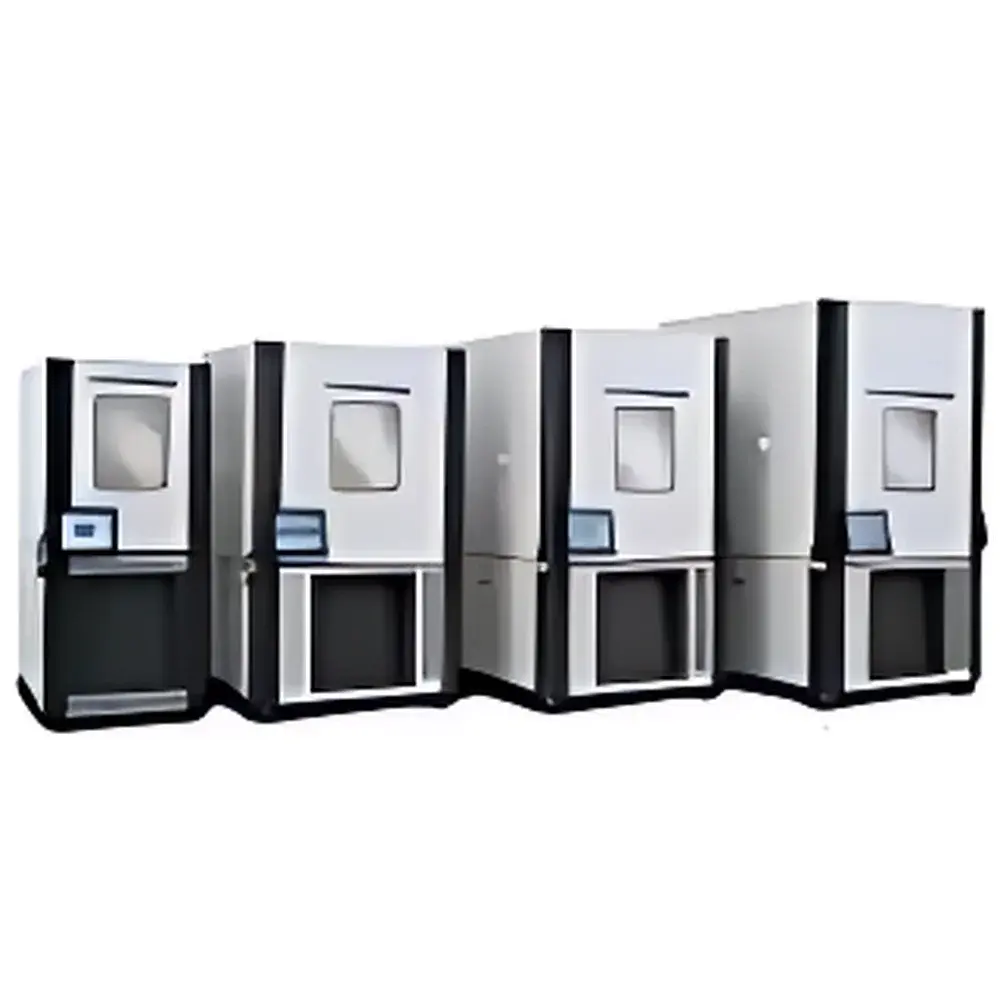
LabCompanion CS101-1EBN Forced-Convection Hot Air Oven
| Brand | LabCompanion |
|---|---|
| Origin | Guangdong, China |
| Manufacturer Type | Direct Manufacturer |
| Model | CS101-1EBN |
| Temperature Range | R.T.+10°C to 300°C |
| Temperature Uniformity | ±2.5% |
| Temperature Fluctuation | ±0.5°C |
| Heating Rate | ≤70 min (to 300°C) |
| Control System | PID with PT100 Sensor |
| Display | LED digital (set & actual temperature) |
| Timer Range | 0–999 min |
| Interior Material | SUS304 mirror-finish stainless steel |
| Exterior Material | Powder-coated cold-rolled steel |
| Insulation | Ultra-fine glass fiber |
| Viewing Window | High-temperature tempered glass |
| Door Seal | Eco-friendly silicone rubber |
| Exhaust Port | Φ45 mm (rear-mounted) |
| Heating Element | Nickel-chromium alloy wire |
| Safety Features | Independent over-temperature protection, over-current protection |
| Internal Dimensions (W×D×H) | 450×400×400 mm |
| External Dimensions (W×D×H) | 610×575×905 mm |
| Net Volume | 72 L |
| Power Supply | AC 220 V, 50 Hz |
| Rated Power | 1.5 kW |
| Compliance | JB/T 5520–1991 |
Overview
The LabCompanion CS101-1EBN is a precision-engineered forced-convection hot air oven designed for stable, repeatable thermal processing in research laboratories, quality control environments, and industrial production settings. Utilizing a robust axial fan-driven airflow system, it ensures uniform heat distribution across the entire chamber—critical for applications requiring high spatial temperature consistency and minimal thermal drift. Unlike natural convection ovens, this model maintains laminar, high-velocity air circulation that minimizes boundary-layer effects and accelerates heat transfer to samples. Its operational range spans from ambient +10°C to 300°C, supporting drying, baking, curing, sterilization (non-sterile), aging, and pre-conditioning protocols for non-flammable, non-explosive materials. The oven’s architecture adheres strictly to JB/T 5520–1991—the Chinese national standard governing performance, safety, and construction requirements for laboratory drying ovens—ensuring mechanical integrity, thermal reliability, and long-term calibration stability.
Key Features
- Forced-air circulation system with adjustable-speed axial fan for enhanced thermal homogeneity (±2.5% uniformity) and rapid thermal response
- PID-based temperature controller with dual-channel PT100 platinum resistance sensor for high-resolution feedback and ±0.5°C fluctuation control
- Dual LED display showing both setpoint and real-time chamber temperature, enabling immediate visual verification during operation
- Programmable timer (0–999 minutes) supporting unattended batch processing with automatic shutdown
- SUS304 mirror-finish stainless steel interior chamber resistant to oxidation, corrosion, and organic residue buildup
- High-efficiency insulation using ultra-fine glass fiber (≥80 mm thickness) minimizing external surface temperature rise and energy loss
- Front-access viewing window constructed from high-temperature tempered glass, facilitating sample monitoring without opening the door
- Integrated safety circuitry including independent over-temperature cutoff (mechanical backup) and over-current protection on the heating circuit
- Ergonomic double-layer door with eco-silicone gasket ensuring tight thermal seal and reduced leakage under sustained high-temperature operation
Sample Compatibility & Compliance
The CS101-1EBN accommodates a broad spectrum of non-hazardous solid and semi-solid specimens—including electronic components (LEDs, LCD panels, quartz crystals, capacitors, resistors), polymer films, ceramic substrates, pharmaceutical excipients, food-grade powders, and analytical reference standards. Its chamber geometry (450 × 400 × 400 mm) and 72 L volume support stacked trays or multi-level rack configurations. All materials contacting the internal environment comply with RoHS Directive 2011/65/EU restrictions on hazardous substances. While not certified for sterile processing per ISO 14644 or EN 285, the unit meets essential requirements for GLP-compliant thermal validation studies when paired with external data loggers and documented IQ/OQ protocols. Its adherence to JB/T 5520–1991 enables traceable performance verification against defined thermal accuracy, recovery time, and insulation efficiency benchmarks.
Software & Data Management
This model operates as a standalone analog-digital hybrid instrument without embedded firmware or network connectivity. Temperature setpoints, timer values, and operational status are managed exclusively via front-panel membrane keys and LED indicators. For regulated environments requiring audit trails, users may integrate third-party calibrated thermocouple data loggers (e.g., Omega OM-DAQPRO-5300 series) connected through the rear exhaust port or optional side access port (available upon request). When deployed within FDA-regulated workflows, the oven supports 21 CFR Part 11 compliance when used in conjunction with validated electronic record systems that enforce user authentication, change control, and electronic signatures for thermal process documentation.
Applications
- Accelerated aging of electronic assemblies under controlled thermal stress (per JEDEC JESD22-A108)
- Moisture removal from hygroscopic powders prior to FTIR or XRD analysis
- Curing of epoxy-coated PCBs and conformal coatings at precise dwell temperatures
- Pre-drying of filter membranes and chromatographic media before gravimetric analysis
- Thermal stabilization of reference standards used in calibration laboratories
- Baking of metal oxide semiconductor thin films in materials science R&D
- Residual solvent evaporation from coated optical lenses and photomasks
- Post-processing heat treatment of 3D-printed polymer prototypes
FAQ
What is the maximum continuous operating temperature?
The CS101-1EBN is rated for continuous operation up to 300°C. Sustained use above 280°C requires periodic verification of door seal integrity and fan bearing lubrication.
Can this oven be used for sterilization?
No. It lacks steam generation, pressure control, and validated microbial kill cycles required for sterilization per ISO 17665. It supports dry-heat decontamination only for non-critical surfaces.
Is the temperature controller compliant with GLP requirements?
The built-in PID controller provides traceable setpoint logging but does not generate electronic audit trails. Full GLP compliance necessitates external validation and manual or software-assisted recordkeeping.
What maintenance is recommended for long-term accuracy?
Annual recalibration of the PT100 sensor against a NIST-traceable reference thermometer is advised. Fan motor bearings should be inspected every 2,000 operating hours; replace if audible grinding or reduced airflow is observed.
Are additional shelves available as accessories?
Yes. Optional stainless steel shelves (SUS304, 450 × 400 mm) and reinforced shelf supports can be ordered separately to expand vertical capacity without compromising airflow dynamics.



